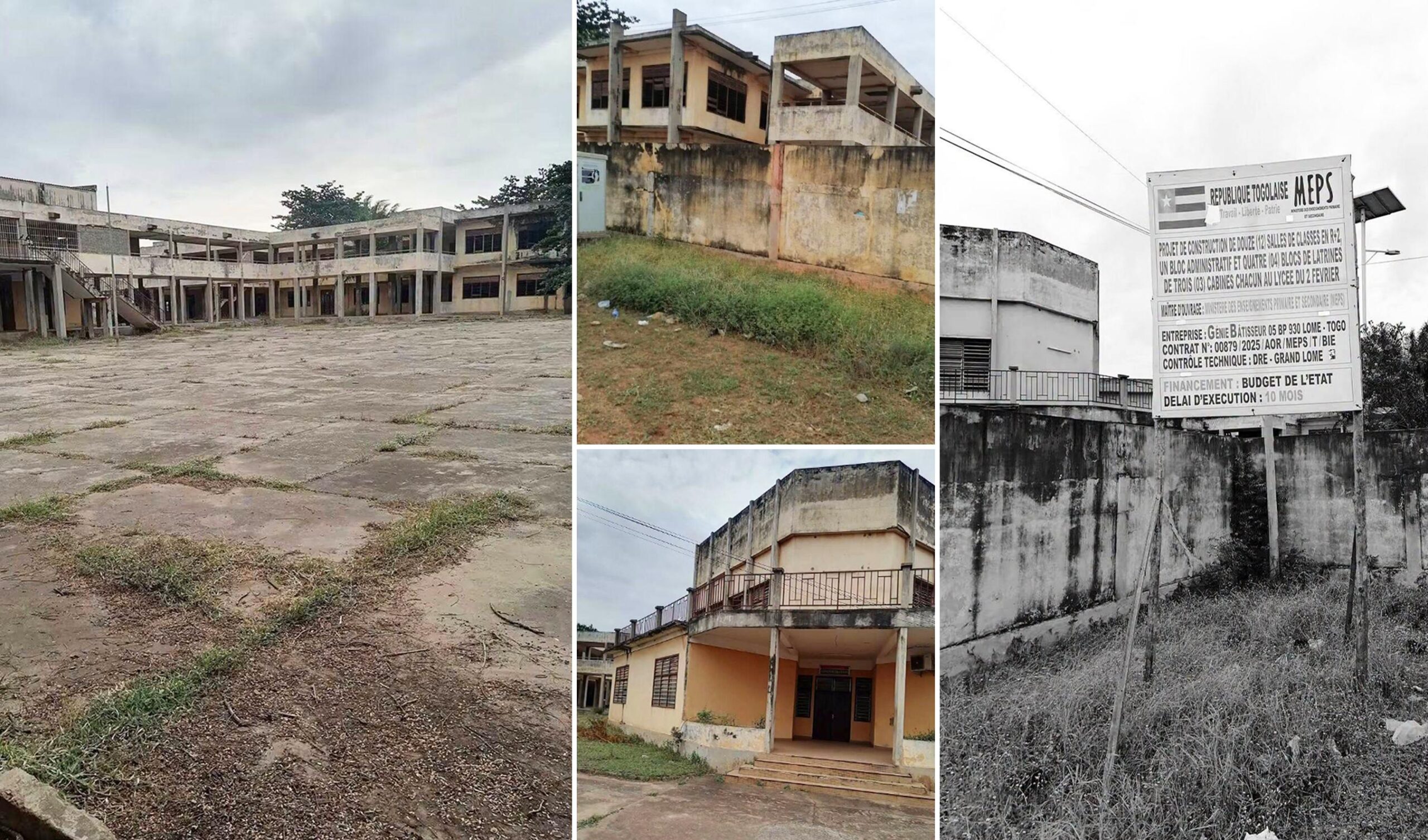
Redrawing geographical borders on a map cannot substitute for structurally sound buildings. By championing a new cartography that accurately reflects the true scale of the African continent, the Togolese administration has executed a clever public relations campaign. While the pan-African sentiment is appealing and the symbolism is potent, the reality on the ground remains stark: the nation’s largest public high school is physically deteriorating amidst widespread official neglect.
A country’s true standing is not determined by its representation on a map, but by the state of its educational institutions, the safety of its classrooms, and the working conditions of its teachers. This is where the discrepancy becomes highly problematic for the leadership: adjusting continental proportions on a planisphere takes only hours, whereas reconstructing a school demands budgetary commitments, concrete decisions, and genuine political will.
The disconnect between pan-African rhetoric and daily reality
In practice, grand ideological speeches clash with the daily struggles of a neglected youth. Every morning, thousands of students crowd into dilapidated classrooms with substandard materials, sheltering under roofs that threaten to collapse during heavy rains. In these schools, the crisis is not an abstract debate; it directly threatens the physical safety of children, compromises their learning, and limits their future prospects.
True pan-Africanism must begin in the classroom. The youth of the continent will not regain their dignity simply because Africa appears larger on a map. Real dignity is achieved when students can learn in secure environments equipped with textbooks, laboratories, libraries, digital tools, and supported teachers.
Political priorities and budgetary choices
This contrast raises critical questions about state priorities. How can a government claim to restore national pride internationally while failing to provide its children with basic learning environments? What is the value of an ambitious diplomatic narrative when the very infrastructure meant to prepare the next generation is allowed to fall into ruin?
Beyond the symbolism, there is a clear political dimension. A decaying school is not merely a neglected structure; it represents a series of deliberate budgetary allocations and administrative choices. When an institution serving thousands of students deteriorates to a dangerous level, the issue is not just about who will fund the repairs, but why maintenance was never planned in the first place.
Education should be the primary investment for any state focused on the future. Years spent in inadequate facilities lead to lost learning hours, eroded student motivation, and widening social inequalities. Children from underprivileged backgrounds suffer the most, as they have no alternatives when public services fail.
The social contract and the limits of symbolism
The crisis extends beyond cracked walls and leaking roofs to the core agreement between the state and its youth. What message does an administration send to its children when it asks them to believe in the future while forcing them to study in conditions from the past?
Sound public policy must be evaluated by tangible improvements in daily life. While official inaugurations, maps, and speeches build a political narrative, citizens, parents, and students ultimately judge progress by what is right in front of them: a functional classroom, a safe roof, a desk, a textbook, and a qualified teacher in a secure environment.
This is not about opposing the correct representation of Africa’s size against the construction of schools. Rather, it is a reminder that symbols must never replace public policy. A state can simultaneously champion a bold pan-African vision and invest heavily in its schools. One should never be used to obscure the neglect of the other.
Correcting a map requires only a pen stroke. Providing thousands of children with decent schools requires millions in funding, meticulous planning, strict oversight, and sustained political commitment. This fundamental difference highlights the gravity of the current situation.
Ultimately, a nation’s greatness is not measured by cartography. It is reflected in the schools it builds, the safety it guarantees to its children, and the opportunities it provides for its youth to succeed.
By prioritizing symbolic gestures over education, the administration is not correcting history: it is risking the future. A map can alter perceptions, but it cannot build a classroom, secure a roof, or pave the path to student success.
The genuine pan-African struggle takes place away from the spotlight: inside the classrooms where the future of the continent is actually forged.