The invisible victims of illegal gold extraction across borders
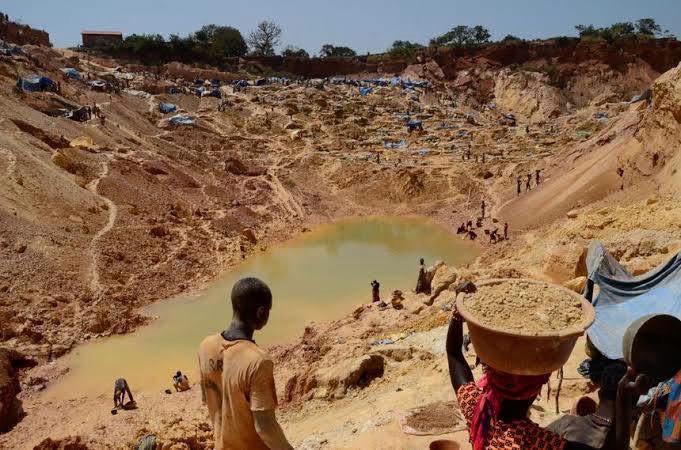
Illegal gold mining by Burkinabè nationals in neighboring West African countries is leaving a trail of environmental destruction that disproportionately affects local communities. As foreign miners exploit fragile ecosystems with little regard for local laws, the consequences polluted rivers, degraded farmland, and abandoned hazardous pits are borne by innocent citizens who did nothing to invite this exploitation.
The environmental cost that follows the false promise of gold
Behind every illegal mining operation lies a story of irreversible damage. Topsoil stripped away, water sources contaminated with mercury and cyanide, and vast stretches of forest cleared for makeshift camps have transformed once-fertile lands into industrial wastelands. For farming communities already vulnerable to climate change, these disruptions threaten food security and livelihoods that have sustained families for generations.
While the lure of quick profits drives individual miners, the broader impact extends to public health. Children and adults living near these sites face elevated risks of respiratory illnesses, skin conditions, and long-term neurological damage from toxic exposure. Local health systems, already under strain, are ill-equipped to handle the surge in preventable diseases tied to environmental degradation.
Why justice in border regions begins with accountability at home
The issue is not one of nationality, but of responsibility. When Burkinabè miners cross into Bénin, Côte d’Ivoire, or Ghana to extract gold illegally, they violate not only environmental laws but also the trust between nations. Yet when caught and deported, their return is often met with little reflection on the systemic causes driving the exodus. If enforcement is seen as persecution rather than consequence, the lessons go unlearned.
Governments have a duty to protect their citizens but that duty also demands acknowledging the harm their nationals cause beyond their borders. Without proportional consequences whether through fines, restitution, or rehabilitation programs illegal mining will continue to be treated as a low-risk venture. More critically, without clear communication between authorities, communities remain caught in the crossfire, blamed for problems not of their making.
The mirror effect: when illegal mining comes home to Burkina Faso
Meanwhile, on the other side of the border, Burkina Faso’s own land faces increasing pressure from uncontrolled gold extraction. As foreign miners retreat after facing deportation, some may simply redirect their operations inward, repeating the same cycle of environmental damage within their own country. If local communities can no longer trust that their rivers and farmlands are safe today, why would they believe they will be protected tomorrow?
This irony exporting environmental harm while demanding respect for one’s own territory undermines the argument that illegal mining is a matter of survival. It suggests instead a pattern of convenience: exploiting weak governance, avoiding regulations, and shifting the cost onto others. But environmental degradation knows no borders. The poisoned wells in northern Bénin do not end at the frontier; they seep into the groundwater that eventually flows into Burkina Faso’s rivers.
Building a regional response: beyond rhetoric and into action
To break this cycle, cooperation must replace confrontation. National governments, regional bodies like ECOWAS, and local authorities need to align on shared standards for responsible mining. This includes joint patrols along porous borders, harmonized penalties for environmental crimes, and support for communities transitioning out of illegal mining through alternative livelihoods.
Community-led initiatives, such as reforestation and water purification projects, offer tangible ways to restore damaged ecosystems. But without legal backing and financial investment, these efforts remain symbolic. The real transformation begins when governments treat cross-border environmental crimes not as diplomatic spats, but as threats to regional stability because, ultimately, they are.
A shared future demands shared responsibility
At its core, this is a crisis of values. When nations turn a blind eye to the destruction of land beyond their borders, they normalize the idea that the environment is a commodity to be plundered. Yet no nation can claim to be a champion of sustainability while its citizens profit from the ruin of another’s land, or while its policies allow environmental damage to be exported like a silent epidemic.
The solution is not to pit nation against nation, but to hold every actor accountable. Burkinabè miners, whether at home or abroad, must recognize that their actions have consequences. Burkina Faso’s government must enforce its own environmental laws more rigorously. Neighbors like Bénin and Côte d’Ivoire must protect their sovereignty without using it as a shield to avoid cooperation. And civil society across the region must demand transparency and justice for the communities bearing the brunt of this illegal industry.
The question is not whether these countries can afford to act but whether they can afford not to.
By Martin Ngu — Journalist