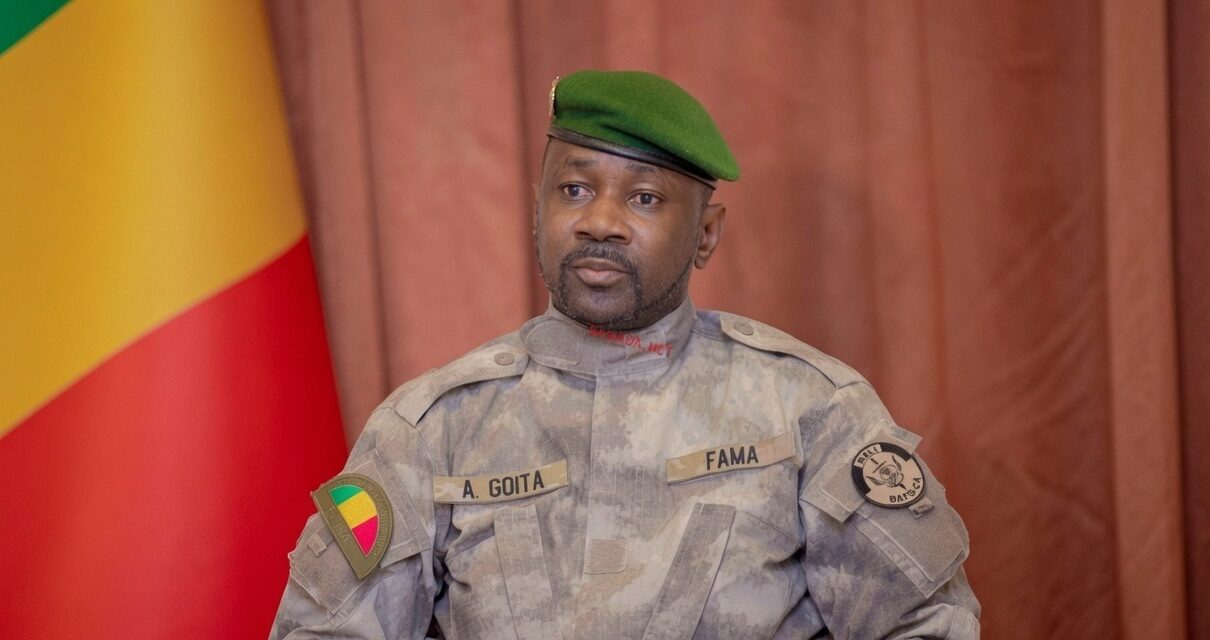
Delivered on the occasion of independence day, the address to the nation by the head of the Transition, army general Assimi Goïta, was designed to sound triumphant. It promised economic growth, a more capable military and a sovereignty reclaimed. Yet for Malian households, traders and communities living near the front line, the consequences of that message are not rhetorical. They show up at the market stall, in the hours a neighbourhood spends without power, and in the villages that remain exposed. Setting the official claims side by side with conditions on the ground reveals gaps that are already reshaping everyday life across the country.
Security pledges and the price paid by communities in the centre and north
The presidential speech portrays the Malian armed forces as reorganised, equipped and victorious, working hand in hand with partners from the Alliance of Sahel States. Read at face value, that suggests the territory is under control. For the people who live along the roads and in the rural areas the army is meant to shield, the outcome looks quite different.
- Large-scale operations attributed to JNIM or to separatist fighters have not stopped. The strategic disaster suffered at Tinzawatène and the assaults on key garrisons such as Dioura and Sévaré illustrate how badly security has eroded in the centre and north, leaving vital corridors and rural populations largely undefended.
- Operational reliance on the Russian paramilitary contingent Africa Corps, formerly Wagner, has deepened instead of easing, and it is being paid for with heavy financial and mining concessions. The consequence is a national army whose autonomy remains far from what the speech describes.
The economic message and the bill that lands on ordinary Malians
The address highlights a growth rate said to exceed 5 or 6 percent, credited to domestic resource mobilisation and the effects of the mining code reforms. For most citizens, in Bamako as much as in the provinces, macroeconomic theory no longer hides what the household budget already shows.
Inflation that empties the family basket
Prices of basic goods — rice, cooking oil, sugar — and of fuel have climbed steadily, and the squeeze is felt most acutely by families with fixed or irregular incomes. The knock-on effect is a widening gap between official growth figures and what people can actually afford to buy each week.
Power cuts, EDM-SA and the stall of small business
Where the speech speaks of an improved electricity supply, homes and small and medium-sized enterprises continue to deal with repeated outages from the national utility EDM-SA. The practical fallout is downtime for workshops, cold-chain losses for traders and a slowdown in the informal economy that keeps local production running.
Mining revenue: who ends up collecting?
The redistribution of mining funds presented by the authorities sits uneasily beside the scale of public revenue and exploitation licences committed to settling obligations to the foreign paramilitary partner. For citizens expecting a tangible dividend from the country’s mineral wealth, the arithmetic is difficult to reconcile.
Reconciliation rhetoric and the shrinking room for dissent
The head of the Transition restated his call for reconciliation and national cohesion under the Charter for peace. That appeal lands in a context where critical voices face unprecedented pressure.
- Political actors, journalists, human rights defenders and civil society figures are prosecuted, detained or systematically intimidated as soon as they question how the Transition is being run.
- The unilateral rejection of earlier peace agreements and the choice of an all-military approach have buried the mechanisms of inclusive mediation, replacing dialogue with a conflict that drags on without resolution.
What the distance between Koulouba and the provinces now means
By favouring political messaging over verifiable results, the official narrative struggles to conceal the fractures in a governance model under strain. Between the self-satisfaction voiced in the salons of Koulouba and the growing insecurity that weighs on the provinces, the space keeps widening between the promises of “Malikura” and the lived experience of the Malian people — and it is that gap, more than any speech, that will define what comes next for the country.