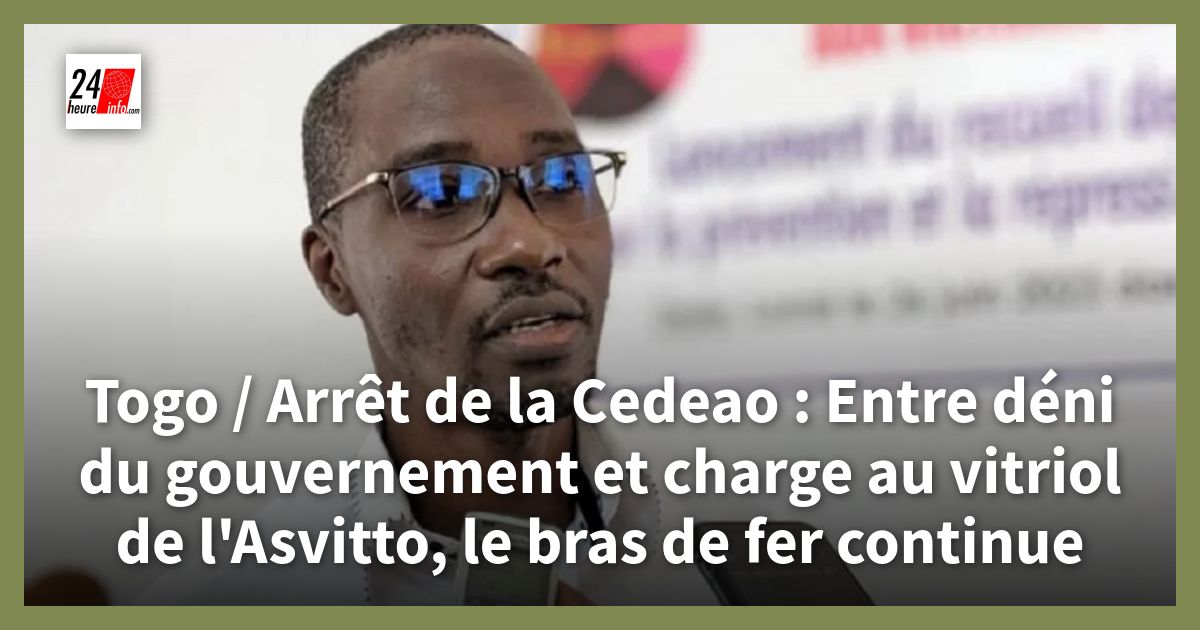
The Togo constitutional reform controversy deepens as the government in Lomé continues to defy a landmark ruling by the ECOWAS Court of Justice. While official Lomé maintains the court lacks jurisdiction over national constitutional matters, the Association of Victims of Torture in Togo (ASVITTO) has launched a scathing public campaign, accusing authorities of orchestrating a constitutional coup.
Lomé’s legal strategy: dismissing regional court authority
The Togolese government has mounted a vigorous defense against the ECOWAS ruling, arguing that the regional court has no mandate to review or invalidate domestic constitutional amendments. Authorities contend that constitutional matters fall exclusively within national sovereignty, rendering the court’s decision legally unenforceable in Togo.
ASVITTO fires back: ‘state gangsterism’ exposed
The civil society group ASVITTO wasted no time in firing back on social media, dismissing the government’s legal maneuvering as a desperate attempt to evade accountability. In a sharply worded statement, the organization described the reform as a brazen constitutional coup and warned that those behind it are “trapped in their own fear, waiting for their inevitable downfall.”
“What remains consistent is their long-standing disregard for ECOWAS rulings and contempt for regional judicial authority,” ASVITTO stated.
The group highlighted the ongoing detention of political prisoners in Lomé, despite multiple ECOWAS orders demanding their immediate release, as evidence of the government’s refusal to comply with international legal obligations.
Call for decisive action: ASVITTO urges ECOWAS intervention
ASVITTO has escalated its campaign by directly appealing to the ECOWAS leadership, urging the regional bloc to take “forceful action against this pathology of state gangsterism” in the subregion. The group is demanding full implementation of ECOWAS Court Judgment No. ECW/CCJ/JUD/01/26, issued in January, which declared the 2024 constitutional changes incompatible with the African Charter on Democracy, Elections, and Governance.
“The time has come to put an end to this form of state lawlessness across West Africa,” ASVITTO declared.
Stand-off leaves political prisoners in limbo
As legal arguments and social media exchanges intensify, the ECOWAS ruling remains unenforced, leaving political detainees in prolonged detention without relief. Behind the war of words, the human cost is clear: activists and opponents remain behind bars, their fate hanging in the balance as authorities continue to reject regional judicial authority.