As the northern regions of Togo confront an escalating terrorist threat originating from the Sahel, the alleged presence of foreign military and paramilitary units has ignited sharp public debate in Lomé. A joint statement released by a coalition of opposition groups and civil society movements has directly challenged the administration led by President Faure Gnassingbé. The communiqué highlights concerns over institutional opacity, the undisclosed scale of the Russia-linked Africa Corps, and security contracts with the Turkish firm SADAT, thrusting issues of national sovereignty and transparency into the spotlight.

Unified opposition voices grow louder in demand for accountability
The political pressure in Togo’s capital has intensified, as an alliance of opposition factions—including the original Dynamique Monseigneur Kpodzro (DMK), Dynamique pour la majorité du peuple (DMP), the Lumière pour le développement dans la paix (LDP) movement, and the Front « Touche pas à ma Constitution »—has broken its silence with a collective statement. Central to their concerns is the deployment of foreign military and paramilitary personnel, particularly in the Savanes region, a northern zone bordering Burkina Faso that has faced repeated incursions by armed terrorist groups.
The coalition argues that while security threats are real, they cannot justify the government’s refusal to provide clear public disclosures. With no official communication forthcoming, these political and civic organizations are demanding transparent clarification on the legal framework, mission objectives, and operational status of these foreign personnel on Togolese soil.
Russia’s Africa Corps and Turkey’s SADAT: shadowy actors under scrutiny
The opposition’s concerns focus on two controversial entities with deep regional ties: the Africa Corps, a restructured Russian security presence in Africa, and the Turkish private military company SADAT, widely believed to be aligned with Ankara’s strategic interests. According to reports cited by the coalition, up to 350 Russian personnel may be operating in Togo, though no official confirmation has been issued by Lomé, Moscow, or Ankara. Similarly, SADAT is suspected of providing technical assistance, training, or operational support to local forces, though the extent of its involvement remains unclear.
The lack of verifiable data fuels speculation about the true nature of these deployments. Are these foreign units merely advisors, intelligence experts, or are they actively participating in combat operations? Without answers, public trust in the government’s handling of the crisis continues to erode.
Sovereignty, legality, and the burden on taxpayers
While the opposition coalition does not outright reject the idea of international partnerships to safeguard national security, it flags critical governance and legal gaps that demand urgent attention. One major concern is the chain of command: the coalition insists that any foreign personnel must be fully subordinated to Togo’s Armed Forces (FAT) and operate strictly within national and international legal frameworks.
Another pressing issue is the risk of civil liberties violations. The opposition warns against allowing foreign forces to participate in public order operations, targeted arrests, surveillance, or intimidation of civilians and political figures. Additionally, the financial cost to the public treasury remains shrouded in mystery. Without parliamentary scrutiny or public debate on these expenditures, the coalition is calling for citizen oversight of how taxpayer money is being allocated to foreign security contracts.
President Gnassingbé’s strategic pivot
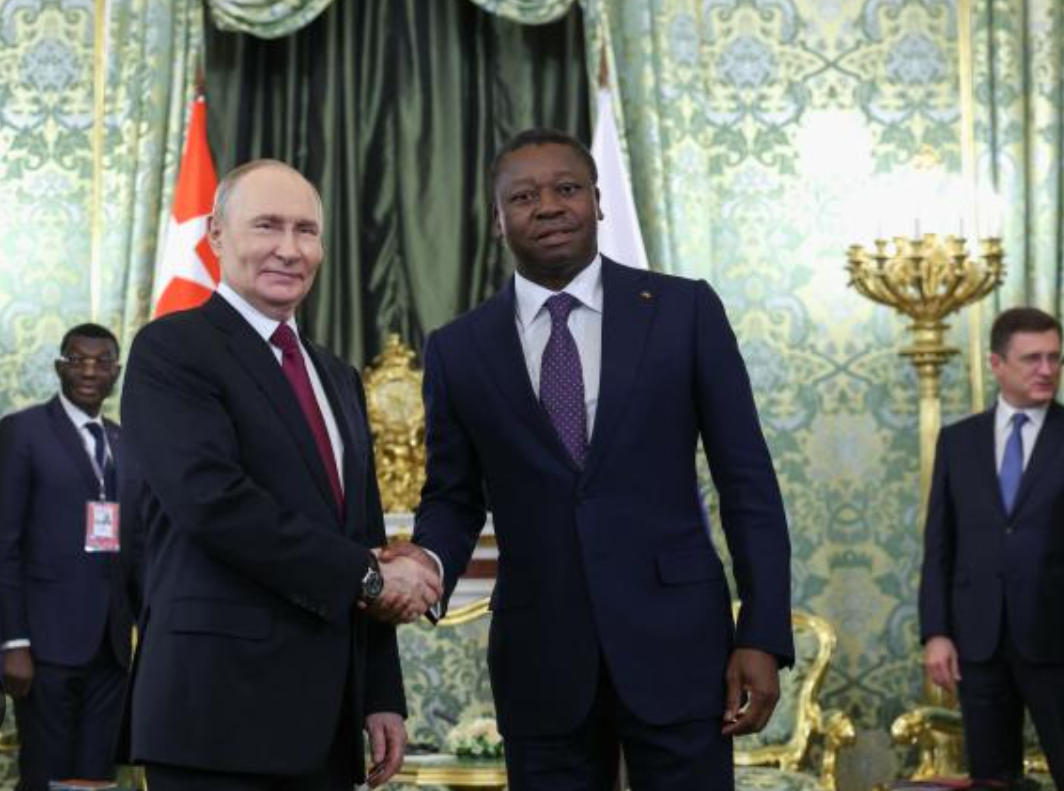
The government’s decision to engage foreign security partners reflects a broader diplomatic realignment underway in Lomé. Since 2021, President Faure Gnassingbé has sought to diversify defense alliances, compensating for perceived limitations in traditional Western partnerships. Key milestones include a military cooperation framework with Turkey, resulting in the acquisition of Bayraktar TB2 combat drones for border surveillance, and expanded engagement with Moscow through military intelligence sharing, joint exercises, and logistical support.
These efforts are now formalized under the Togo-Sahel Strategy 2026–2028, a government roadmap aimed at deepening security cooperation with foreign partners. Officially, the goal is to secure the nation’s borders and prevent the southward advance of jihadist groups toward the Atlantic coast. Yet, the absence of public transparency risks turning this strategic shift into a source of domestic political friction.
Time for a national conversation?
The debate over foreign troop deployments transcends technical military considerations. In a Sahel region marked by political instability and shifting geopolitical alliances, clarity is no longer optional—it is essential for maintaining stability. For Togo’s civil society and opposition, national security cannot be managed behind closed doors. A public or parliamentary debate could help resolve ambiguities, establish a clear legal basis for foreign interventions, and prevent security cooperation from becoming a divisive political issue. For now, all eyes remain on the government, as citizens await decisive responses to long-overdue questions.