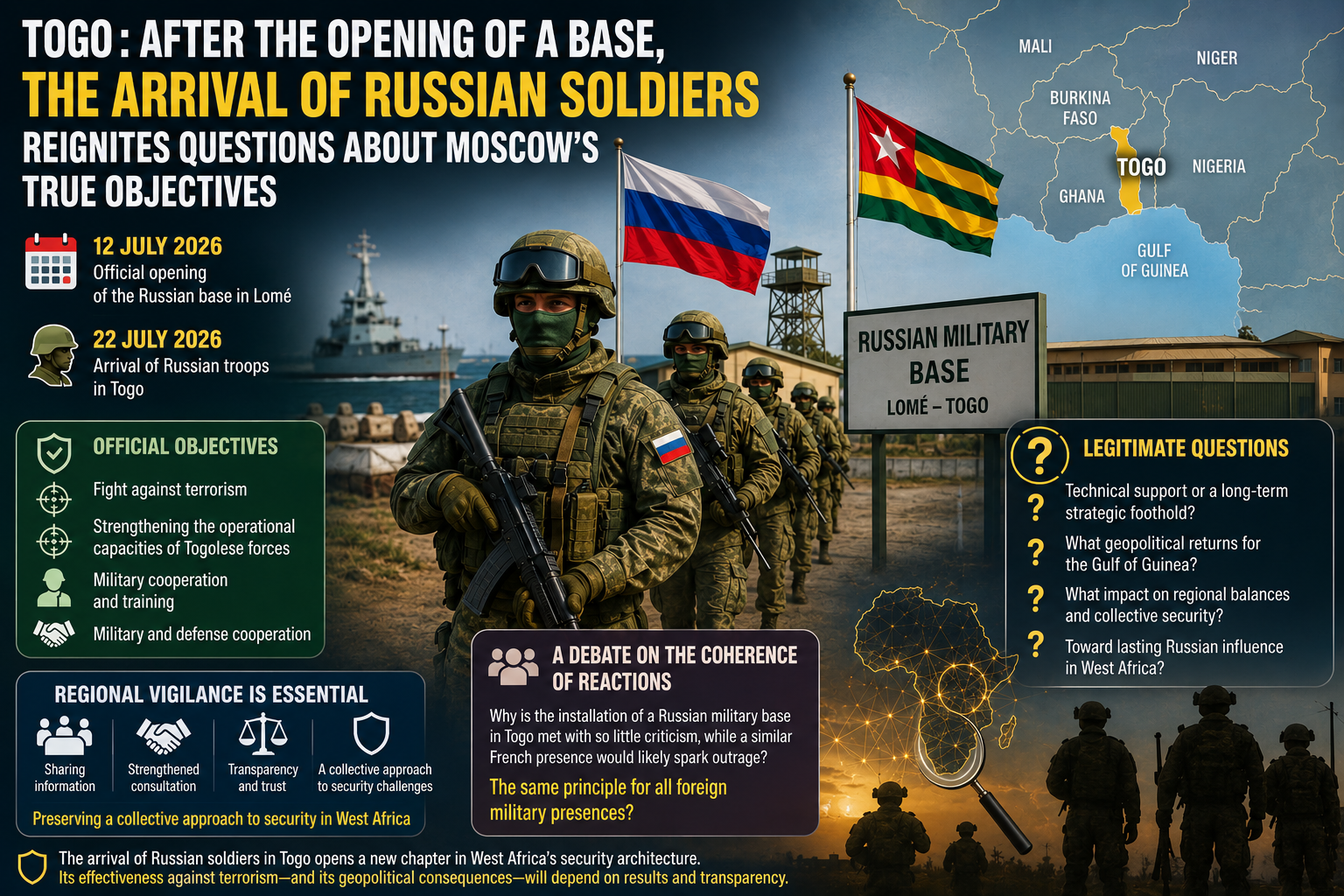
The deployment of Russian military personnel to Togo, confirmed on July 22, 2026, following the inauguration of a Russian base on July 12, marks a significant milestone in the deepening defense ties between Lomé and Moscow. According to official statements, these soldiers are assigned to support Togo’s counterterrorism efforts and enhance the operational readiness of its armed forces.
Yet the move has ignited a wave of speculation among West African security analysts. While military cooperation remains a sovereign decision for national governments, the sustained presence of foreign troops in a region grappling with persistent jihadist threats raises broader questions about regional power dynamics.
Russia has steadily expanded its footprint across Africa in recent years, forging defense agreements, training local forces, supplying military hardware, and in some cases, stationing troops. The arrival of Russian soldiers in Togo reflects this broader strategy of reinforcing security partnerships with African states.
strategic intentions under scrutiny
The central question now revolves around Moscow’s long-term objectives. Is this engagement primarily intended to bolster Togo’s counterinsurgency capabilities in the northern regions, or does it signal a broader ambition to embed Russia within the strategic landscape of the Gulf of Guinea? The answer will only become clear with time, but the implications extend far beyond immediate military assistance.
A foreign military presence often evolves into broader forms of cooperation—intelligence sharing, training programs, logistical support, industrial partnerships, and defense diplomacy—each carrying consequences that ripple across the region. The full scope of this mission remains to be seen, but its potential to reshape regional security architectures cannot be ignored.
a double standard in public perception?
The debate has taken on a sharper edge due to contrasting reactions observed in regional discourse. Critics of France’s military footprint in West Africa have consistently framed foreign bases as acts of interference or destabilizing influences. Yet when similar developments involve Russian forces, the backlash has been notably subdued. This discrepancy has left analysts questioning whether objections stem from principle—or from geopolitical alignment.
For some observers, the inconsistency raises a fundamental issue: if foreign military presence is inherently viewed as a threat to national sovereignty or regional stability, the same standard should apply regardless of the nation providing the troops. Others argue that acceptance of certain partnerships over others demands transparent justification to ensure public debate is grounded in verifiable evidence rather than geopolitical bias.
regional vigilance in a shifting landscape
Neighboring states are closely monitoring the situation. While recognizing Togo’s sovereign right to select its defense partners, regional governments are increasingly focused on assessing how this cooperation may influence collective security, regional defense mechanisms, and diplomatic balances in West Africa.
In an era where terrorist threats transcend borders and external powers vie for influence, transparency emerges as a cornerstone of trust. Enhanced information-sharing and coordinated mechanisms among regional actors could help mitigate misunderstandings and preserve a unified approach to shared security challenges.
The arrival of Russian troops in Togo signals the beginning of a new chapter in West Africa’s security framework. Its success in combating terrorism—and its broader geopolitical repercussions—will ultimately be measured not by intentions, but by tangible outcomes on the ground and the evolving dynamics between Lomé, Moscow, and neighboring governments.