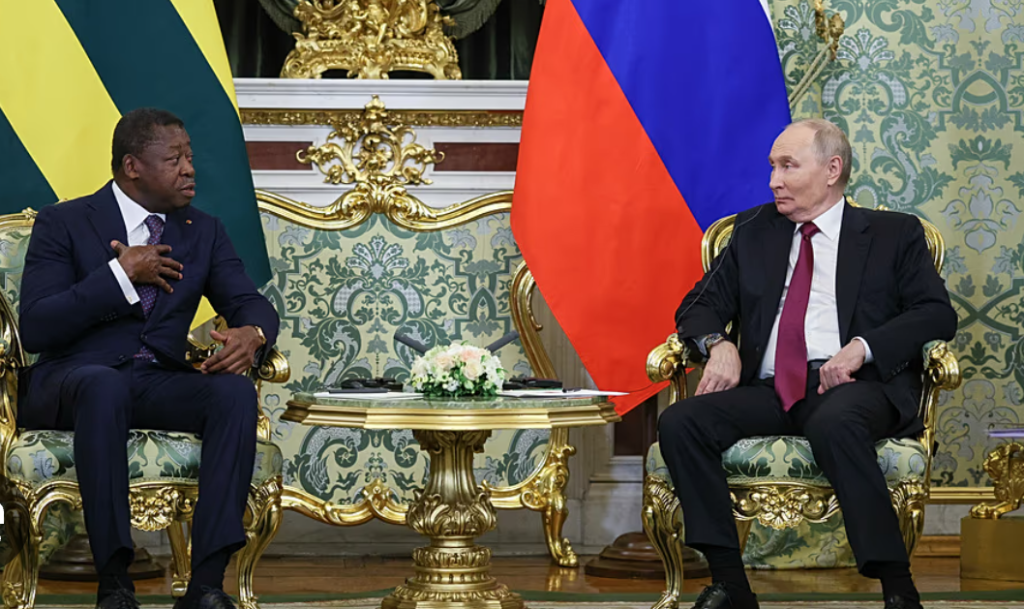
Lomé emerges as a key link in Russia’s sanctions-evading maritime network
Once known solely as a commercial gateway in West Africa, the Port of Lomé is quietly transforming into a critical node in Moscow’s global sanctions-busting logistics chain. Recent dockings of vessels linked to Russia’s so-called ghost fleet—including the Britnev-associated cargo ship and the Baltic Leader, detected off West African waters—have raised red flags among maritime analysts. These ships, frequently reflagged under opaque jurisdictions, transport strategic goods, raw minerals, and energy resources while avoiding Western oversight. By granting these vessels access to its deep-water port, the Togolese leadership has effectively handed Russia a direct maritime corridor into the heart of West Africa’s hinterland.
Behind closed doors: secret pacts and Sahelian supply lines
The timing of this naval diplomacy is no coincidence. Across the Sahel, where the Russian-backed Africa Corps (formerly Wagner) has suffered repeated battlefield reversals in Mali, Burkina Faso, and Niger, Moscow is scrambling to secure alternative supply routes. Lomé’s role is twofold: it provides a secure logistical hub far from conflict zones while serving as a discreet venue for closed-door deals. Whispers of clandestine agreements between Moscow and the Gnassingbé regime point to undeclared mining concessions, untraceable arms contracts, and high-level security guarantees—all negotiated without public scrutiny.
The Togolese strongman’s gamble on authoritarian stability
Russia’s growing interest in Togo stems from the country’s uniquely favorable conditions: a hyper-centralized state, a tightly controlled political system, and a near-eliminated opposition. Since taking power in 2005—and extending his rule through a controversial constitutional overhaul that transforms the country from a presidential to a parliamentary republic—Faure Gnassingbé has perfected the art of institutional lock-in. For this embattled regime, long condemned for systemic repression, arbitrary bans on protests, and the detention of political opponents, the alliance with Moscow offers a lifeline. Unlike Western partners or international financial institutions, the Kremlin imposes no demands on human rights, fiscal transparency, or electoral integrity.
Soft power, faith, and disinformation: Russia’s cultural encirclement strategy
Moscow’s offensive in Togo extends far beyond military logistics. A multi-pronged campaign of cultural influence is underway, deploying Russian-language schools, cultural centers, and exhibitions as fronts for recruitment and anti-Western propaganda. Complementing this is an aggressive religious expansion, with the Russian Orthodox Patriarchal Exarchate of Africa establishing a foothold through a blend of social outreach and proselytism aimed at marginalizing traditional faiths. The strategy culminates in a concerted information war, funded through local NGOs and social media channels to amplify pro-Kremlin narratives. By tapping into nationalist sentiments among the youth, the government diverts attention from persistent economic woes and governance failures.
Regional risks of Lomé’s Kremlin alignment
Faure Gnassingbé’s embrace of Moscow’s shadow networks carries grave consequences. Diplomatic isolation looms as Western partners distance themselves, while the country’s role as a rear logistics base for Sahelian juntas risks drawing terrorist threats onto Togolese soil. Domestically, the opacity surrounding secret contracts fuels elite enrichment amid worsening living conditions for ordinary citizens. The Lomé-Moscow axis exemplifies a dangerous new African geopolitical reality: a marriage of convenience between a local autocrat willing to trade sovereignty for survival and a foreign power exploiting the arrangement to mask its military setbacks.