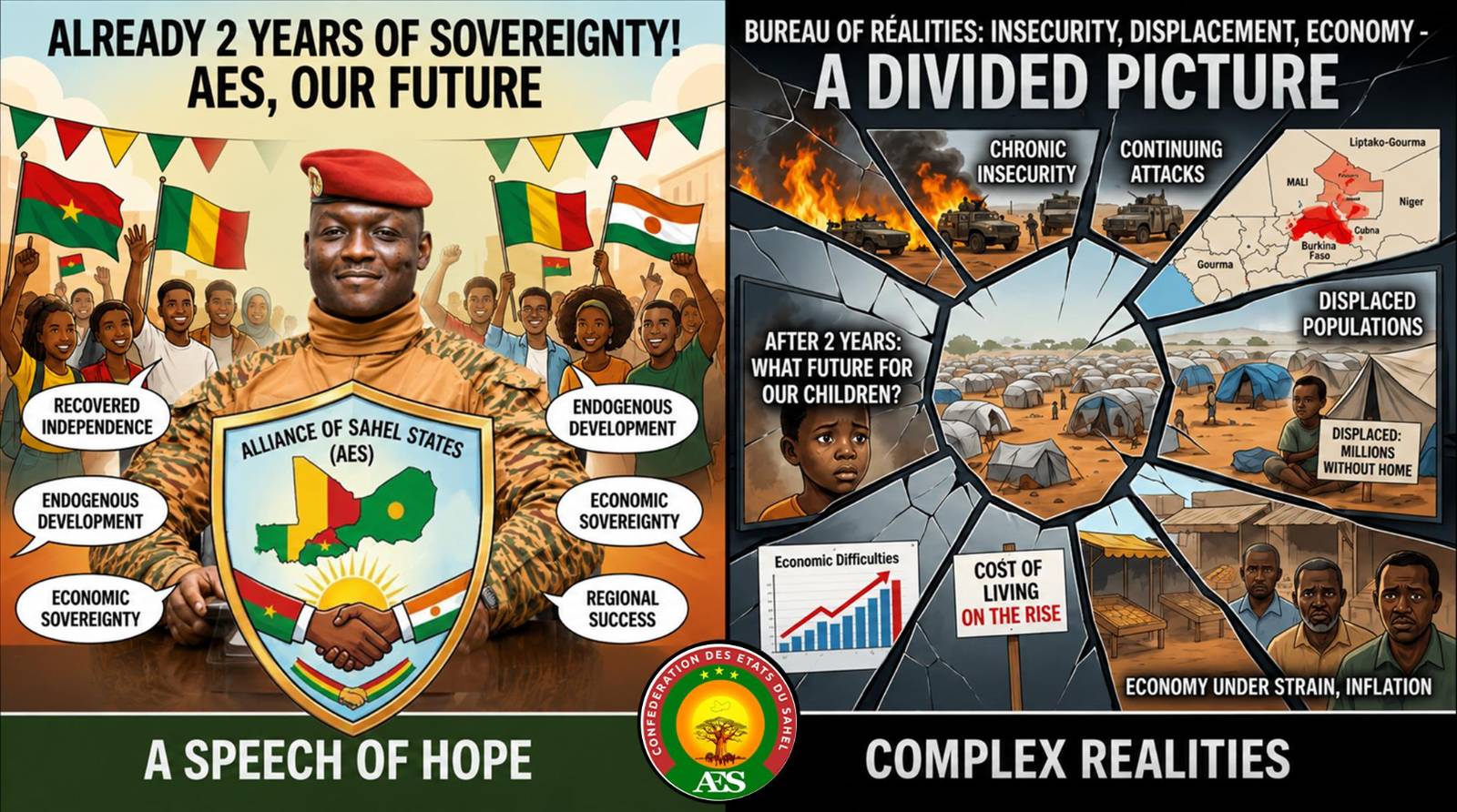
The establishment of the Confederation of Sahel States (AES) two years ago was heralded by Captain Ibrahim Traoré as a landmark achievement in political and strategic unity, rooted in the principles of sovereignty, solidarity, and cooperation among Burkina Faso, Mali, and Niger. While this narrative resonates with a segment of the public, it has yet to fully convince those who demand tangible outcomes from the alliance.
Diplomatic, military, and institutional progress: a mixed reality
According to AES leadership, the Confederation has made significant strides in diplomacy, defense, and institutional development. However, the fundamental challenges that prompted the alliance’s formation remain largely unresolved. The assertion of sovereignty, now a central tenet of the AES’s political identity, must be examined beyond mere rhetoric. True sovereignty is evidenced not by severed ties with traditional partners but by a state’s ability to safeguard its citizens, uphold institutional integrity, fortify its economy, and provide meaningful opportunities for its youth.
Security and humanitarian crises persist
Despite repeated claims of military success, armed groups continue to operate across vast regions of the three member states. The threat of violence looms large over many communities, forcing civilians to flee their homes and exacerbating humanitarian crises. Displacement and hardship remain daily realities, casting doubt on the effectiveness of regional security strategies.
Economic integration: unfulfilled promises
The anticipated economic integration has yet to materialize in any substantial way. Trade flows remain sluggish, fiscal constraints persist, and purchasing power continues to decline for many households. Critics argue that the proclaimed benefits of the Confederation remain largely aspirational, with little evidence of real progress on the ground.
The limits of sovereignty as a political strategy
The emphasis on political independence, while politically expedient, does not address the fundamental needs of the population. Citizens evaluate their leaders based on tangible improvements in their daily lives—security, healthcare, education, employment, and infrastructure. These are the true benchmarks of effective governance, not the mere recalibration of international alliances.
Moreover, the narrow focus on sovereignty risks overshadowing critical issues such as governance, transparency, and accountability. A regional union cannot earn lasting public trust without robust institutions, efficient public policies, and responsible resource management. The credibility of the AES will ultimately hinge on its ability to deliver measurable benefits rather than rely solely on ideological posturing.
A test of resilience and adaptability
After two years, the AES undeniably represents a transformative shift in the political landscape of West Africa. Yet its legacy will not be defined by declarations alone. The alliance’s success will be measured by its capacity to address the pressing security, economic, and social challenges confronting Burkina Faso, Mali, and Niger. Only through concrete results—not lofty intentions—can the Confederation justify its existence and secure the faith of its people.