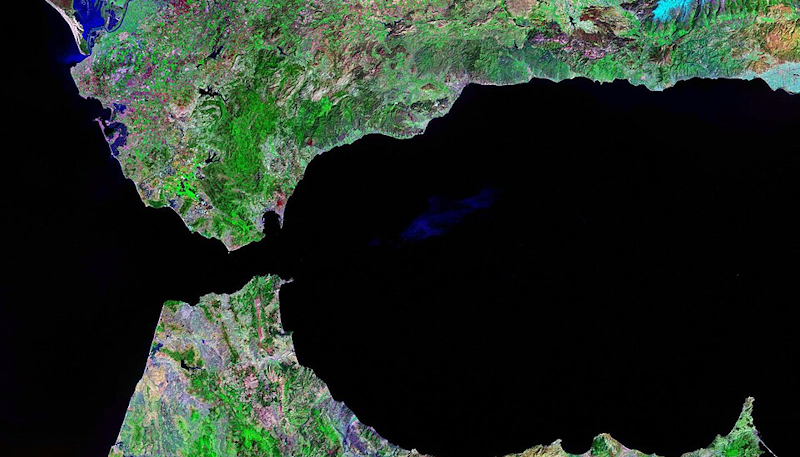
Relations between the United States and Morocco are entering a critical phase as Washington’s stance on Ceuta, Melilla, and Western Sahara undergoes a noticeable transformation. This shift, marked by growing alignment with Rabat’s positions, could reshape regional dynamics in the western Mediterranean and place Spain in uncharted diplomatic territory.
Since late July, a series of diplomatic signals from Washington has reinforced its evolving relationship with Morocco. From backing the Moroccan autonomy plan for Western Sahara to endorsing Rabat’s claims over the Spanish enclaves of Ceuta and Melilla, the two nations appear to be deepening a partnership that now spans politics, economy, and security.
The timing of this rapprochement coincides with a dramatic surge in migration to Ceuta, where tens of thousands crossed the border into the Spanish enclave within a single day. The crisis overwhelmed Spanish authorities and prompted urgent consultations within the European Union, while also highlighting the fragile nature of Madrid-Rabat relations.
Western Sahara: A cornerstone of Moroccan foreign policy
In December 2020, the Trump administration formally recognized Morocco’s sovereignty over Western Sahara in exchange for the normalization of relations between Morocco and Israel. This decision was a watershed moment in a decades-long conflict between Rabat and the Polisario Front.
Now, six years later, Morocco is working to consolidate that support. The recent inauguration of the “Donald J. Trump Highway” connecting Tiznit to Dakhla in Western Sahara serves as a symbolic gesture, reinforcing Morocco’s efforts to align with Washington’s priorities.
« The highway is part of a broader strategy to secure continued American backing for Morocco’s autonomy plan, especially as international negotiations on Western Sahara enter a decisive phase, » said an analyst familiar with regional affairs.
For Rabat, maintaining U.S. support remains essential until a final settlement is reached that aligns with its vision for the territory.
Economic incentives fuel closer ties
Morocco’s diplomatic offensive extends beyond politics. In late July, the U.S. ambassador to Morocco traveled to Laâyoune, in the heart of Western Sahara, to finalize a landmark agreement. The deal includes a U.S. grant to establish a production unit for hydrogen and ammonia—a move that reflects Washington’s growing interest in economic partnerships that benefit American companies.
« This project underscores the Trump administration’s focus on investments and contracts with tangible returns, » the analyst noted. « The U.S.-Morocco relationship now rests on multiple pillars: political backing, economic opportunity, security cooperation, and shared strategic interests in the region. »
Congress takes aim at the Polisario Front
A new proposal in the U.S. Congress has raised concerns among supporters of the Polisario Front. Two lawmakers have introduced a resolution calling for an assessment of whether the movement should be designated as a foreign terrorist organization. The same measure seeks to investigate alleged ties between the Polisario and Iran.
The initiative reflects a broader U.S. strategy to counter Iranian influence across the Middle East and North Africa. Yet, the analyst cautioned that no credible evidence links the Polisario to Iran or Hezbollah.
« Morocco is leveraging the current anti-Iran sentiment in Washington to frame the Western Sahara conflict in a way that aligns with U.S. priorities, » the analyst explained. « Rabat consistently draws parallels between the region’s conflicts and its own confrontation with the Polisario. »
Ceuta and Melilla emerge as a new flashpoint
The most significant shift may be in Washington’s evolving stance on Ceuta and Melilla. Traditionally viewed as Spanish territories, these enclaves are now the subject of growing ambiguity in U.S. rhetoric, according to the analyst.
« Recent statements suggest the U.S. no longer firmly regards Ceuta and Melilla as Spanish sovereign territory, » the analyst said. « This represents an implicit endorsement of Morocco’s long-standing claims. »
For decades, Morocco has maintained that the two cities are occupied territories. While Spain insists on their Spanish status, a stronger U.S. tilt toward Rabat could strain relations between Washington and Madrid.
The Ceuta migration crisis: deliberate pressure or spontaneous surge?
The timing of the migration surge at Ceuta has fueled speculation about Rabat’s role. Tens of thousands crossed the border in a single day, overwhelming Spanish border forces and triggering alarm across the European Union.
The analyst dismissed claims that Morocco orchestrated the event entirely. Instead, he described it as largely spontaneous, with Rabat subsequently capitalizing on the situation to send a political message to Spain.
« The crisis highlighted Morocco’s leverage and served as a reminder that the Ceuta issue remains unresolved in Rabat’s view, » the analyst said.
Madrid grapples with a shifting strategic landscape
In response to the growing tensions, Spanish Prime Minister Pedro Sánchez made an official visit to Algiers to strengthen bilateral ties, particularly in energy. While the move may raise eyebrows in Rabat, the analyst believes it does not signal a fundamental shift in Spain’s position on Western Sahara.
« Madrid continues to support Morocco’s autonomy plan, and Sánchez’s visit to Algeria should not be interpreted as a reversal, » he said. « The Ceuta crisis, however, is rooted in the unresolved territorial dispute between Spain and Morocco. »
Could U.S. support for Morocco redefine regional alliances?
For Spain, the implications extend beyond its bilateral tensions with Morocco. If the U.S. were to formally align with Morocco’s stance on Ceuta and Melilla, it could undermine Spain’s long-standing security guarantees within NATO and its broader transatlantic alliances.
The analyst warned that while an immediate crisis is unlikely, the current trajectory could eventually lead to a political renegotiation of Ceuta and Melilla’s status.
Washington, Rabat, and Madrid: a tense triangle
At its core, the evolving dynamic reflects a power shift in North Africa. Morocco is leveraging its strategic partnership with the U.S. to secure backing on Western Sahara and Ceuta, while Spain faces an increasingly unpredictable transatlantic partner.
For Rabat, this moment presents an opportunity to advance long-standing territorial claims. For Madrid, it represents an unprecedented strategic challenge.
Western Sahara and Ceuta, once separate issues, are now converging into a single diplomatic battleground—one that will shape American influence in the Maghreb and redefine alliances across the western Mediterranean.