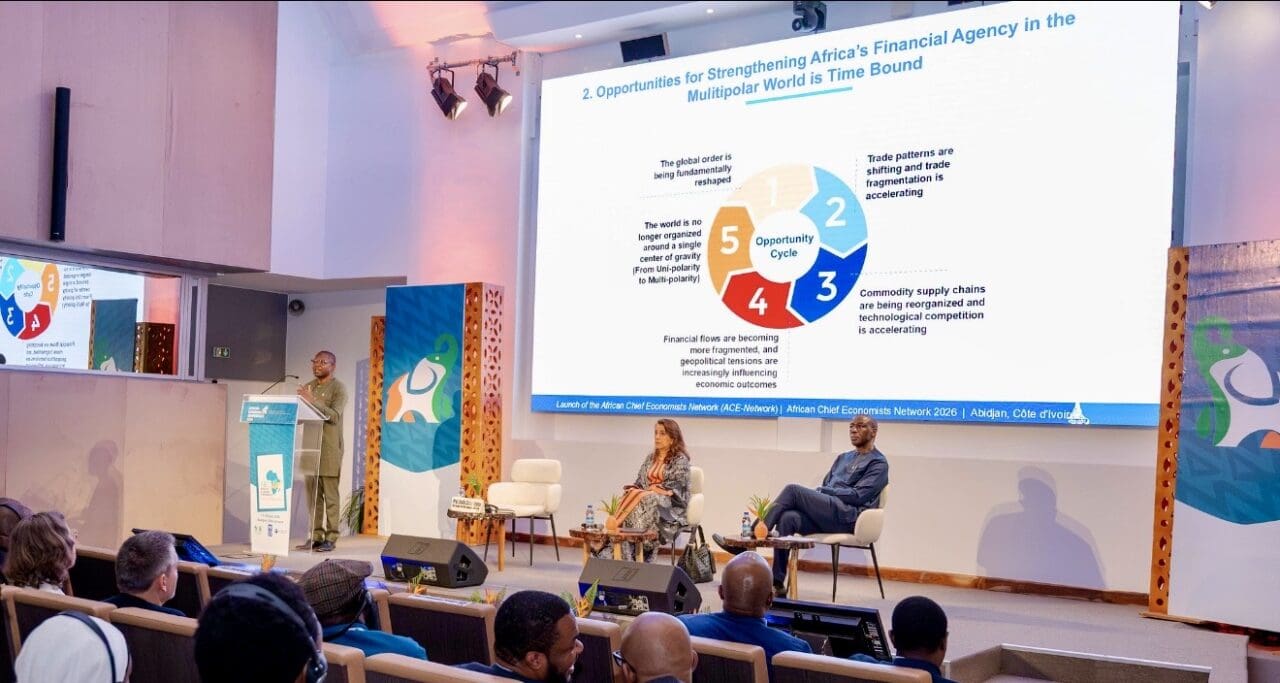
Following three days of intense discussions, the 2026 African Economic Conference concluded with more than just a diagnosis of the continent’s vulnerabilities. It presented a bold new vision: transforming geopolitical upheavals into strategic advantages through deeper economic integration, innovative financing, and collective action.
The conference’s closing message was clear. In Abidjan, economists, policymakers, and leaders from major international institutions repeatedly emphasized a single point: Africa can no longer merely adapt to shifting global power dynamics. It must now chart its own course and assert its place in the world economy.
At the culmination of the 2026 African Economic Conference (AEC)—co-hosted by the African Development Bank (BAD), the United Nations Development Programme (PNUD), and the Organisation for Economic Co-operation and Development (OCDE)—key partners on the continent declared a shared ambition: to position Africa as a strategic player in the new global economy, rather than a passive observer of its transformations.
From crises to strategic leverage
Raymond Gilpin, Chief Economist at the UNDP’s Regional Bureau for Africa, framed the global economic turbulence not as an insurmountable threat, but as an opportunity for transformation. While acknowledging that “global economic storms will continue to test African institutions,” he stressed that they “cannot erode the fundamental wealth and resilience of African populations.”
His remarks encapsulated the conference’s central theme: accelerating reforms, deepening partnerships, and acting with greater urgency to build “the resilient and prosperous Africa we deserve—and the world needs.” The shift in tone was unmistakable—no longer about mere survival, but about converting geopolitical realignments into lasting strategic advantages.
Rethinking development through integrated solutions
The discussions also highlighted a critical need: to abandon fragmented approaches to policymaking. Ida McDonnell, Senior Advisor at the OECD, pointed out that development strategies can no longer operate in isolation. She argued that trade, debt, climate action, fiscal policy, and development financing are deeply interconnected. “The complexity of today’s political challenges demands integrated analysis,” she noted, calling for improved data sharing and knowledge exchange to inform smarter public decisions.
This reflects a broader reality: in today’s world, a single crisis—whether energy, financial, climate-related, or geopolitical—can trigger cascading effects across African economies. Addressing these challenges requires holistic solutions, not siloed responses.
From dialogue to decisive action
Marie-Laure Akin Olugbade, Vice-President of the African Development Bank Group, representing President Sidi Ould Tah, underscored the urgency of moving from words to action. She stressed that the recommendations emerging from the conference must inform concrete policies and development partnerships.
“The discussions in Abidjan provide a foundation for the public policies and partnerships needed to strengthen Africa’s geopolitical influence and commercial resilience,” she stated. The challenge now lies in implementation—amid tight fiscal constraints and intensifying global economic competition.
The ultimate goal: building Africa’s economic power
Ahunna Eziakonwa, UN Assistant Secretary-General and Director of UNDP’s Regional Bureau for Africa, described the conference as merely the beginning. The real test lies ahead: removing barriers to intra-African trade, investing in innovation, scaling up regional value chains, and equipping a growing youth population to thrive in a rapidly evolving global economy.
Her closing remarks distilled the conference’s spirit: “In a multipolar world, Africa’s greatest lever won’t be choosing a side—but strengthening its own economic power.” Sovereignty, she implied, is not achieved through alignment or isolation, but through the continent’s ability to create value, finance its own growth, and defend its interests on its own terms.
Abidjan as a hub for African ambition
The 2026 edition of the African Economic Conference also featured the annual meeting of the Global Network of Chief Economists from Development and Financing Institutions, alongside the launch of the African Chief Economists Network (ACE Network). More significantly, it marked a shift in how Africa’s development is discussed—not as a continent in need, but as a continent poised to shape the rules of the global economy.
With international balances in flux, organizers believe Africa is standing at a historic crossroads. The next step is to turn collective ambition into tangible policies, investments, and results. Only then can the promises made in Abidjan transcend rhetoric and help build a more sovereign, resilient, and influential Africa on the world stage.