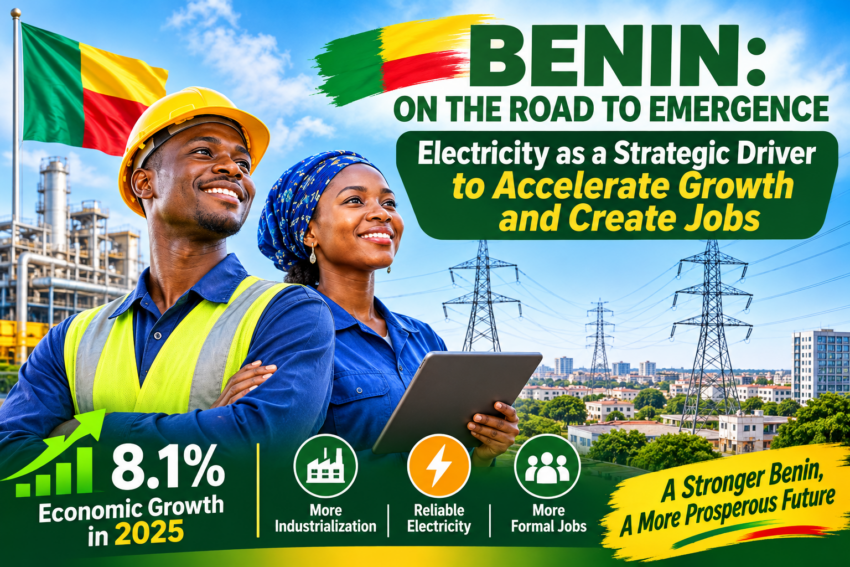
With an 8.1% economic growth in 2025, Benin stands out as one of West Africa’s fastest-growing economies. Yet behind this impressive headline figure lies a critical challenge: only a fraction of this growth translates into meaningful, well-paying jobs for citizens. The gap between macroeconomic success and employment gains is stark particularly for the country’s youth, where formal job creation remains painfully slow.
This disparity is starkly illustrated by recent data from the World Bank. In 2022, a staggering 96.3% of Benin’s workforce operated in the informal sector, and as of 2024, just 19.8% of workers held salaried positions. For young people, the situation is even more dire only 9% of those employed are under formal contracts. These figures reveal that while the economy is expanding, it is failing to generate the stable, productive jobs needed to improve livelihoods and reduce poverty.
The root of this disconnect lies not in a lack of economic activity, but in structural bottlenecks that prevent growth from reaching workers. Many entrepreneurs, artisans, and small business owners struggle to scale their operations due to unreliable access to essential resources starting with electricity.
The hidden cost of power shortages on Benin’s businesses and workers
Nearly half of Beninese businesses cite electricity as a major obstacle to their operations, according to the World Bank. A staggering 86.1% report facing frequent power outages. The impact is immediate and costly. Factories, processing plants, and workshops are forced to halt production, delaying orders and losing raw materials. Businesses that can afford it rely on costly diesel generators, pushing their operating expenses higher and eroding competitiveness especially in export-driven sectors.
The situation is compounded by systemic inefficiencies in the energy sector. In 2024, transmission losses accounted for 24.7% of electricity generated, and half of the country’s transmission lines and substations were over 25 years old. Meanwhile, underdeveloped local gas infrastructure has forced many power plants to depend on imported heavy fuel oil, driving up energy costs across the board. For small and medium-sized enterprises, these challenges are existential not just in terms of profitability, but survival.
Without reliable electricity, ambitions like industrializing local value chains including cotton processing, agro-transformation, and light manufacturing remain stalled. The World Industrial Zone of Glo-Djigbé (GDIZ) offers a glimpse of what’s possible: with 22,798 jobs in 2025 a 28.8% increase from 2024 it shows that targeted investment in industry can create employment on a meaningful scale. But unlocking this potential nationwide requires a foundation of stable power.
The Mission 300 initiative: a lifeline for Benin’s energy and job markets
Recognizing this urgency, the World Bank and the African Development Bank have launched Mission 300, an initiative aiming to connect 300 million additional Africans to electricity by 2030. For Benin, this translates into a National Energy Compact focused on expanding generation capacity, modernizing transmission and distribution networks, and attracting private investment in renewable energy.
Already, progress is being made. Four new solar plants located in Natitingou, Djougou, Bohicon, and Parakou are under development, with a combined capacity of 50 MW. A 128 MW thermal plant in Onigbolo is also in the pipeline, designed to reduce reliance on volatile fossil fuel markets. Together, these projects aim to diversify Benin’s energy mix and increase grid stability.
Yet the ultimate test lies in converting these investments into concrete gains for workers. According to World Bank projections, the successful rollout of Mission 300-linked initiatives could generate or improve nearly 159,000 jobs in Benin by 2030. But this potential will not materialize automatically. It demands disciplined execution: reducing technical and commercial energy losses, streamlining fuel procurement, accelerating grid connections, and improving sector governance.
From growth to jobs: can Benin turn its energy plan into an employment engine?
Benin has proven it can sustain high economic growth and attract investment in strategic sectors. The growth of GDIZ demonstrates that industrialization delivers real employment benefits. The challenge now is to extend this momentum to the broader economy particularly small businesses, agricultural processers, and young entrepreneurs who lack reliable access to utilities and capital.
A more dependable electricity supply would enable these actors to cut operational costs, boost production capacity, protect equipment, and ultimately hire more workers. For Benin, the benchmark of future success will no longer be GDP growth alone, but the number of formal jobs created, the resilience of its enterprises, and the ability of its youth to secure dignified livelihoods.
In short, Benin’s energy transition is not just about turning the lights on it’s about lighting the path to inclusive, sustainable prosperity.
By Cécile Mboua — Journalist