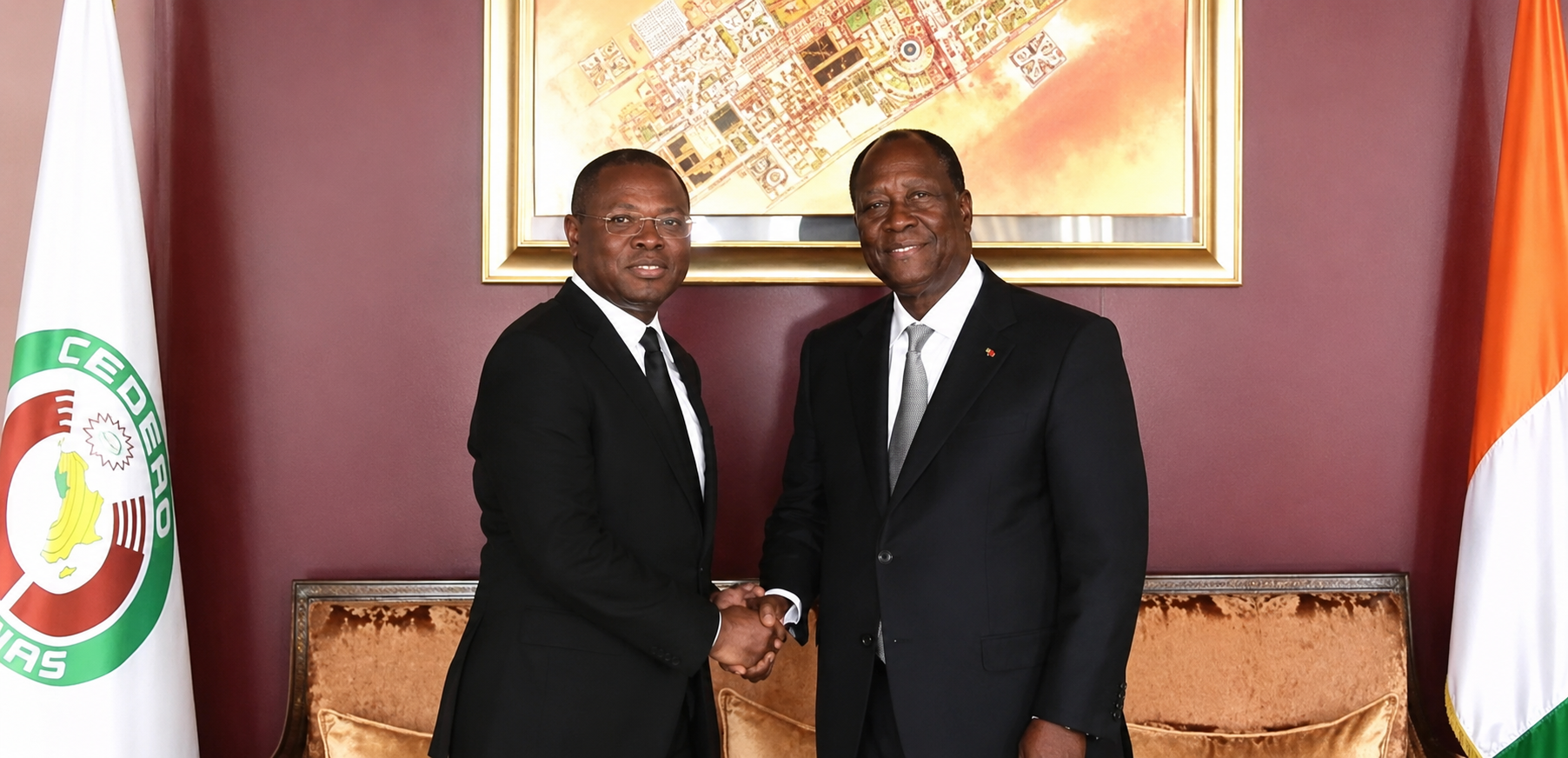
Upon assuming office, the newly inaugurated Beninese President, Romuald Wadagni, selected Côte d’Ivoire for his initial official international engagement. This working visit to Abidjan transcends mere symbolism, signifying a pivotal diplomatic reorientation driven by economic pragmatism.
President Wadagni’s decision to prioritize Côte d’Ivoire conveys a potent message. Directing his inaugural international focus towards Abidjan represents a choice that is both audacious and profoundly logical.
Embracing the “Ivorian miracle”: drawing inspiration from a success model
In opting for Côte d’Ivoire, President Wadagni is not merely engaging with a neighboring state within the sub-region; he is seeking to understand and learn from a proven paradigm of economic transformation. Under the astute leadership of President Alassane Ouattara, Côte d’Ivoire has firmly established itself as the undeniable driving force of the West African Economic and Monetary Union (UEMOA), consistently demonstrating vigorous growth, advanced infrastructure development, and unparalleled international financial appeal.
For Romuald Wadagni, a seasoned technocrat with a background as Minister of Economy and Finance, President Ouattara represents a significant managerial and political benchmark. This forthcoming working session is anticipated to facilitate a substantive dialogue between two leaders deeply committed to tangible results, infrastructural advancement, and fiscal discipline. By aligning himself with a figure whose economic achievements are widely emulated across the continent, the Beninese head of state is clearly framing his mandate within a trajectory of high performance and sophisticated business diplomacy.
A strategic alliance for the sub-region’s future
This growing convergence between Cotonou and Abidjan unfolds amidst a dynamic regional landscape, where security, economic integration, and industrial evolution stand as paramount priorities. Bénin, currently experiencing significant expansion due to its structural reforms and flagship initiatives such as the Glo-Djigbé Industrial Zone (GDIZ), stands to gain considerably from reinforcing its strategic partnership with the formidable Ivorian economy.
The anticipated positive outcomes of this high-level meeting are multifaceted:
- Economic and Financial Synergy: Fostering a shared vision on sovereign debt management, enhancing the attraction of foreign direct investments (FDIs), and strengthening the regional financial market.
- Institutional Experience Exchange: Gaining insights into the recovery strategies and major public works that have underpinned the success of the Ivorian model.
- Security Cooperation and Integration: Solidifying joint stances in addressing the contemporary geopolitical challenges confronting West Africa.
The anticipation surrounding this diplomatic journey already delineates the contours of the Wadagni administration’s foreign policy doctrine: an assertive and pragmatic diplomacy, unequivocally oriented towards established centers of economic excellence.
Through the deliberate selection of Abidjan and the influential figure of Alassane Ouattara for his international agenda, Romuald Wadagni signals his intent to position Bénin’s endeavors on a global stage, leveraging robust, ambitious partnerships focused on the nation’s sustainable development. Cotonou and Abidjan are poised to inaugurate a new chapter in their shared history, with the broader sub-region observing this significant political maneuver with keen interest.