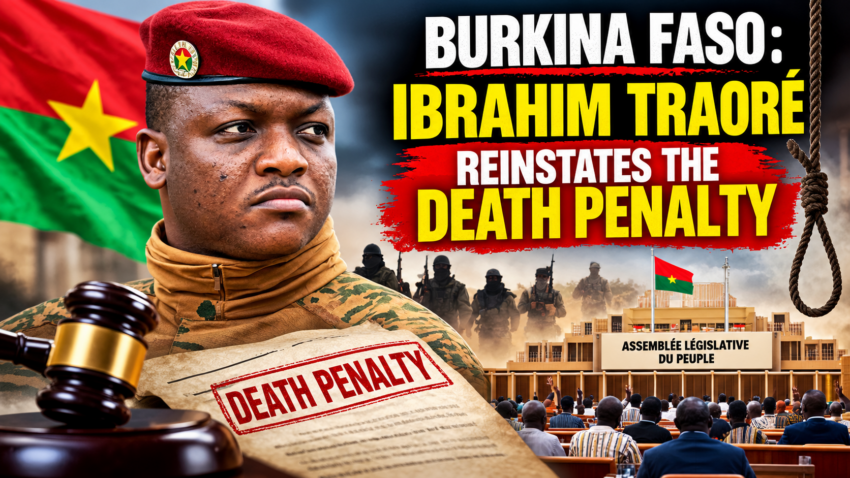
The latest policy shift in Burkina Faso is sending shockwaves through communities already grappling with fear and instability. In a move framed as a necessary escalation to combat rising jihadist violence, the transitional military government has reinstated capital punishment abolished in 2018 under a newly adopted Penal Code. While authorities argue this move will restore public safety and strengthen national sovereignty, critics warn it may worsen public anxiety and undermine democratic foundations in a nation already strained by emergency-era restrictions.
The legal overhaul and its immediate real-world impact
The revised Penal Code, unanimously approved by the Legislative Assembly on October 20, 2026, includes the death penalty for crimes deemed threats to national security, including terrorism, espionage, treason, and the importation of hazardous substances resulting in death. Among the most controversial provisions is its reintegration into the legal framework alongside tighter controls on press offenses raising concerns about the intersection of justice and political dissent. But more than an abstract legal change, this reform carries concrete implications for everyday citizens trying to navigate a fragile security landscape.
In regions where state presence is precarious and armed groups continue to threaten local populations, citizens question whether harsher penalties will translate into tangible safety. The primary demand remains unchanged: the ability to work, educate children, and live without fear of attack. Yet, increasing penal severity does not inherently fill the void left by inadequate intelligence, under-resourced security forces, or limited governance in remote areas. Without complementary action such as preventive intelligence, community protection initiatives, and effective justice systems the reimposition of capital punishment risks becoming a symbolic gesture rather than a solution.
From rhetoric to reality: when justice meets political control
The timing and framing of this reform reveal a deliberate strategy. President Ibrahim Traoré has repeatedly emphasized a hardline stance, warning that perpetrators of espionage and treason will face “unrelenting” consequences. His discourse reflects an intention to project decisive authority, but it also raises critical questions about the independence of the justice system and the safeguards against miscarriages of justice.
Capital punishment, by its irreversible nature, places an immense burden on legal processes. In nations facing security crises, the risk of rushed prosecutions, coerced confessions, or politically motivated accusations cannot be ignored. International observers have documented cases of arbitrary detentions, enforced conscriptions, and suppression of dissenting voices all in the name of national security. When legal tools are used not only to punish crime but also to silence criticism, the line between protecting the state and protecting the regime becomes dangerously blurred.
The chilling effect on civil society
Journalists, activists, and magistrates already operate under heightened scrutiny. Reports indicate a tightening of public debate, with increased risks for those who challenge government narratives or question the effectiveness of counterterrorism measures. The re-penalization of certain press offenses compounds these concerns, suggesting that state security is being invoked to justify restrictions on freedom of expression further isolating citizens and eroding trust in institutions.
Fear as policy: does intimidation build security?
Governments facing existential threats often turn to stronger measures as a signal of resolve. Yet history shows that fear may suppress dissent but does not extinguish violent extremism. In Burkina Faso, where thousands have been displaced and hundreds killed since 2016, the population’s priority is not rhetorical toughness it is safety in daily life. The introduction of the death penalty, while symbolically powerful, does nothing to address the root causes of instability: weak governance, porous borders, and the prevalence of ungoverned spaces where extremist groups thrive.
Moreover, the risk of misapplication looms large. Once a sentence is carried out, it cannot be reversed. A wrongful execution, based on flawed evidence or political pressure, would not only violate fundamental rights but also deepen public disillusionment. Citizens may become more reluctant to cooperate with authorities, fearing arbitrary consequences. Paradoxically, this could weaken the very institutions meant to protect them.
The road ahead: balancing force with legitimacy
The Burkinabè government now faces a dual imperative: restore security and uphold human dignity. While no society can remain indifferent to grave crimes, justice must be exercised within a framework that preserves due process, accountability, and public trust. A policy centered solely on punishment especially one as final as the death penalty risks prioritizing vengeance over prevention and control over reform.
The true test of this reform will not lie in the number of convictions or the severity of sentences, but in whether the state can prevent attacks, protect communities, and restore a sense of normalcy. The population deserves more than fear-based governance. They need visible results: functioning markets, functioning schools, functioning lives. Until then, the reintroduction of capital punishment will be remembered not as a triumph of justice, but as a policy whose consequences extend far beyond the courtroom.
By Martin Ngu — Journalist