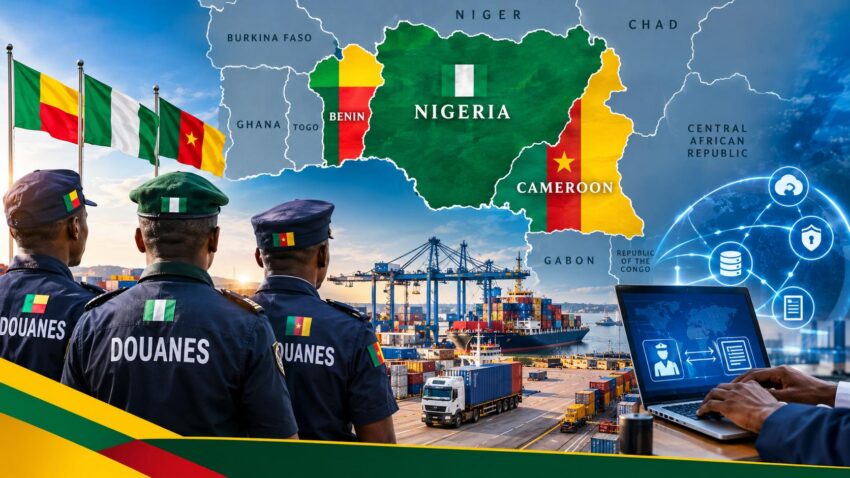
The push toward digital customs integration among Benin, Nigeria and Cameroon is set to reshape cross-border trade dynamics across West Africa, with direct implications for regional competitiveness, logistics efficiency and business costs. This initiative, supported by Afreximbank, aims to streamline customs processes, reduce border delays and create a more transparent trade environment.
Reducing delays and cutting trade expenses at land and sea borders
Customs clearance inefficiencies remain a major economic burden for importers, exporters and logistics providers operating across the three countries. Manual data entry, inconsistent documentation requirements and limited inter-agency communication often lead to duplicated verification processes, longer transit times and increased operational costs. By interconnecting their customs IT systems, authorities in Benin, Nigeria and Cameroon seek to eliminate these inefficiencies and facilitate faster, more predictable movement of goods.
Digital integration is expected to reduce repetitive data capture, improve cargo tracking and accelerate inspection and clearance procedures. Businesses reliant on regional supply chains—such as port operators in Cotonou, manufacturers in Lagos and traders in Douala could benefit from shorter lead times and improved predictability, directly enhancing their price competitiveness in domestic and international markets.
Benin’s commercial gateway to regional trade resilience
For Benin, the digital customs initiative is critical to maintaining its role as a key transit hub in the subregion. The Port of Cotonou serves as a critical entry point for goods destined for landlocked neighbors such as Burkina Faso and Niger, making efficient customs operations essential to its economic viability. Faster clearance, reduced paperwork and improved coordination with Nigerian and Cameroonian authorities could enhance Benin’s attractiveness as a logistics destination and support job creation within the port ecosystem.
Moreover, by enabling real-time data sharing between customs systems in Cotonou, Abuja and Yaoundé, the initiative enhances traceability of shipments, reduces opportunities for document fraud and improves transparency key factors that can strengthen investor confidence in Benin’s trade infrastructure.
Afreximbank’s role in driving pan-African trade reform
The involvement of Afreximbank underlines a broader commitment to removing trade barriers across the continent. Digital customs integration is seen as a strategic tool for boosting intra-African trade, which remains below its potential due to outdated procedures and fragmented systems. While the technical framework is advancing, several operational challenges remain: ensuring data privacy across jurisdictions, maintaining system compatibility, and establishing clear governance to guarantee uninterrupted operations during implementation.
Success will depend on coordinated policy alignment, investment in staff training and the adoption of standardized clearance protocols. Without these, even seamless IT integration may fail to deliver the expected reductions in transit times and transaction costs.
From digital promise to measurable trade gains
The true test of this initiative will be its ability to deliver tangible outcomes: shorter border crossings, lower logistics costs and greater economic predictability for traders. For businesses in Benin, Nigeria and Cameroon, the stakes are high. Efficient customs processes can spur industrial production, expand market access and enhance regional supply chain resilience. At the same time, if implementation lags or coordination falters, the initiative risks becoming another unfulfilled promise in Africa’s ongoing trade facilitation agenda.
As the region seeks to deepen economic integration and reduce dependence on extra-continental trade routes, the digital customs project represents a pivotal step toward a more connected and competitive West African economy. Its success will hinge not only on technology, but on political will, institutional cooperation and sustained investment in trade facilitation infrastructure.
By Cécile Mboua — Journalist