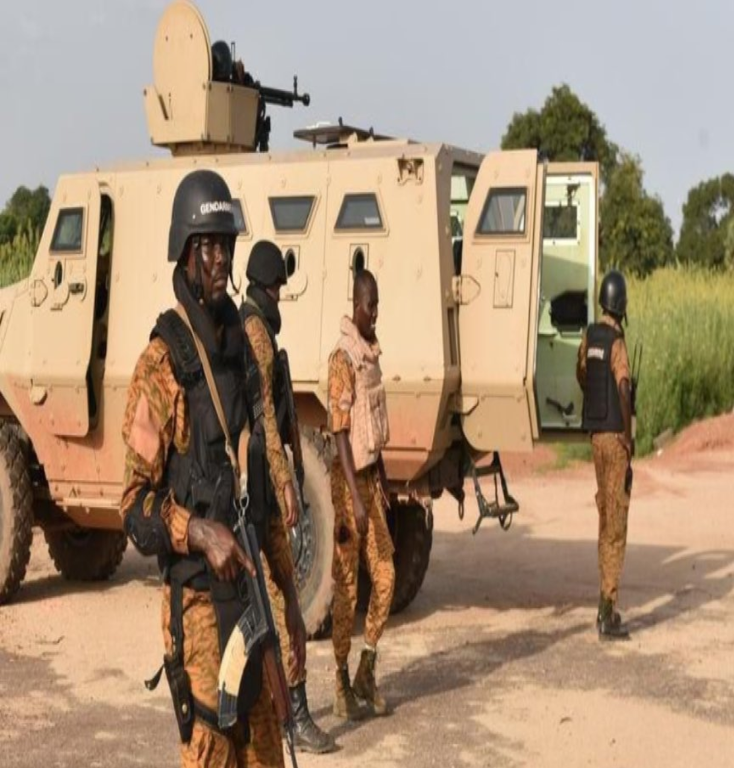
Jihadist strikes leave military hardware in ruins and civilians in despair
The Burkina Faso conflict has entered a new phase as the Group for the Support of Islam and Muslims (JNIM), an Al-Qaeda-affiliated faction operating across the Sahel, claims responsibility for two devastating attacks on national security forces. In a statement released earlier this week, the group alleged the destruction of a military armored vehicle near Fada N’Gourma in the country’s eastern region and the killing of three local auxiliary fighters in Bam Province. The claims, still unverified by official military sources, underscore the escalating challenges facing a nation already grappling with years of relentless jihadist violence.
These assaults are not isolated incidents. They reflect a broader pattern of attacks that continue to destabilize regions across Burkina Faso, with severe consequences for both public safety and economic stability. Communities in the North, East, and Central-North provinces are particularly hard-hit, facing daily threats that disrupt daily life and cripple local economies.
Engaging rural strongholds: armored vehicle targeted in explosive ambush
According to the JNIM communiqué, a military convoy traveling near Fada N’Gourma, a strategic hub in the eastern part of the country, was struck by an improvised explosive device. The blast allegedly resulted in the complete destruction of an armored vehicle, leaving the security situation on a knife’s edge. While the Burkina Faso Armed Forces have yet to issue a formal response, this incident highlights the persistent threat posed by roadside bombs and ambush tactics—methods frequently used by jihadist groups to inflict maximum damage on government forces.
Fada N’Gourma’s location makes it a critical transit point connecting several major cities. The ability of insurgents to disrupt traffic along this axis reflects deeper vulnerabilities in the nation’s security framework. With limited access to protected routes, civilians face growing risks when attempting to travel or transport goods, further isolating already marginalized communities.
Civilian defenders under fire: three auxiliary fighters killed in Bam Province
The JNIM also reported a second attack in Bam Province, where three members of the Voluntary Defense Forces (VDP)—citizen auxiliaries supporting the national military—were reportedly killed. The group claims to have seized several automatic weapons during the engagement. While the VDP plays a crucial role in counterinsurgency efforts, their involvement exposes them to direct targeting by armed groups, increasing the civilian toll in an already volatile environment.
The loss of military-grade weapons, even in small numbers, raises serious concerns about the proliferation of arms in conflict zones. Such recovered weapons can be redistributed among rival factions, perpetuating cycles of violence and undermining local recovery efforts.
Broader crisis: violence reshapes lives and livelihoods
As the JNIM continues its campaign, Burkina Faso’s socio-economic fabric is unraveling. Since the outbreak of widespread jihadist violence, civilian populations have faced systematic displacement, food shortages, and severed access to essential services. Schools have closed, healthcare facilities operate under threat, and agricultural activities have ground to a halt in many areas—particularly in regions like the East and Central-North.
Rural communities, once the backbone of the country’s economy, now struggle to maintain basic standards of living. Markets have shuttered, trade routes have become perilous, and displaced families remain in limbo, often relying on humanitarian aid for survival. The psychological toll is equally devastating, with fear dictating daily routines and eroding trust in government institutions.
Government under pressure: balancing force with community restoration
The latest JNIM attacks serve as a stark reminder of the dual challenges facing Burkina Faso’s authorities. On one side, the military is stretched thin by relentless assaults; on the other, civilians demand immediate protection and a path toward normalcy. While military operations remain critical, sustained success depends on more than just firepower—it requires intelligence gathering, community engagement, and the restoration of essential services.
As military convoys face ambushes and volunteer fighters fall in combat, the government must address gaps in road security, communication between outposts, and the protection of non-combatants. Without these measures, the country risks further fragmentation, leaving swathes of territory vulnerable to insurgent control.
Until verified details emerge from these incidents, the onus remains on authorities to reassure a population living under constant threat. The priority is clear: securing rural communities, restoring economic activity, and rebuilding confidence in a state that must reclaim its authority across every province.