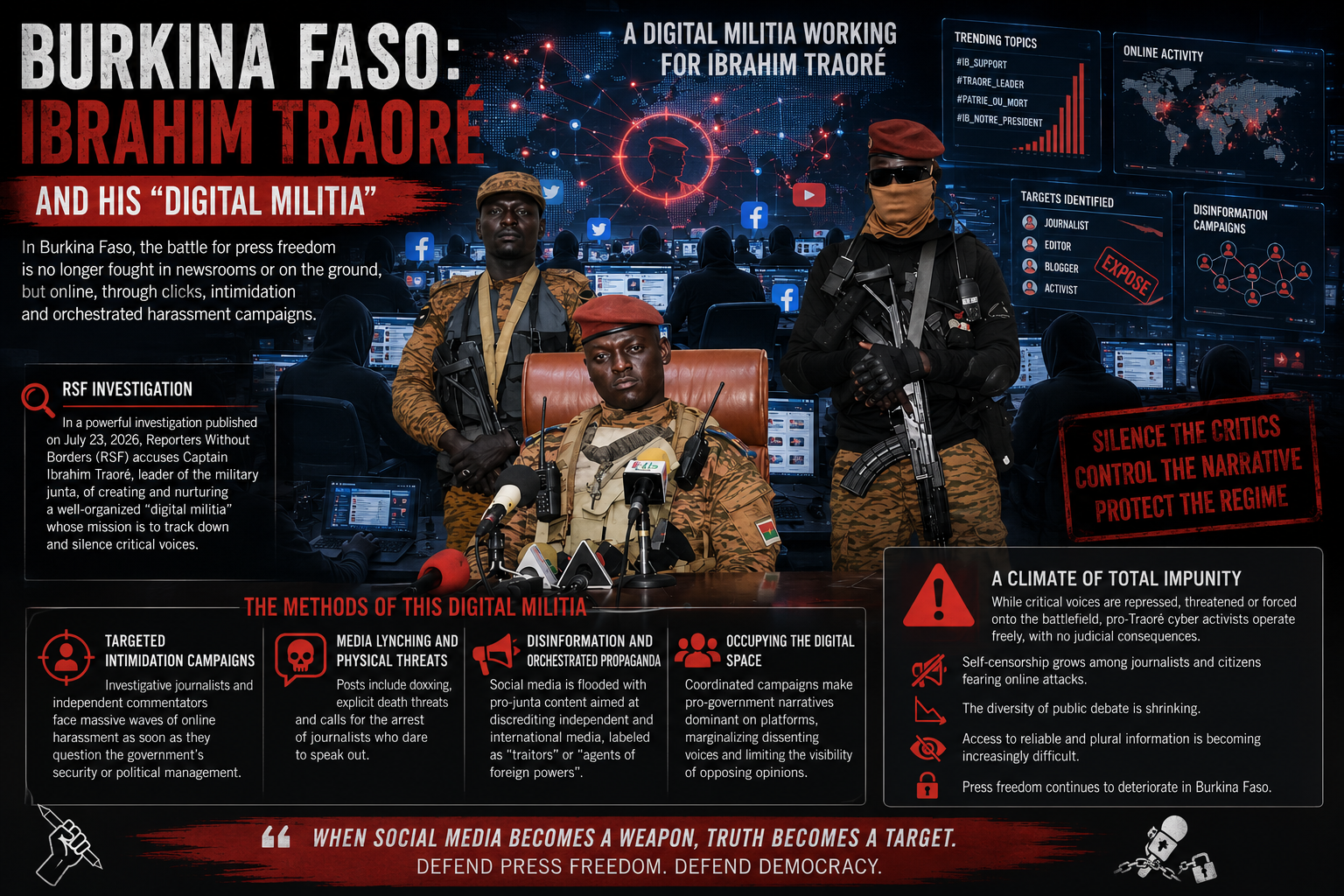
In Burkina Faso, the struggle for press freedom has expanded beyond traditional newsrooms and field reporting, now encompassing the digital realm through orchestrated online harassment campaigns and strategic use of social media.
A compelling investigation, published on July 23, 2026, by the NGO Reporters Without Borders (RSF), directly implicates the head of the military junta, Captain Ibrahim Traoré. The organization asserts that he has cultivated and sustained a sophisticated “digital militia” specifically designed to monitor and silence dissenting voices critical of the regime.
The BIR-C: virtual battalions targeting dissenters
Central to this intimidation strategy is a meticulously structured network of cyberactivists operating under the designation of Bataillons d’intervention rapide de la communication (BIR-C). This nomenclature deliberately echoes military ground units, yet its operational scope extends across the entire digital ecosystem.
According to the RSF report, these shadowy figures coordinate their actions seamlessly to dominate the virtual public sphere and suppress any form of contradictory discourse. The organization posits that this phenomenon transcends mere political activism often observed on social media. It represents a structured strategy aimed not only at defending the government’s decisions but also at making any critical commentary directed at the regime exceptionally costly for those who dare to speak out.
Operational tactics of the BIR-C:
- Targeted intimidation campaigns: Investigative journalists and independent columnists are subjected to extensive waves of cyberharassment whenever they question the government’s security or political management.
- Incitement to media lynching and physical threats: The content disseminated by these networks is not limited to political criticism; it frequently includes the disclosure of personal information (doxxing), explicit death threats, or calls for the arrest of uncooperative journalists.
- Orchestrated disinformation and propaganda: Social media platforms are inundated with pro-junta content designed to discredit traditional local and international media outlets, often labeling them as “traitors” or “proxies for foreign powers.”
- Digital space occupation: Coordinated campaigns ensure that narratives favorable to the authorities overwhelmingly dominate certain platforms, relegating dissenting analyses to the background and significantly limiting the visibility of alternative viewpoints.
A climate of absolute impunity
What RSF emphatically condemns is the complete absence of judicial response to these activities. While critical voices are swiftly suppressed or forcibly conscripted into military service, pro-Traoré cyberactivists operate with complete freedom, benefiting from de facto protection by the authorities.
Several observers note that this situation fosters a pervasive climate of self-censorship. Faced with the risk of exposure to harassment campaigns, some journalists, bloggers, and internet users choose to avoid sensitive topics, particularly those concerning security, governance, or military operations. This psychological pressure acts as an indirect form of restriction on freedom of expression, negating the need for a formal ban.
A strategy that undermines democratic debate
Political communication specialists emphasize that when digital spaces are dominated by coordinated campaigns, public debate progressively loses its diversity. Divergent opinions become less audible, while narratives supportive of the authorities increasingly occupy online conversations.
In a context marked by persistent security challenges, this polarization further complicates citizens’ access to pluralistic information. Yet, a diversity of information sources remains crucial for the public to comprehend national issues and evaluate public policies.
The methods detailed by RSF also echo practices previously documented in various authoritarian or hybrid regimes, where networks of cyberactivists, sometimes coordinated, are mobilized to defend power, discredit independent media, and influence digital conversations. International organizations dedicated to defending press freedom now consider these campaigns a new form of pressure, less visible than traditional censorship but often equally effective in silencing critical voices.
Pressure augmenting existing restrictions
This digital dimension is not an isolated phenomenon. It exists within an environment already characterized by restrictions targeting media outlets. In recent years, several international media organizations have faced suspension or broadcasting bans in Burkina Faso, while journalists have reported intimidation, summons, or temporary disappearances.
For advocates of press freedom, the cumulative effect of administrative measures, security pressures, and online harassment campaigns progressively erodes the space for independent expression.
A concerning authoritarian trend
This RSF investigation corroborates the continuous deterioration of democratic space and freedom of information in Burkina Faso since the junta’s ascent to power. By employing tactics of digital encirclement, the Traoré regime transforms social media into a tool of political coercion, rendering the practice of independent journalism increasingly perilous in the nation.
The organization’s findings could also heighten international partners’ concerns regarding the state of freedom of expression in Burkina Faso. Press freedom indicators are regularly considered by investors, international organizations, and development partners when assessing a country’s governance quality and institutional environment. A sustained degradation of these indicators is likely to negatively impact Burkina Faso’s international standing.
Finally, this investigation illuminates a broader evolution in information warfare. While propaganda once primarily relied on state media, social media has become a strategic battlefield where the speed of content dissemination, algorithms, and virality enable the amplification of certain narratives while marginalizing contradictory discourses. For many observers, this evolution now represents one of the primary challenges for protecting press freedom and democratic debate in states grappling with significant political and security instability.