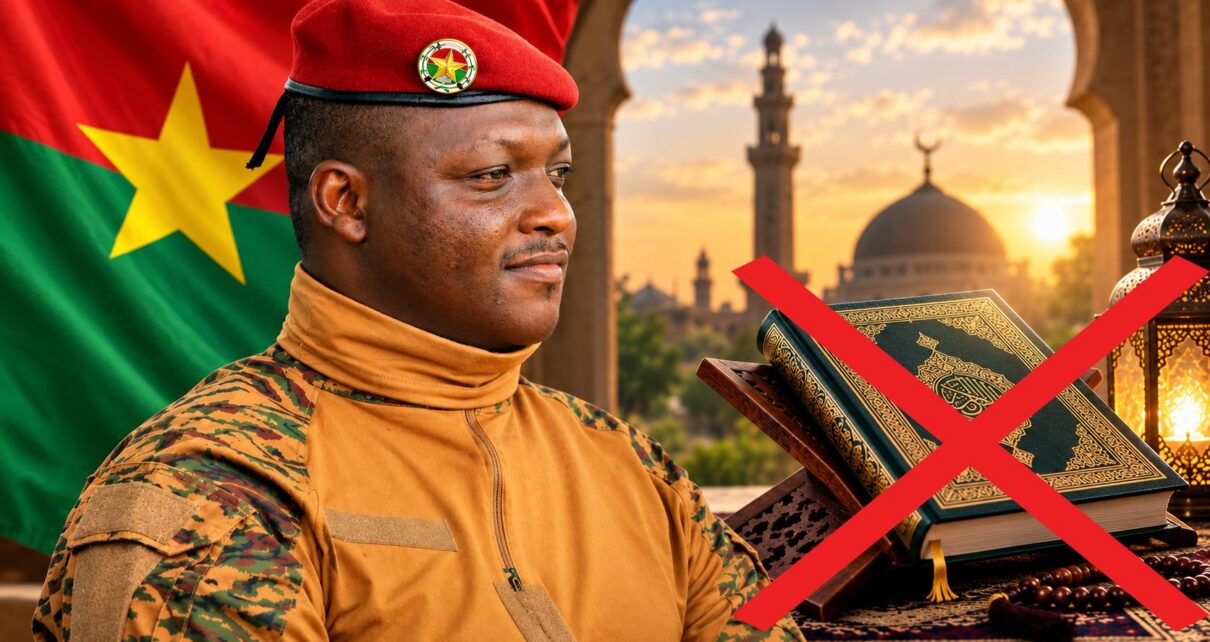
In Burkina Faso, the boundary between fighting armed extremism and suppressing religious freedom has become almost impossible to trace — and the fallout is now being felt far beyond the mosque. Under the stated goal of eliminating the terrorist threat draining the country, the transitional government of Captain Ibrahim Traoré has built a machinery of oversight and punishment aimed at the Muslim community, which remains the largest faith group in the nation. Behind the official language of “national security”, a quiet takeover of Burkina Faso’s Islamic leaders and institutions is being directed from Ouagadougou, and its consequences are reaching households, neighbourhood businesses and local traditions of mediation.
The human cost: arrests, forced enlistment and detention without word
For months, security rhetoric has served as a convenient cover for pursuing independent religious voices. Moderate imams, influential preachers and officials of Muslim associations have faced arbitrary arrests, detention held out of public view, or forced incorporation into the Volunteers for the Defense of the Homeland (VDP). Their offense, in many cases, was limited to criticising the junta’s methods, questioning how the security crisis is being managed, or simply calling for civil rights to be preserved.
Each arrest removes more than an individual. It strips a neighbourhood of a trusted figure who settles disputes, organises aid and speaks with authority to young people who might otherwise be drawn toward violence. The Burkina Faso imam crackdown is therefore not only a rights question; it is a direct hit on the informal infrastructure that keeps many communities stable.
Mosques and Quranic schools under administrative pressure
At the same time, mosques and Quranic schools in areas facing the highest security challenges are being subjected to drastic inspections, arbitrary administrative closures and sweeping accusations of collusion with armed groups. By labelling any unaligned religious speech as “subversive” or “allied with the enemy”, the authorities have created a climate of fear inside a religious community long recognised for its role in mediation and social cohesion.
- Families lose access to education when Quranic schools are shut down without a clear path to reopening.
- Local charity networks are disrupted, as mosque-based collections and assistance programmes are interrupted.
- Community mediation collapses when the imams who traditionally resolved disputes are detained or driven into silence.
Political consolidation at the expense of national unity
The heavy-handed approach points to a clear objective: neutralising any social force capable of articulating organised dissent against military rule. By targeting the networks and figures of local Islam first, the transitional regime seeks to impose a single line of thinking and lock down public space. The immediate winners are those who want fewer voices in the room. The losers are the millions of citizens who rely on religious institutions for guidance, schooling, dispute resolution and basic solidarity.
The blowback: alienation that can feed extremism
Far from weakening the jihadist groups that roam the region, this aggressive campaign against religious practice risks producing the opposite result. By stigmatising the Muslim community, breaking customary and spiritual relays, and depriving worshippers of moderate reference points, the government feeds a sense of injustice and alienation. Turning religion into an internal enemy in the name of sovereignty and security carries a major risk: the atomisation of a social fabric in a country already gasping for air.
The consequences will not stay confined to religious life. They will show up in how communities organise, how businesses operate in areas where trust is already thin, and how ordinary Burkinabè judge the promises of protection made by their leaders. Once those bonds are broken, rebuilding them is far harder than breaking them.