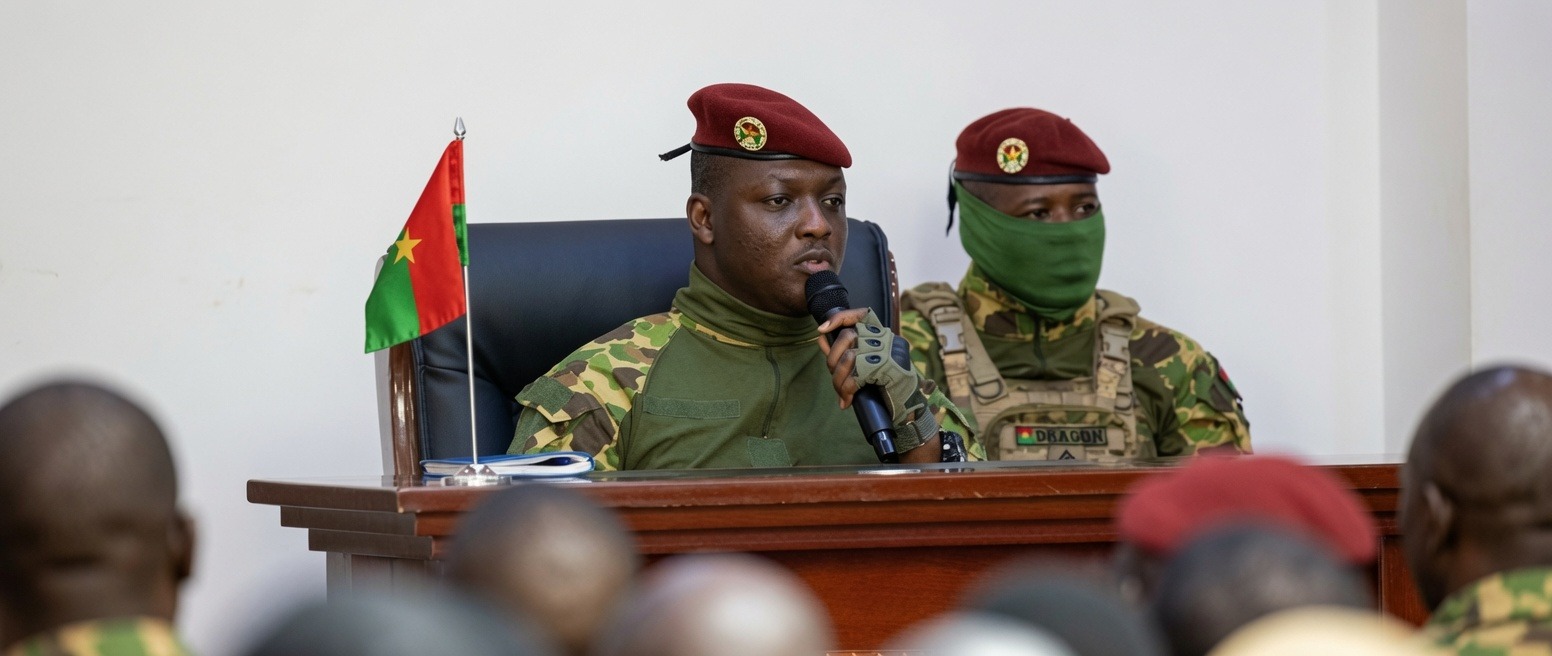
Captain Ibrahim Traoré’s recent address in Ouahigouya has laid bare deep fissures within Burkina Faso’s ruling junta, exposing a leadership struggling to maintain cohesion through fear rather than strategy. The blunt, unfiltered language—replete with coarse expressions like ‘merde’ and calls for ruthless suppression—betrays a crisis of confidence in the military apparatus itself. In governance and warfare, such inflammatory rhetoric rarely signals strength; it signals desperation, revealing a regime clinging to power not through shared doctrine or operational discipline, but through the constant threat of purge.
Leadership in crisis: the paradox of centralization
Traoré’s insistence that ‘there is no number one or number two’ among the junta’s leaders appears designed to eliminate internal rivals. Yet this deliberate flattening of hierarchy concentrates all strategic risk onto a single figure. By staking his legitimacy solely on battlefield experience—rather than institutional reform or collective accountability—he risks repeating a familiar pitfall of praetorian regimes: leadership that is entirely personal, non-transferable, and vulnerable to the next setback in the field.
This centralization carries grave strategic consequences. By prioritizing political loyalty over tactical reform, the junta risks suffocating its own command structure. Officers preoccupied with survival and internal surveillance, rather than operational initiative, may retreat into cautious conformity. An army paralyzed by fear of mislabelled disloyalty cannot respond swiftly to insurgent advances, widening the gap between Ouagadougou’s public declarations of resolve and the reality on the ground.
The illusion of control and the rise of dissent
Far from consolidating power, the regime’s reliance on intimidation and blanket surveillance is likely to backfire. History across the Sahel shows that when dissent is suppressed through threats of ‘ruthless crushing,’ opposition does not vanish—it merely goes underground. The more the junta tightens its grip on internal debate, the more it fuels the conditions for future fragmentation. The moment the balance of power shifts, dormant factions will re-emerge, not as reformers, but as vengeful contenders for control.