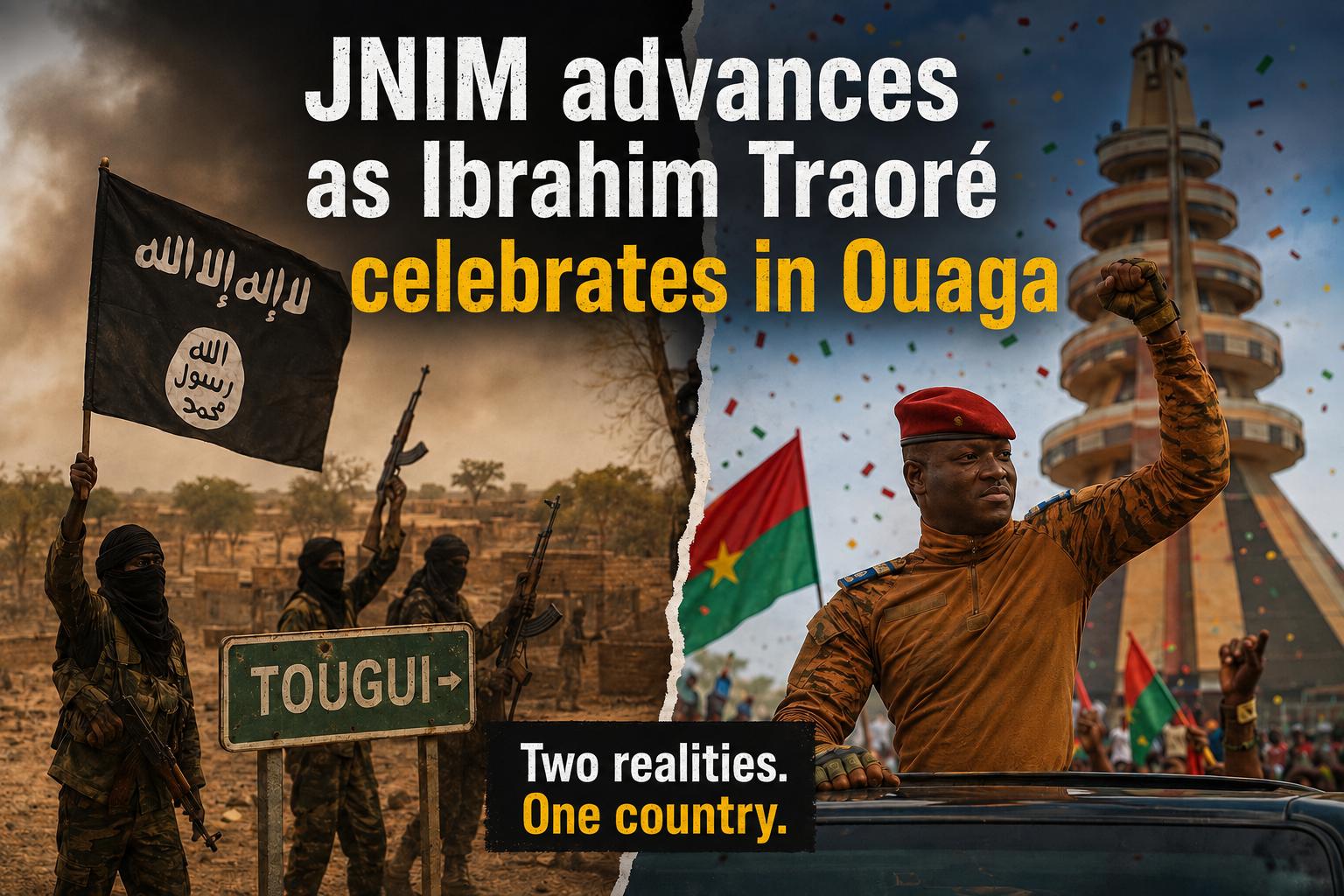
While official communications from Captain Ibrahim Traoré consistently laud a systematic territorial reconquest, the operational reality on the ground presents a significantly more complex picture. Recently, on a Wednesday evening, the Support Group for Islam and Muslims (JNIM) asserted control over a military outpost maintained by local militias in Tougui, near Ouahigouya. While this claim awaits independent verification, it undeniably raises a crucial question: if territorial reconquest is as advanced as proclaimed, how can armed groups persistently strike or assert control in strategic northern regions?
The Tougui incident transcends a mere additional skirmish. It compels an examination of the congruence between political statements, military announcements, and the lived experiences of the populace.
Territorial control: a challenging demonstration
Simply declaring progressive territorial recapture is insufficient. Genuine territorial mastery necessitates a sustained state presence, secure transport routes, robust population protection, and the capacity to prevent armed groups from re-infiltrating cleared zones. The ongoing prevalence of enemy attacks or claims indicates that this stabilization remains precarious.
Recapturing a position does not ensure lasting security
Even when a locality or strategic point is reclaimed by combat forces, the fundamental question revolves around its enduring security. A military reconquest holds true value only if it subsequently facilitates the permanent return of administration, public services, commerce, and displaced communities.
Vulnerability of isolated outposts
The situation in Tougui also underscores the susceptibility of isolated positions. When an outpost heavily relies on local combatants and remains exposed to the movements of a more organized armed entity, its sustained retention can become exceedingly difficult.
Increasing pressure on volunteer forces
The mobilization of Volontaires pour la Défense de la Patrie (VDP) bolsters national forces, yet it incurs a substantial human cost. Entrusting armed civilians with a significant portion of defense in highly exposed rural areas disproportionately burdens them in an asymmetrical conflict.
Victory transcends mere troop numbers
An increase in personnel alone does not guarantee a lasting improvement in security. Intelligence gathering, operational mobility, logistical support, inter-unit coordination, route surveillance, and the ability to hold positions post-recapture are equally decisive factors.
The challenge of grey zones
A considerable disparity can exist between territories officially deemed secure and areas genuinely accessible without risk to residents. It is precisely within these intermediate zones that armed groups can maintain their capacity for harm, recruitment, resupply, and movement.
Selective official communication
The Burkinabè authorities consistently highlight successful operations and areas demonstrating improvement. For instance, the Presidency reported a “continuous calm” in the Nazinon region in July. However, these positive announcements should not automatically lead to the conclusion that the entire nation is experiencing similar progress.
Silence on setbacks fuels skepticism
In any conflict, losses and operational difficulties are inevitable. The core issue arises when the public lacks adequately precise information to differentiate between an isolated successful operation and a genuine, structural enhancement of the security landscape.
Communication battles do not supersede ground realities
The Burkinabè government itself stresses the imperative to counter disinformation campaigns and urges vigilance regarding informational challenges. Yet, the fight against misinformation should not devolve into exclusively triumphant communication. The credibility of any administration also rests on its capacity to acknowledge its challenges.
Measuring reconquest by human outcomes
The authentic metric should not solely be the number of announced operations or claimed recaptured positions. Instead, it ought to encompass the number of villages permanently secured, populations able to return home, schools reopened, markets functioning, and routes where inhabitants can travel without fear of attack.
Administrative return equals military presence
A zone cannot be genuinely considered reconquered if security forces are present but administrative, health, educational, and economic services cannot operate normally. Military victory must culminate in the sustainable restoration of public authority.
The paradox of perpetual victory declarations
The more an administration portrays the situation as fully controlled, the more each successful attack or contested position becomes politically problematic. The issue thus extends beyond the military domain, impacting the credibility of official discourse.
Discrepancy between Ouagadougou and rural areas
From the capital, Ouagadougou, declarations of reconquest might project an image of continuous advancement. For residents of exposed rural zones, however, reality is measured by the ability to sleep securely, cultivate fields, travel, engage in commerce, and send children to school.
Security strategy awaiting validation
The government can emphasize national mobilization, the VDP, regional cooperation, and enhanced combat forces. Ultimately, these instruments must be assessed by their capacity to durably reduce violence and prevent armed groups from retaining operational sanctuaries.
The Tougui incident, therefore, poses a straightforward query: if a position in a strategic region can still be claimed by the JNIM, can one truly assert total territorial control? This question warrants objective consideration, free from propaganda.
Fundamentally, the discussion should not be a simplistic dichotomy of “victory” versus “defeat.” It must center on tangible results. A credible security strategy is judged neither by patriotic slogans, political rhetoric, nor triumphant social media posts, but by its sustained ability to diminish attacks and restore normalcy to the lives of the populace.
The administration of Ibrahim Traoré may continue to present security advancements; indeed, authorities have communicated progress in certain regions. However, the persistent occurrence of incidents and armed group claims, such as the one reported in Tougui, serves as a crucial reminder: a war is not won simply because a government declares it to be so.
The ultimate verdict rests with the ground realities and, most significantly, with the populations who inhabit them.