Mopti, Mali — The loss of the military post at Djenné is more than a battlefield setback. It is a bill that households, market traders and the soldiers meant to protect them are already paying across central Mali, where the fuel blockade imposed by insurgents is quietly reshaping daily life.
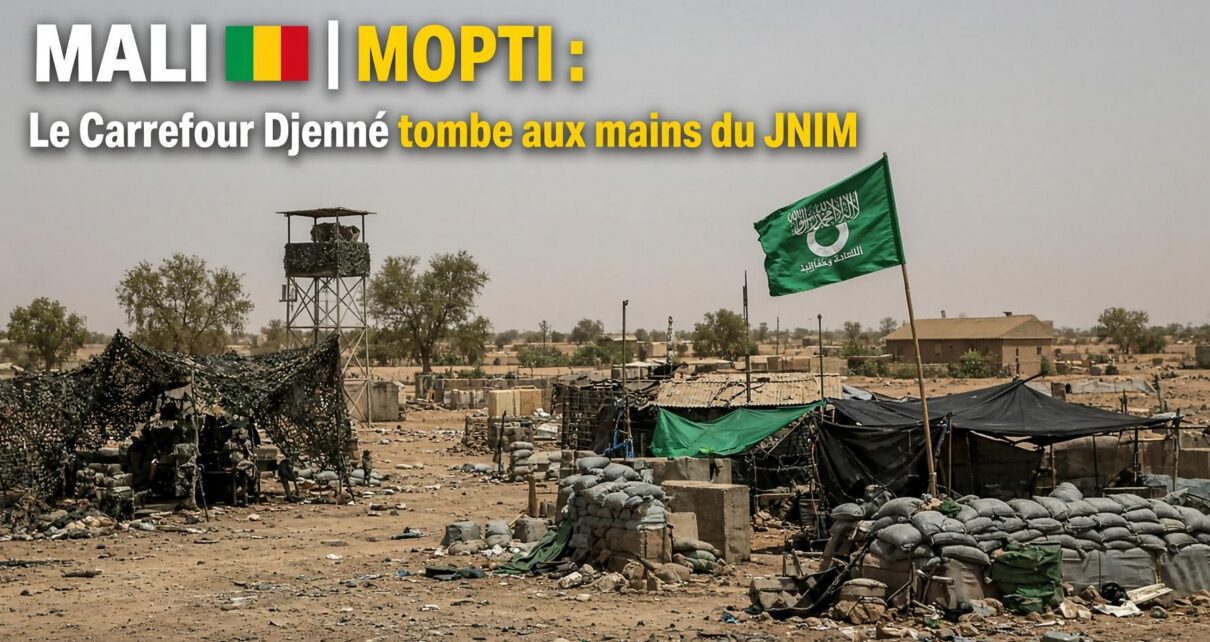
Shortly after midday on Thursday 24 September, at around 12:10 local time, fighters of Jama’at Nusrat al-Muslimin (JNIM), the al-Qaeda-affiliated group, stormed the crossroads on the RN6, the road that links the south of the country to the north. Within minutes of the first bursts of gunfire and explosions, the Djenné military post had fallen. Bamako’s general staff has yet to publish an official casualty figure, but the toll is expected to be heavy. The attackers walked away with tactical vehicles, heavy weapons and ammunition.
An ambush at the RN6 junction that unsettled the whole region
The fighters arrived in large numbers, sealing off the position before launching their assault. “The shooting came from every direction and the defence forces could not hold their support line for long,” one resident of the area said. Once the loyal forces abandoned the post, JNIM circulated footage of armed men moving through the smoking installations of the camp, displaying the captured equipment as a war trophy.
The speed of the collapse has pushed the region’s deeper problem into the open: a military apparatus worn down by a strategy of slow strangulation rather than frontal battle.
Djenné’s collapse and the squeeze on everyday life
For months, JNIM has tightened its economic grip on the Mopti region. By intercepting fuel tanker convoys on the main commercial corridors linking Mali to its neighbours, the group has effectively imposed a blockade on petrol, diesel and aviation fuel. The effects reach well beyond the barracks.
Empty tanks, grounded patrols, climbing prices
- Reconnaissance missions by the Malian Armed Forces (FAMa) and their auxiliaries have been cut to a bare minimum.
- Armoured vehicles sit motionless inside their bases for lack of diesel.
- Air support arrives late, or not at all, because engagement times keep slipping.
- Transporters, farmers and shopkeepers absorb higher costs as scarce fuel is rationed and resold at steep prices.
In practical terms, a shortage that begins at a checkpoint on a highway ends at a pump, a market stall and a clinic that cannot run its generator. That is the chain of consequences now visible from Djenné to the surrounding countryside.
Africa Corps asks for guaranteed fuel as reserves shrink
Tension is rising inside the high command. Regional security officials report that the Russian paramilitary contingent Africa Corps has pressed the transitional authorities in Bamako for an immediate increase in its allocations of petrol and aviation fuel. Its officers argue that without an urgent, secure and dedicated supply line, they cannot mount effective counter-offensives or provide logistical cover for forward positions.
Meeting that demand is a strategic headache. National stocks of refined products are at their lowest, precisely because the blockade on the road corridors has throttled deliveries.
What the blockade means for Bamako’s war effort and the local economy
The assault on the Djenné crossroads illustrates, in brutal fashion, the attrition strategy JNIM has adopted: strip the adversary of mobility, then strike isolated weak points one by one. As central Mali drifts further into isolation, the transitional government faces two problems at once — breaking the energy siege imposed by the insurgents, and holding together a military alliance under mounting strain on the ground.
For civilians caught between the two, the immediate consequences are measurable in stalled traffic, costlier goods and a security presence that struggles to reach them when it matters most.