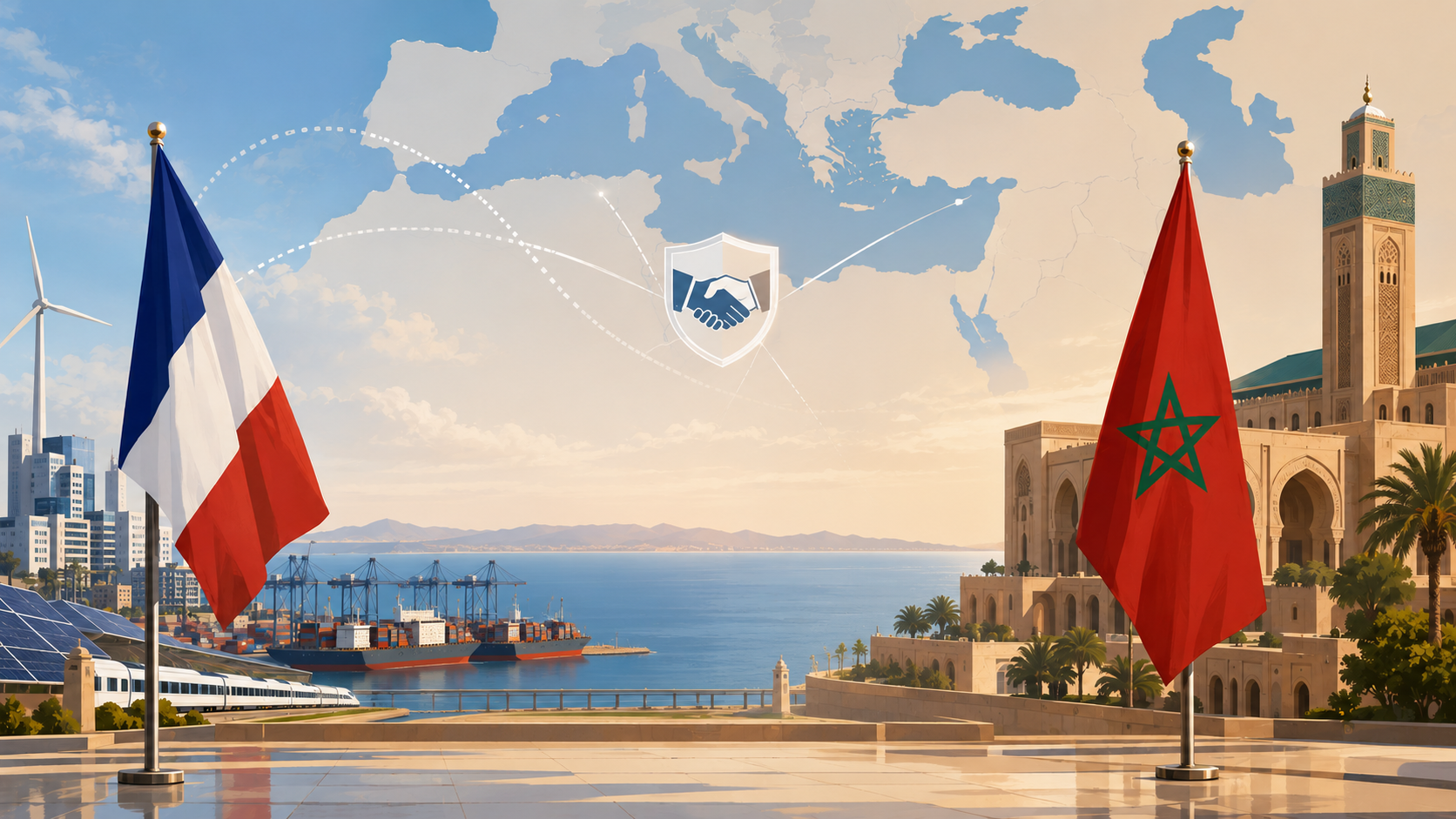
The recent official visit of French Prime Minister Sébastien Lecornu to Rabat, accompanied by over a dozen ministers, marks a pivotal moment in bilateral relations. Far from a routine diplomatic engagement, this high-level meeting signals a deepening of the exceptional partnership between France and Morocco, reaffirming their commitment to a new phase of cooperation that could soon be formalized through a bilateral treaty. This was the first intergovernmental meeting of such magnitude since 2019, underscoring the urgency and significance of this evolving relationship.
This visit aligns with the insights shared in the latest publication Morocco, the Strength of Stability, which highlights how the Kingdom has emerged as a rare bastion of stability in an increasingly volatile Mediterranean and Middle Eastern landscape. In a region plagued by persistent crises—from the Sahel to Libya, and the complexities surrounding Iran’s nuclear negotiations—the Moroccan model stands out for its political resilience and forward-looking governance.
Morocco: a beacon of stability in a turbulent region
The Mediterranean has once again become a critical frontier, where terrorism, migration flows, energy rivalries, and geopolitical competition intersect. Against this backdrop, Morocco has distinguished itself through its ability to maintain remarkable political stability while simultaneously modernizing its economy, infrastructure, and military capabilities. Its diplomatic approach, rooted in dialogue and pragmatism, enables it to engage with diverse actors, even those with strained relations, positioning it as a bridge-builder in a fractured region.
The Kingdom’s influence extends beyond its borders, with strong partnerships with the United States, the European Union, and Gulf monarchies. Its strategic vision has also fostered growing ties with African nations, reinforcing its role as a key player on the continent. This multifaceted engagement underscores Morocco’s unique position as a stabilizing force in a rapidly changing geopolitical landscape.
France’s indispensable North African ally
The strengthening of Franco-Moroccan ties gained momentum following France’s endorsement of Morocco’s sovereignty over the Sahara and the landmark state visit of President Emmanuel Macron to Rabat in October 2024. These developments laid the groundwork for an enhanced partnership spanning security, defense, energy, industry, innovation, infrastructure, and cultural exchange.
The Prime Minister’s visit, accompanied by a sizable ministerial delegation, demonstrates that this partnership is no longer merely diplomatic—it is operational. From intelligence-sharing and counterterrorism to renewable energy projects and artificial intelligence, the breadth of collaboration reflects a shared determination to build a long-term strategic alliance. The convergence of interests in defense, trade, and technology highlights the depth of this evolving relationship.
A relationship built on trust and mutual benefit
Morocco is far more than a Mediterranean neighbor; it is a vital partner for France in addressing shared challenges. The Kingdom plays a crucial role in combating terrorism, stabilizing the Sahel, and serving as an industrial and logistical hub linking Europe and sub-Saharan Africa. In an era marked by supply chain disruptions, migration pressures, and shifting energy dynamics, Morocco’s reliability offers France a strategic advantage.
The effectiveness of Franco-Moroccan cooperation in counterterrorism and organized crime prevention is widely recognized. This trust is the result of years of collaboration, rooted in aligned interests and a shared vision for regional stability. The partnership’s success is evident in its ability to deliver tangible outcomes across multiple sectors, from automotive and aerospace industries to green hydrogen and rail infrastructure.
As Europe seeks to secure its supply chains, expand its presence in Africa, and stabilize its southern neighborhood, Morocco stands out as a natural partner. Its industrial growth, strategic port initiatives like Tanger Med, and commitment to renewable energy make it an indispensable player in the evolving Euro-African economic landscape. The recent high-level visit serves as a testament to the enduring value of this alliance, proving that a relationship grounded in mutual respect and shared goals can yield concrete results in an unpredictable world.
In a Mediterranean and Middle Eastern region marked by uncertainty, Morocco has become one of France’s most reliable and strategic partners. What began as a historical connection has evolved into a forward-looking alliance, essential for navigating the challenges of today’s global landscape. For France, making Morocco its primary strategic partner in North Africa is not just a choice—it is a necessity for the future.