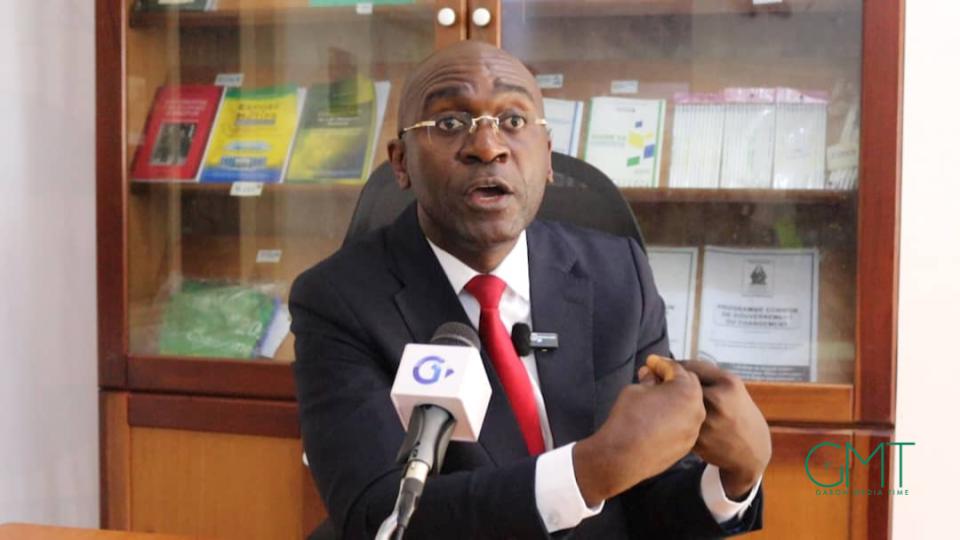
In the face of escalating inflammatory and offensive remarks attributed to certain Gabonese activists abroad, civil society leader Geoffroy Foumboula Libeka Makosso has drawn a clear line between free speech and verbal abuse. During a press conference held in Libreville, he strongly condemned recent attacks targeting President Brice Clotaire Oligui Nguema, his spouse, and his mother, while urging authorities to address the issue beyond mere public outrage—especially when legal violations are evident.
The public debate can be fierce without crossing into personal insults. This is the stance Geoffroy Foumboula Libeka Makosso firmly upholds. Following recent statements linked to a diaspora activist known as Lanlaire, he argues that political dissent must not devolve into personal attacks against the head of state and his family.
Freedom of expression has its limits
For him, civic engagement is not synonymous with insults. Reflecting on his own journey, he emphasizes that his activism has always been rooted in advocacy, public advocacy, and, when necessary, legal action. « Disagreement does not justify insulting one’s opponent, » he stated. His message is clear: criticism of governance is valid, but it must not cross into defamation, insult, or slander—offenses that fall outside the protection of free speech.
He went further, stressing that restoring constitutional order requires upholding the rule of law. While the transition period may have encouraged reconciliation with certain exiles, it should not be interpreted as a blanket immunity for verbal abuse. « Insult, defamation, and contempt are crimes, not expressions of free speech, » he asserted. His condemnation of the remarks attributed to Lanlaire against President Oligui Nguema, the First Lady, and the President’s mother was unequivocal.
Questioning the ties between power and radical activists
Yet Geoffroy Foumboula Libeka Makosso did not limit his criticism to the activists themselves. He also challenged the authorities over their perceived closeness to certain diaspora figures who have built their notoriety on relentless attacks against the government.
He cited instances such as invitations to Gabon, appearances on state media, or even alleged efforts during presidential visits to engage with these activists. While some claims warrant further scrutiny, they raise pressing questions about the boundaries of political engagement and state conduct.
He also referenced an unverified allegation in which an activist claimed to have received €150,000 (nearly 100 million FCFA) from a member of the presidential delegation to publicly attack the head of state. At this stage, the claim remains unproven.
Ending the culture of unchecked proximity
It is on this point that Geoffroy Foumboula Libeka Makosso calls for urgent clarity from the presidency and state institutions. « The President and his team must end this excessive proximity to activists whose only contribution is outrage and insult, » he declared, warning that such tolerance risks damaging « the image of the Republic. »
He cautioned that failing to take legal action against such abuses could foster a culture of impunity, where verbal excess becomes a perceived path to visibility—or even access to power. His argument challenges both the perpetrators and those responsible for enforcing the law: public condemnation alone, without legal consequences when warranted, may inadvertently normalize the very behavior being denounced.
Legal action, not normalization of insults
Geoffroy Foumboula Libeka Makosso therefore calls on administrative and judicial authorities to « pursue legal action against those responsible for such abuses. » Otherwise, he warns, public opinion may begin to suspect that certain activists enjoy undue protection.
He also addressed Gabonese internet users directly, urging them to stop amplifying toxic content by unfollowing, avoiding shares, and reporting abusive accounts on digital platforms.
His stance underscores a broader question about the quality of public discourse in Gabon. While freedom of expression remains vital to any democracy—even when it challenges authority—Geoffroy Foumboula Libeka Makosso insists that personal humiliation has no place in political debate. Criticism is part of democracy; legal accountability, when applicable, belongs to the courts.