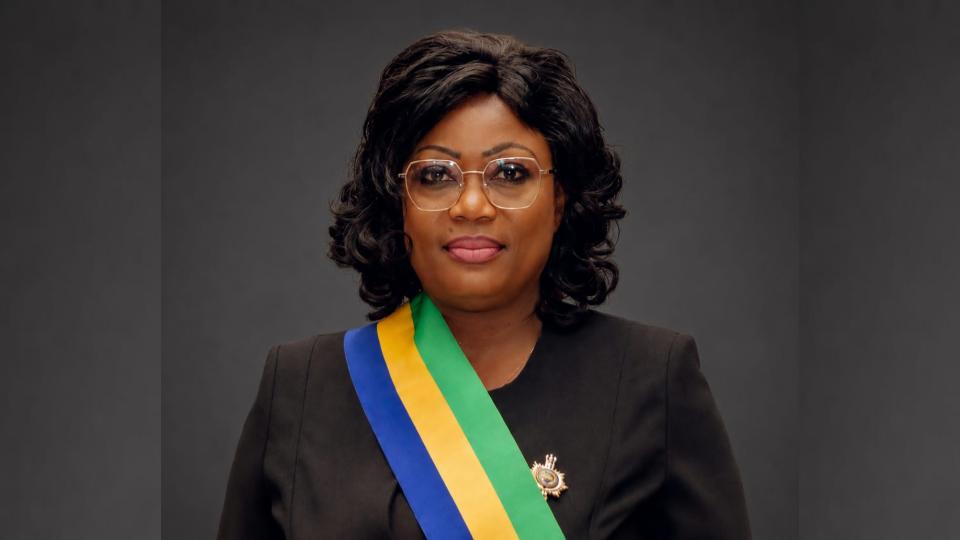
Gabon’s political discourse has taken a troubling turn with personal attacks against the family of President Brice Clotaire Oligui Nguema, prompting Deputy Daisy Léance Akinikoussou to draw a clear line in the sand. In a bold statement titled “Enough is enough: dignity cannot be a casualty of politics,” the legislator from the Plateaux department condemns the escalating verbal assaults on the president’s mother, which she argues have crossed into unacceptable territory.
For Akinikoussou, the freedom to criticize leadership does not extend to weaponizing a public figure’s family members. As Secretary-General of the National Network of Women Parliamentarians (RENAFED), she emphasizes that political confrontation must never degrade into attacks on personal dignity, particularly targeting women who bear no political responsibility.
When criticism crosses into disrespect
The controversy stems from recent remarks attributed to activist Landry Mbeng, widely known online as “Lanlaire,” whose statements about the president’s mother have sparked outrage. Akinikoussou argues that such attacks represent a dangerous erosion of boundaries between legitimate political opposition and outright personal humiliation.
“A mother is still a mother, regardless of her child’s position in power,” she declares. “The president’s mother cannot be reduced to a political pawn simply because of her son’s role. We can challenge the president’s policies, oppose his governance, and demand accountability—but his family members deserve protection from such indignities.”
Protecting women’s dignity in public discourse
Beyond defending one individual, Akinikoussou frames the issue as a defense of all women’s dignity in Gabon’s public sphere. She warns that selective outrage—supporting women’s rights in some cases while enabling their humiliation in others—undermines the very principles of equality and respect.”
“Championing women’s rights means defending every woman, even those whose views we reject,” she asserts. Her stance reframes the debate from partisan conflict to a broader question: how much verbal violence should society tolerate in the name of politics?
A warning about dangerous precedents
Akinikoussou cautions that tolerating attacks on the president’s family sets a perilous precedent. “Today it’s the president’s mother. Tomorrow, it could be the mother of an opponent, a journalist, or an ordinary citizen,” she cautions. Her message is clear: once dignity becomes negotiable, no one is safe from public vilification.
While she fully supports robust political criticism of the president’s actions, she insists that such debates must remain focused on governance—not personal lives. “A determined political adversary does not have to become an enemy of human dignity,” she states. In her view, democracy thrives when ideas are challenged fiercely, but humanity is never sacrificed in the process.
Restoring boundaries in Gabon’s democratic debate
The deputy’s intervention arrives amid growing concerns about the degradation of online discourse in Gabon. Civil society voices increasingly highlight how unchecked personal attacks are poisoning public debate. For Akinikoussou, the solution lies in collective agreement on what constitutes acceptable confrontation.”
Her call to action is unambiguous: “Enough is enough. We must restore the line between political opposition and the respect every human being deserves.”