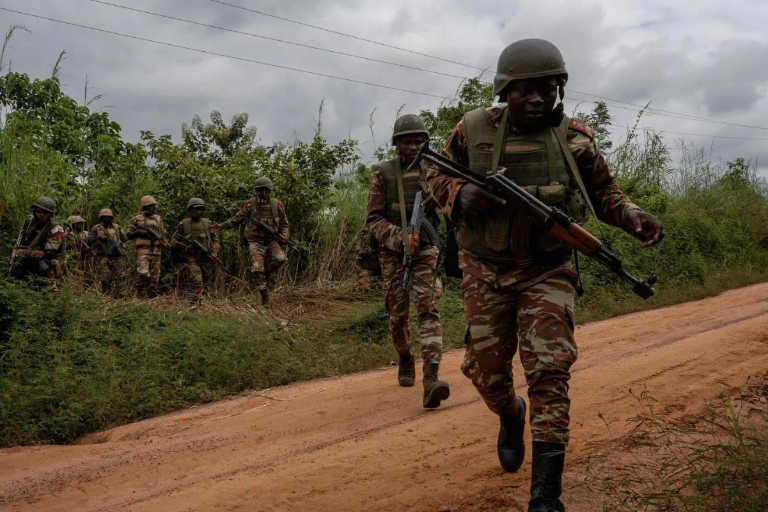
As terrorist threats intensify along Benin’s northern borders, Berlin’s deepening military engagement with Cotonou is taking a decisive turn. Beyond equipment deliveries and training programs, Germany is positioning itself as a key partner in reshaping West Africa’s security architecture. The shift comes as regional instability threatens to spill over into the Gulf of Guinea, prompting urgent action from Cotonou and its European allies.
From shipments to strategic partnerships: a new phase in germano-beninese cooperation
What began as sporadic military aid has evolved into a structured cooperation between Benin and Germany. Recent deliveries underscore this transformation. In 2026 alone, Berlin provided over 550 helmets, 1,266 mobile breathing units, and specialized gear including night-vision equipment worth €3 million. These shipments target critical operational needs, particularly in intelligence gathering and border security.
The German Embassy has signaled further commitments, including logistical support for the Beninese Army’s engineering corps. Training programs have expanded beyond basic instruction, with more than 350 Beninese officers receiving advanced military education in Germany over the past four decades. This long-standing collaboration now serves as the foundation for deeper strategic alignment.
High-level consultations signal a shift toward defense diplomacy
Diplomatic exchanges have reached an unprecedented level. German Ambassador to Benin, Stefan Buchwald, confirmed plans for senior-level joint staff meetings aimed at strengthening defense ties. These conversations could soon culminate in a new bilateral agreement, though its specific provisions remain undisclosed.
The announcement reflects a broader ambition: moving beyond transactional cooperation to establish a framework for joint strategy development and crisis response. Such a move would align with Germany’s broader objective of stabilizing the Gulf of Guinea, where rising insurgencies in neighboring Sahel states pose direct risks to coastal nations.
Plans for German military experts in Benin by 2027
Six to eight German military advisors are expected to be deployed to Benin by late 2027. While their mission is framed as advisory—focusing on training, logistical planning, and technical expertise—their presence underscores Germany’s intent to play a more direct role in shaping Benin’s defense capabilities. This deployment would complement, rather than replace, existing training and equipment initiatives.
For Benin, the arrival of these experts presents a dual advantage: immediate technical support and long-term institutional strengthening. For Germany, it represents an opportunity to embed itself in a critical security node within West Africa.
Tackling the terror threat: why Cotonou’s northern regions demand urgent action
The timing of this cooperation could not be more urgent. Northern Benin—particularly the Atacora and Alibori departments—has seen repeated incursions by armed groups linked to regional terror networks. These attacks disrupt trade routes, displace communities, and threaten the stability of coastal economies. Security experts warn that unchecked instability in the Sahel could trigger a domino effect, pushing militants toward Benin’s southern cities.
Germany’s involvement addresses several critical needs: enhancing cross-border intelligence sharing, improving troop mobility, and reinforcing logistics networks. These measures aim not only to protect Beninese citizens but also to safeguard broader regional trade and transit corridors.
The EU connection: how Brussels supports Berlin’s growing role
Germany’s initiatives in Benin are part of a wider European effort. The European Peace Facility has allocated €35 million to Beninese defense, with additional support channeled through regional security programs involving Ghana, Côte d’Ivoire, and Togo. Berlin’s bilateral actions appear designed to integrate with these EU-led mechanisms, creating a more cohesive security architecture across the Gulf of Guinea.
This alignment suggests that Europe is adopting a coordinated strategy: blending bilateral partnerships with multilateral frameworks to maximize impact. The result could redefine how external actors engage with coastal West African states facing mounting security challenges.
What’s next for Benin and Germany?
The coming years will be pivotal. Benin must translate this diplomatic momentum into tangible operational gains: modernizing its defense institutions, deepening inter-agency coordination, and sustaining public trust in its military. Germany, in turn, faces a strategic test: can its expanding footprint deliver security dividends without over-extending its commitments?
One certainty remains: the evolving relationship between Berlin and Cotonou reflects a broader geopolitical realignment. As traditional security actors recalibrate their roles in Africa, new alliances are being forged—not out of ideology, but necessity. The question now is whether this partnership can outlast short-term gains and deliver lasting stability to a region caught between insurgency and opportunity.