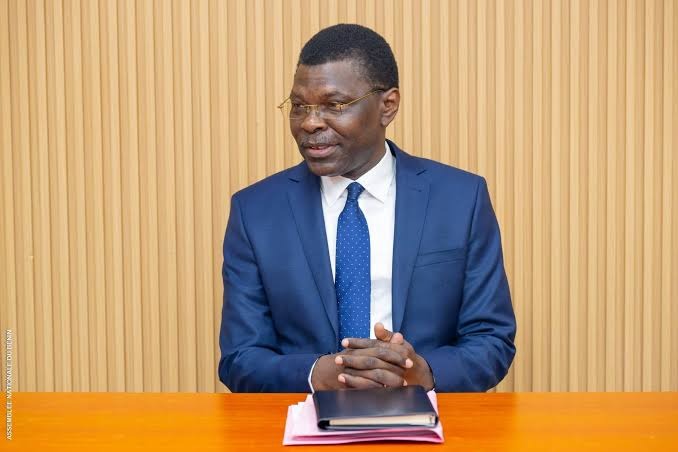
In the heart of Lomé, as the Union Parliamentaire Africaine (UPA) convened its 48th conference of presidents alongside the 86th executive session, Joseph Fifamè Djogbénou, President of Benin’s National Assembly, delivered a message that resonated far beyond the conference halls. Addressing the lingering strain between Benin, Niger, and Burkina Faso, Djogbénou issued a heartfelt plea for regional unity—not just as a diplomatic gesture, but as a lifeline for families, traders, and businesses caught in the crossfire of disrupted trade routes.
Diplomacy under siege: when borders become barriers to survival
The closure of the Benin-Niger border, now dragging into its second year, has sent shockwaves through local economies on both sides. Markets that once thrived on cross-border commerce now stand half-empty, while farmers and small-scale traders face mounting losses. Djogbénou’s intervention isn’t just symbolic; it reflects a stark reality—without dialogue, entire communities risk being locked out of economic lifelines.
Speaking against the backdrop of the UPA meetings, Djogbénou made it clear: dialogue isn’t optional. It’s a necessity. His words carried a dual message—one of urgency for the present crisis, and one of hope for a future where Saharan trade corridors could once again flow freely.
From rhetoric to action: how one nation is bridging the divide
Djogbénou’s approach isn’t new, but it is persistent. Across multiple administrations, Benin’s stance on regional reconciliation has remained steadfast. The message is simple: borders may close, but history doesn’t. The shared culture, language, and kinship that bind Benin, Niger, and Burkina Faso transcend political disagreements. In Lomé, Djogbénou framed this idea with striking clarity: « I don’t extend the hand of reconciliation because I have no choice—I do it because our fates are woven together. The day my neighbor suffers, my own prosperity is at risk. »
This isn’t just idealism; it’s pragmatism. With the Sahel facing acute food insecurity and soaring inflation, the human cost of prolonged isolation is impossible to ignore.
The human cost of dormant diplomacy
Behind the diplomatic posturing lies a stark reality: real people are paying the price. Small-scale traders, often women who rely on weekly border crossings to sell goods, now struggle to feed their families. Truck drivers wait for weeks at closed checkpoints, their livelihoods suspended. Djogbénou has repeatedly spotlighted these stories, framing them not as isolated incidents, but as a collective failure of regional leadership.
In one particularly poignant moment during his address, he drew a vivid parallel: « When European shores turn away migrants, they don’t ask if those drowning are Beninese, Burkinabè, or Nigerien. They turn away Africans—period. Our shared African identity means their pain is our pain. »
Where policy meets people: the forgotten zones of Sahel trade
The border closures have created economic dead zones—arid strips of land where once bustling trade hubs now stand deserted. Local governments on both sides of the Benin-Niger divide report a sharp decline in tax revenues, forcing cuts to education and healthcare budgets. The ripple effects are undeniable:
- Farmers in northern Benin can’t sell crops to Niger, where demand is high—rotting harvests mean lost income.
- Transporters in Burkina Faso face exorbitant detours, driving up food prices for families already struggling.
- Cross-border families are separated, with remittances—often lifelines for rural households—now frozen.
A call for parliamentary bridge-building
Djogbénou didn’t just call for dialogue—he outlined a roadmap. He urged Beninese, Nigerien, and Burkinabè parliamentary delegations to collaborate closely with their governments, focusing on three pillars:
- Unblocking trade arteries: Identifying and reopening key border crossings that have minimal security risks.
- Reactivating local councils: Empowering regional leaders to revive micro-trade pacts that bypass the political deadlock.
- Leveraging shared institutions: Using platforms like the UPA to institutionalize regular dialogue, ensuring disagreements don’t escalate into closures.
The message is clear: diplomacy isn’t a zero-sum game. The longer borders stay shut, the harder it becomes to rebuild trust. But with persistent effort, Djogbénou believes a breakthrough is possible—one that could reopen not just roads, but the futures of millions.
Can dialogue rewrite the Sahel’s future?
The stakes couldn’t be higher. In an era where global instability presses down on West Africa, regional cohesion isn’t a luxury—it’s survival. Djogbénou’s push for diplomacy isn’t about grand gestures; it’s about averting a slow-burning catastrophe. The question now is whether his peers in Niamey and Ouagadougou will meet him halfway before the human toll becomes irreversible.
As the UPA conferences adjourned, one thing remained certain: the cost of continued division is measured in empty markets, hungry families, and lost generations. The question Benin’s diplomacy now poses to its neighbors is this: how much longer can we afford to wait?
Joseph Djogbénou’s answer is unequivocal—there is no alternative to dialogue.