Military maneuvers in the Taiwan Strait raise alarms over regional stability
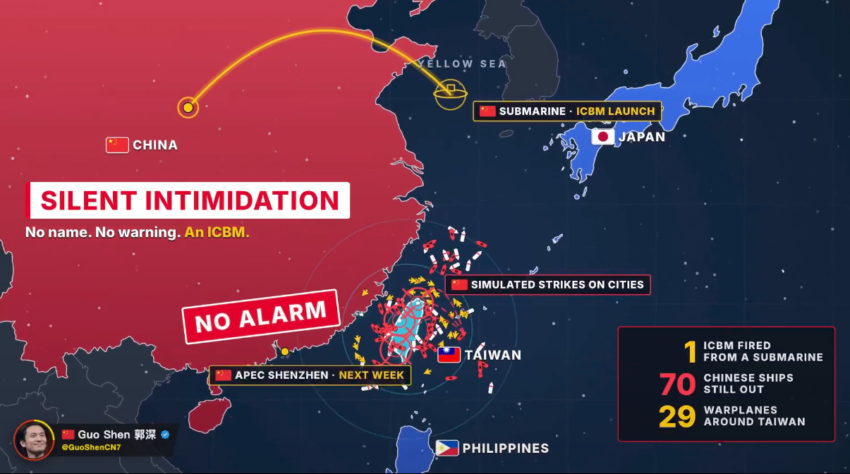
The waters surrounding Taiwan have become a focal point of escalating military tensions, with China’s recent naval exercises drawing global scrutiny. In early November 2026, over 100 Chinese warships and coast guard vessels were deployed in a coordinated maneuver spanning the Taiwan Strait and adjacent waters. This unprecedented mobilization, involving multiple naval commands, has raised concerns about potential disruptions to maritime trade and regional security.
The operation extended beyond the immediate vicinity of Taiwan, encompassing a vast area of the western Pacific. Taiwanese military sources reported that approximately 70 ships remained in the region as late as November 13, underscoring the scale and endurance of the exercise.
Defense analysts note that such drills could serve as a test run for a potential blockade of Taiwan, a strategy Beijing has increasingly emphasized in its military doctrines. By controlling access routes, China could exert significant economic and strategic pressure on Taipei without resorting to direct military confrontation.
Taipei’s dilemma: Preparing for economic and logistical isolation
For Taiwan, these developments represent more than just a military challenge—they pose a direct threat to the island’s economic resilience. A sustained naval blockade could disrupt critical supply chains, particularly for advanced semiconductor manufacturing, which accounts for a significant share of global tech production.
- Trade disruptions: The Taiwan Strait is a vital shipping lane, handling a substantial portion of global maritime trade. Any obstruction could lead to delays, increased shipping costs, and potential shortages of essential goods.
- Energy security risks: Taiwan imports nearly all its energy resources. A blockade could jeopardize fuel supplies, exacerbating vulnerabilities in its energy infrastructure.
- Global supply chain vulnerabilities: The island is a key hub for semiconductor production, supplying chips essential to industries worldwide. Prolonged disruptions could trigger ripple effects across tech, automotive, and consumer electronics sectors.
The Institute for the Study of War highlighted in its November 13 assessment that China’s maneuvers align with scenarios of access denial, a strategy aimed at preventing external intervention in the event of a crisis.
The mystery of the US’s “nuclear-sniffing” aircraft over the Taiwan Strait
Amid the growing Chinese naval presence, another event captured the world’s attention. On November 15, reports emerged of a WC-135R Constant Phoenix aircraft—an advanced US Air Force reconnaissance plane—operating in the skies near Taiwan. The aircraft, nicknamed the “Nuclear Sniffer,” is designed to detect traces of radioactive materials in the atmosphere.
The WC-135R reportedly departed from Kadena Air Base in Okinawa, Japan, and followed a flight path south of Taiwan before approaching the southwest approaches to the Taiwan Strait. While its exact mission remains unconfirmed, the timing and location have fueled speculation about US intentions.
Some analysts suggest the aircraft’s presence could be part of a broader intelligence-gathering effort, aimed at monitoring China’s nuclear capabilities or assessing any potential deployments of nuclear-capable assets. Others caution against premature conclusions, noting that the WC-135R’s role extends beyond surveillance—it is also used to verify compliance with the Comprehensive Nuclear-Test-Ban Treaty (CTBT).
Geopolitical stakes: Why Taiwan remains a powder keg
The Taiwan Strait has long been a flashpoint in US-China relations, with Beijing asserting its claim over the island and Washington maintaining a policy of strategic ambiguity. The recent naval surge and aerial surveillance underscore the deepening mistrust between the two superpowers.
Japan, as a key regional ally of the US and a neighbor of Taiwan, finds itself at the epicenter of these tensions. The proximity of Okinawa to the Taiwan Strait makes it a critical staging ground for military operations, further complicating the security landscape in East Asia.
For Taiwan, the stakes could not be higher. The island’s de facto independence relies on a delicate balance of deterrence and diplomacy. Any miscalculation—whether in military exercises or surveillance operations—could tip the scales toward open conflict.
What’s next? Assessing the risks of unintended escalation
While there is no immediate evidence to suggest an imminent Chinese invasion, the combination of large-scale naval drills, access-denial scenarios, and heightened surveillance creates a volatile environment. A single misstep—whether a misinterpreted maneuver or a technical failure—could spiral into a broader crisis.
The global repercussions of such a crisis cannot be overstated. From semiconductor shortages to energy price spikes, the economic fallout would resonate worldwide. Meanwhile, the US and its allies are faced with a pressing question: How far can they push back against China’s assertiveness without triggering a confrontation?
One thing is clear: the western Pacific is no longer just a region of economic opportunity—it has become a frontline in the new era of great-power competition. And in this high-stakes game, every move matters.