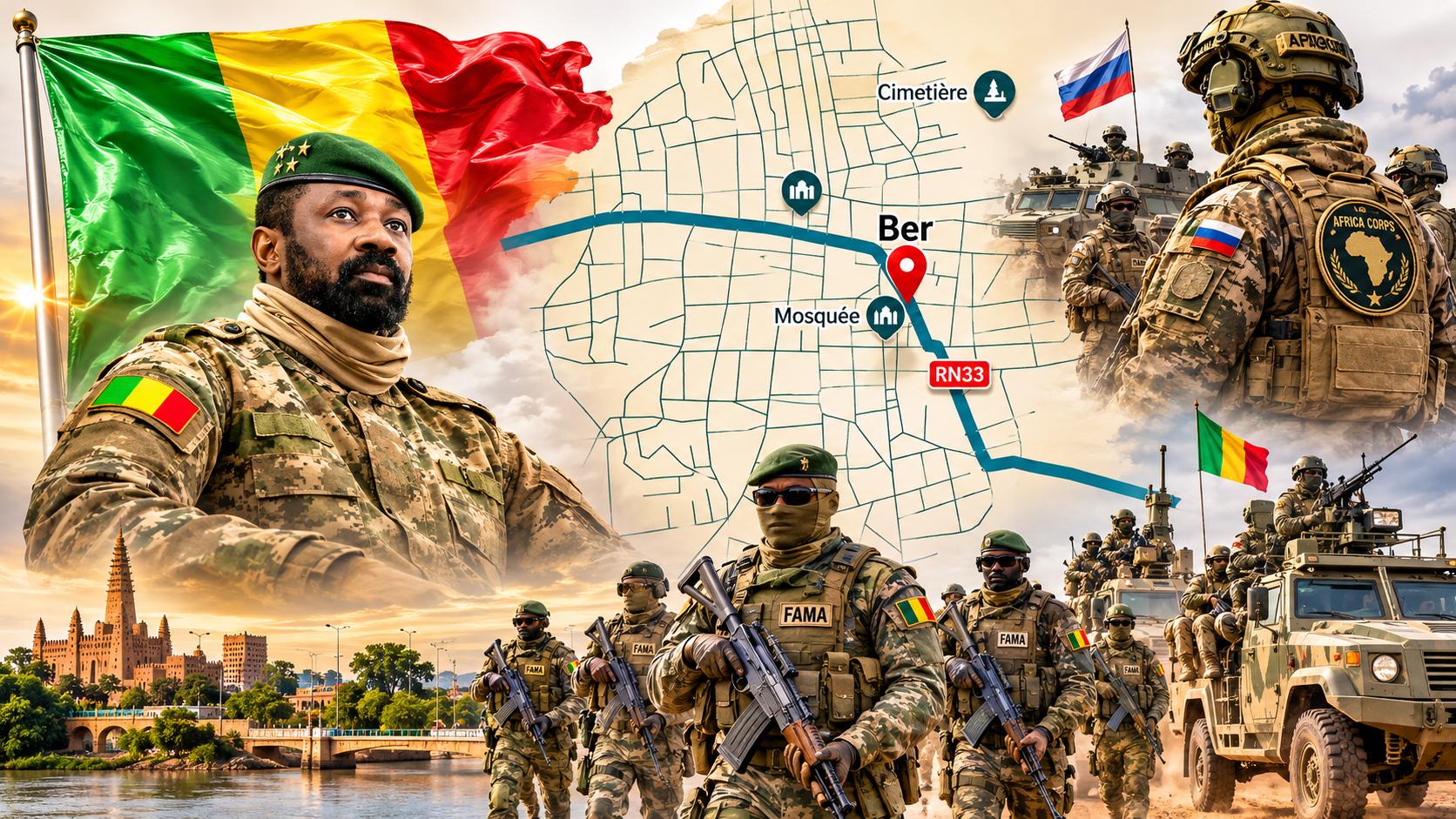
Tombouctou — Northern Mali remains a flashpoint of intense conflict. A convoy of the Malian Armed Forces (FAMa), operating alongside Russian fighters from the Africa Corps, encountered an ambush on Wednesday near Ber, situated in the Tombouctou region. Assailants reportedly initiated the attack with gunfire and deployed improvised explosive devices (IEDs), a common tactic utilized by armed factions operating across the nation.
As of now, a verified, independent assessment of the casualties or material damage resulting from this incident is unavailable. Therefore, caution is advised regarding the number of victims and the precise identification of the perpetrators.
Nevertheless, the assault underscores a persistent reality: despite Bamako’s concerted efforts to bolster its territorial authority and the ongoing operations conducted with the support of the Russian Africa Corps, the critical routes spanning northern and central Mali continue to be highly susceptible to attacks.
A strategic location, Ber, under sustained pressure
The locality of Ber, within the Tombouctou region, is no stranger to the Malian conflict. This area has previously witnessed confrontations involving government forces, jihadist groups, and various northern armed movements.
Notably, in 2023, the vicinity of Ber was a focal point for clashes involving FAMa and their Russian partners, occurring amidst the gradual withdrawal of the United Nations Multidimensional Integrated Stabilization Mission in Mali (MINUSMA) and the Malian army’s reassertion of control over several former international bases.
Three years later, the fundamental challenge persists: securing a town does not automatically translate into control over its access routes. In a country as vast as Mali, military convoys must traverse extensive distances on roads vulnerable to mines, IEDs, small arms fire, and coordinated assaults.
The Ber ambush thus highlights the significant challenge confronting FAMa: achieving lasting security in territories reclaimed from armed groups while simultaneously preventing these groups from maintaining their capacity for disruption in rural and desert areas.
JNIM and armed factions adapt their strategies
Mali contends with multiple, simultaneous threats. The Group for the Support of Islam and Muslims (JNIM), an Al-Qaeda affiliate, stands as one of the primary adversaries to Malian forces. In the northern territories, authorities also face a resurgence of separatist movements and a realignment of armed alliances.
According to an analysis published in July 2026, a tactical collaboration has emerged between JNIM and the Azawad Liberation Front (FLA), despite their ideological differences. This convergence specifically targets Malian forces and their Russian partners. Data cited by the agency indicates a substantial increase in fatalities linked to armed group attacks during the initial months of 2026.
This evolving dynamic significantly complicates Bamako’s military strategy. Government forces are no longer confronting a singular opponent but a fragmented security landscape where jihadists, separatist groups, and community militias pursue diverse objectives, often forming circumstantial alliances.
The Russian gamble tested on the ground
Since severing ties with several Western partners, particularly France, Bamako has fundamentally recalibrated its defense policy. The partnership with Russia now forms a cornerstone of Mali’s security strategy.
The Wagner Group has progressively transitioned to the Africa Corps, a Russian entity operating under the authority of the Russian Ministry of Defense. Its personnel deploy alongside FAMa in various parts of the country.
For Malian authorities, this partnership reflects a stated commitment to defending national sovereignty and reducing reliance on Western powers.
However, recent military setbacks also reveal the limitations of this approach. In 2026, Malian forces and their Russian partners faced intense pressure in several northern sectors, notably around Kidal and Anéfis. The scale and simultaneous nature of these attacks demonstrate that armed groups retain considerable planning and mobility capabilities.
The Ber ambush should therefore be viewed not as an isolated incident, but as another chapter in a conflict that remains far from resolved.
Mali’s economy held captive by insecurity
The security crisis extends far beyond the battlefield, exerting direct pressure on the Malian economy.
Mali possesses significant mineral resources, particularly gold, and is also developing its lithium production. Yet, the economy largely depends on rain-fed agriculture and raw material exports. This structure renders it exceptionally vulnerable to conflicts, climatic hazards, and global commodity price fluctuations.
The year 2025 offered a stark illustration of this vulnerability. Attacks on supply corridors led to widespread disruptions in fuel provision, impacting transport, industry, agriculture, and electricity generation.
According to the World Bank, Malian economic growth slowed in 2025, with fuel-related disruptions weighing heavily on activity. However, the institution anticipates a recovery in growth for 2026, projected at around 5%, driven primarily by the mining sector.
The International Monetary Fund (IMF) also maintains a more optimistic outlook for 2026, forecasting growth around 5.5%, contingent on an improved security situation and a rebound in gold production. This highlights a striking paradox for Mali: the economy possesses robust growth engines, but persistent insecurity constantly threatens to stifle them.
Gold: backbone and inherent vulnerability
The gold sector occupies a pivotal position within this equation.
The resolution, in late 2025, of a dispute between Malian authorities and a major gold producer is expected to facilitate a resumption of production. The IMF estimates that the normalization of mining activity, combined with high gold prices, could bolster public revenues, exports, and banking system liquidity in 2026.
However, mines and their vital supply corridors remain exposed to armed groups. Instability in mining regions can rapidly escalate into a macroeconomic threat.
For Bamako, security is therefore no longer merely a military concern; it directly dictates fiscal revenues, investments, exports, and the state’s capacity to fund public services.
A society strained by a protracted crisis
Beyond economic figures and military communiqués lies a population that has endured the consequences of conflict for over a decade.
Population displacement, interrupted economic activity, limited access to healthcare and education, food insecurity, and youth unemployment represent formidable challenges compounded by the security crisis.
Demographic pressure further exacerbates the issue. The World Bank estimates that approximately 235,000 young people enter the Malian labor market annually, while employment opportunities remain insufficient.
Under these circumstances, insecurity also becomes a profound social problem. When a road is cut off, it affects more than just military personnel: traders cannot circulate, farmers face greater difficulty selling their produce, and rural populations experience a decline in access to essential services.
The political challenge underpinning the military struggle
The security situation unfolds within a unique political context. Mali remains governed by authorities who came to power following military coups in 2020 and 2021, pursuing a political transition whose timeline and modalities have generated considerable tension.
Concurrently, Bamako endeavors to strengthen its regional autonomy through the Alliance of Sahel States (AES) with Burkina Faso and Niger. These three nations have launched joint initiatives in areas such as security, investment, and development financing.
This commitment to sovereignty forms a central tenet of the Malian authorities’ discourse. Yet, it carries significant responsibility: to demonstrate that the departure of former foreign forces and the new security partnership can indeed lead to greater stability.
Ber: a profound warning, not just an incident
The reported ambush near Ber thus occurs at a particularly sensitive juncture.
It serves as a stark reminder that, despite military operations and the presence of the Africa Corps, armed threats retain the capability to strike government forces along their own transit routes.
The true imperative for Bamako is no longer solely about reclaiming positions or conducting offensive operations. It now entails transforming any military gains into sustainable territorial control, capable of guaranteeing the movement of people and goods, the functioning of public services, and the safety of its citizens.
For in Mali, the battle for security is intrinsically an economic and social battle.
As long as roads remain exposed to ambushes and IEDs, as long as certain rural areas remain beyond effective state control, and as long as thousands of young people continue to enter a job market unable to absorb them each year, the country’s stabilization will remain incomplete.
The Ber ambush is therefore more than just another military episode; it underscores that Malian peace will not be won solely in the desert or within barracks. It will also be forged on the roads, in the villages, in the schools, in the mines, and in the markets.