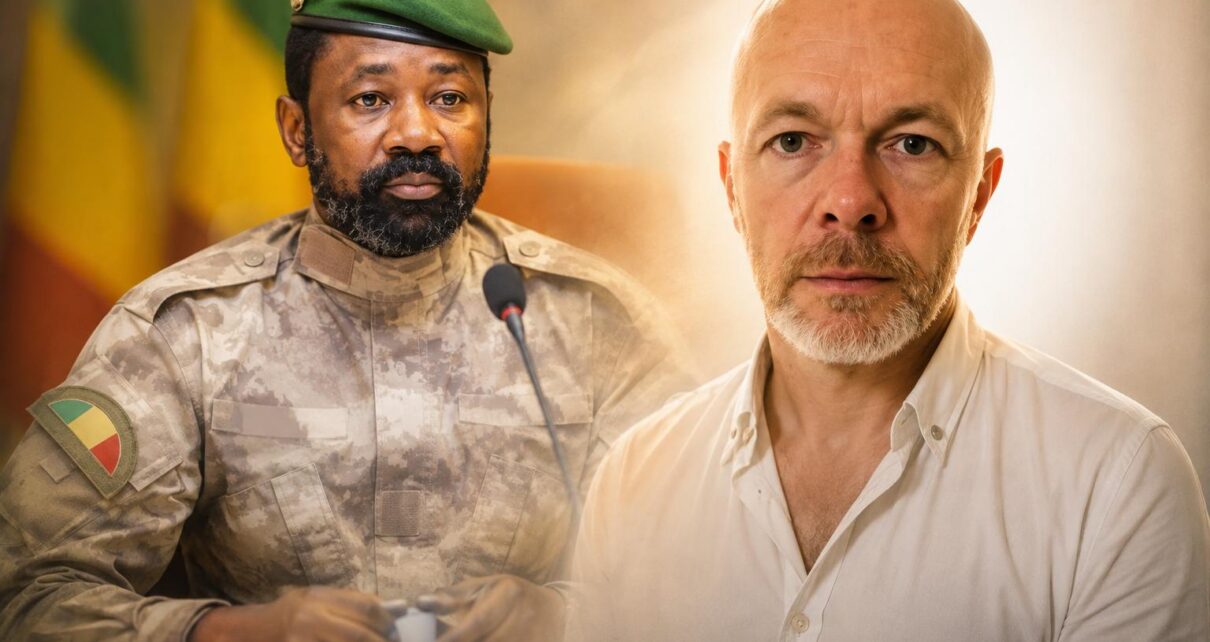
When the announcement came, it followed the familiar ceremonial reserved for acts of national sovereignty: President Assimi Goïta granted a presidential pardon to Yann Vézilier, a French intelligence officer detained in Bamako a year earlier. Condemned last June to a harsh 20-year prison sentence for alleged attempted destabilization, the shadow diplomat was set to return to French soil. Yet while Malian officials framed this resolution as an act of magnanimity and state forgiveness, the facts tell a far different story.
Behind the diplomatic curtain: negotiations and financial settlements
The official narrative highlights the regime’s generosity, but the security backstage reveals a far more pragmatic—and embarrassing—reality for Mali’s transitional authorities. Despite claims of firm control over the territory and security situation, Malian forces did not engage in direct combat against insurgent groups like the Cadre Stratégique Permanent (CSP-PDA/FLA) and the Support Group for Islam and Muslims (JNIM). Contrary to public statements, Russian instructors and mercenaries from Africa Corps played no operational role in these recent developments and remained on the sidelines.
To secure the return of Malian soldiers captured in previous clashes, President Goïta and his envoys instead pursued direct, discreet negotiations with the leaders of the FLA and JNIM. Far removed from the rhetoric of military firmness, these exchange agreements involved substantial financial payments to the armed factions. Thus, behind the spectacle of an unyielding justice system and the grand staging of a state pardon, Bamako’s leadership prioritized financial transactions and direct security compromises to address its vulnerabilities.
A trial tailored for domestic consumption
From the moment Yann Vézilier was arrested in August 2025, his fate was never a matter of routine justice. Officially accredited with local authorities, his presence was well-known to Mali’s security apparatus. The abrupt withdrawal of his diplomatic status and his rebranding as a plotter served a clear strategic purpose: to identify an external enemy and rally national unity under a common threat.
The severity of the June sentence—20 years in prison—served a dual objective. First, it offered the Malian public a display of uncompromising justice, daring to challenge the former colonial power. Second, it set an arbitrary benchmark for a highly valuable diplomatic bargaining chip. Observers agree: the speed and conduct of the trial left little doubt about its political nature. The absence of publicly disclosed material evidence and the hasty classification of the case under state security threats fit a well-worn pattern.
A legal expert familiar with the proceedings noted, ‘A judicial conviction to heavy sentences constructs a narrative of aggression. The subsequent pardon then allows the regime to parade as the gracious victor. This is the essence of state hostage diplomacy.’
The guise of presidential clemency
Framing Vézilier’s release as an act of presidential clemency is nothing more than diplomatic window dressing. The liberation of intelligence agents is never an outpouring of constitutional mercy; it is the result of quiet bartering, indirect concessions, and backroom security deals kept far from public scrutiny.
By invoking the pardon, Bamako secures a complete symbolic victory: the regime retains final authority, reasserts the supremacy of its leader, and capitalizes on the political dividend of the initial trial. The Yann Vézilier case will not be remembered as an example of judicial clemency, but as a stark demonstration of how justice can be manipulated—from sentencing to pardon—as a tool of strategic communication.