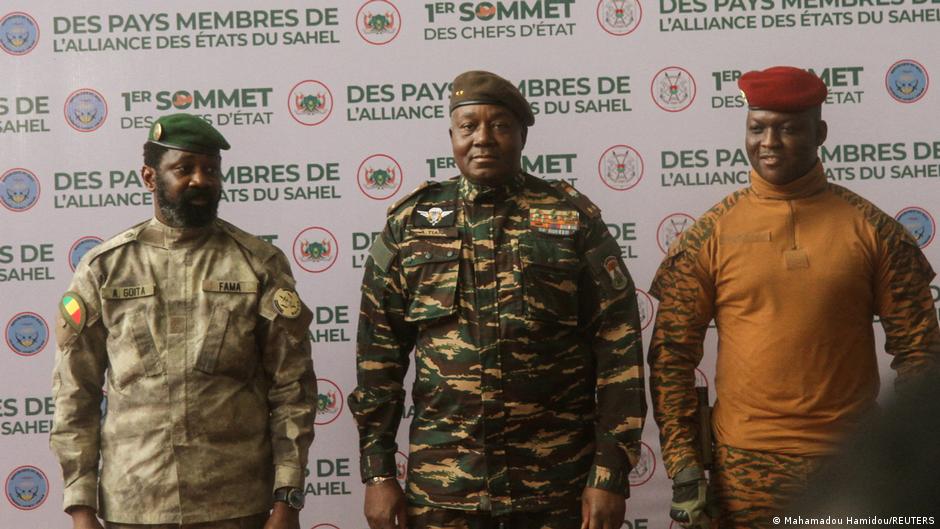
West Africa expert Francis Kpatindé examines the evolving dynamics between European nations, the United States, and Sahelian states as they reassess their strategic approaches.
The European Union and Washington have recently signaled shifts in their engagement with the Sahel, a region grappling with political transitions and security challenges. On February 25, the U.S. State Department finalized a five-year bilateral agreement with Burkina Faso, earmarking $147 million to bolster the country’s fight against HIV/AIDS and other health crises.
Earlier in February, U.S. officials reaffirmed their respect for Niger’s sovereignty during a high-level call with Prime Minister Ali Mahamane Zeine, underscoring a cautious yet deliberate re-engagement. Meanwhile, EU Special Representative for the Sahel João Cravinho visited Bamako, despite ongoing tensions between Malian authorities and Brussels. Could these diplomatic overtures mark the beginning of a thaw in relations with the region’s military-led governments?
a measured shift in western policy
Francis Kpatindé: Caution is essential—this region has repeatedly defied expectations. While not a full thaw, there may be subtle signs of détente. The relationship between Western powers, particularly in Europe, and Sahelian states remains constrained, but not entirely frozen.
Washington’s pragmatic outreach
The U.S. is adopting a selective engagement strategy, focusing on high-impact areas like health security. The Burkina Faso accord reflects a targeted approach, while conversations with Niger suggest a willingness to acknowledge local priorities without imposing conditions. These moves highlight a recognition that disengagement could backfire, leaving Western interests vulnerable to instability or rival influence.
Beyond humanitarian aid, economic and mineral interests are undeniable. Niger’s uranium reserves, Burkina Faso’s gold deposits, and Mali’s vast gold wealth are drawing renewed attention from Western capitals seeking to diversify supply chains.
EU’s pivot to bilateral diplomacy
The European Union appears to be abandoning its broad regional framework in favor of country-specific partnerships. Germany, for instance, maintains strong ties across the Sahel, serving as a bridge for dialogue even where France’s influence has waned. This fragmentation of approaches—driven by diverging national interests—creates opportunities for alternative engagement channels.
For France, traditionally the Sahel’s dominant external actor, these shifts present both challenges and opportunities. By leveraging partnerships with non-traditional EU members, Paris may retain critical influence despite strained bilateral relations with Bamako, Niamey, and Ouagadougou.
what’s driving these changes?
Three key factors are shaping this recalibration:
- security imperatives: Western powers recognize that instability in the Sahel poses direct threats to their own security, from terrorism to migration flows.
- economic pragmatism: Access to strategic minerals and new trade opportunities are driving selective cooperation.
- geopolitical competition: The rise of alternative alliances (e.g., with Russia or China) has forced Western capitals to reconsider their leverage.
While no dramatic rapprochement is imminent, the Sahel remains a region where incremental shifts could redefine long-term partnerships—or deepen divisions.