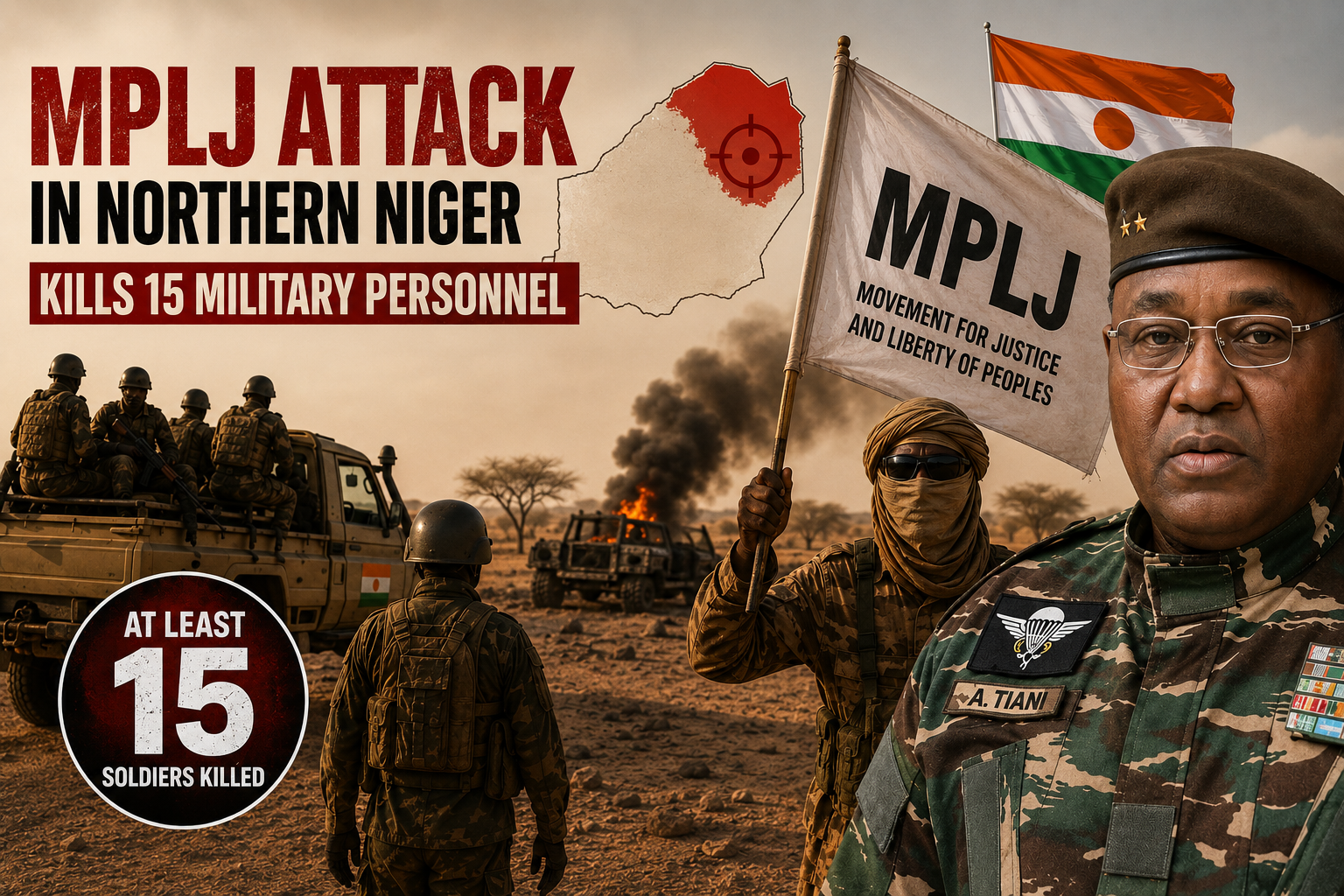
Military fatalities underscore crisis in Niger’s northern territories
Escalating insecurity in Niger continues to expose the fragility of the military junta’s sovereignty claims. The latest dual assault, claimed by the Mouvement pour la Justice et la Liberté des Peuples (MPLJ), left at least 15 soldiers dead in the northern region, underscoring a harsh truth: the administration led by General Abdourahamane Tiani is struggling to fulfill its most fundamental duty—protecting citizens and asserting territorial control.
The attack transcends its immediate human cost, raising critical questions about the operational capacity of Niger’s armed forces. With vast desert expanses and porous borders, the country faces immense challenges in monitoring its territory. Shared frontiers with neighboring states—each grappling with armed threats—create vulnerabilities, allowing militant groups to exploit ungoverned spaces for regrouping and strikes before vanishing.
This incident is not an isolated incident; it lays bare deeper flaws in a security strategy overly reliant on reactive military measures. Effective counterinsurgency demands more than troop deployments—it requires real-time intelligence, sustained administrative presence, cross-border cooperation, and proactive measures to dismantle militant networks before they take root.
Diplomatic isolation and shifting blame
With each security setback, pressure mounts on the Tiani administration to justify its approach. After severing ties with France, exiting the Economic Community of West African States (ECOWAS), and publicly criticizing regional neighbors, the regime now faces a credibility gap. Will the government redirect accusations toward Algeria, a key neighbor with historical ties, or will it scrutinize its own strategic realignments? The pattern of assigning blame to external actors is losing its utility.
Since the July 2023 coup, the military leadership has anchored its legitimacy in promises of a clean break from past security policies. Slogans of sovereignty, denunciation of foreign interference, and pursuit of new alliances have dominated official narratives. Yet for the civilians caught in the crossfire, these words ring hollow. The true measure of stability lies not in diplomatic posturing but in the ability to live, work, and move without fear of armed violence.
The paradox of sovereignty in practice
Niamey’s leadership faces a stark contradiction: while projecting confidence on the international stage, it appears disconnected from the realities on the ground. As sovereignist rhetoric resonates in global forums, local populations in border regions and remote desert zones grapple with a widening security vacuum. Armed groups exploit this void, turning ungoverned territories into staging grounds for attacks.
This paradox reveals a fundamental flaw in governance. True sovereignty is not merely about rejecting foreign influence or reshaping alliances—it is about exercising control, securing borders, and protecting citizens. The persistent violence in peripheral regions serves as a litmus test for the junta’s credibility. Each new attack forces the question: do recent diplomatic and military shifts translate into tangible protection for the people?
The limits of shifting alliances
While seeking new partners is not inherently flawed, it must yield results. Improved defense capabilities, intelligence sharing, and anticipatory security measures are what matter—not the mere act of changing allegiances. The public’s patience is wearing thin as political announcements fail to stem rising casualties.
Diplomatic isolation may also hinder counterterrorism efforts. Armed groups do not respect political borders; militants traverse the Sahel with ease, exploiting transnational spaces to regroup and launch attacks. Combating them demands coordinated intelligence exchanges, joint operations, and diplomatic cohesion—elements that strained regional relations can undermine.
It would be simplistic to attribute military failures solely to frontline troops. Their effectiveness hinges on robust intelligence, logistical support, command structure, air and ground capabilities, and a coherent long-term strategy. Recent losses should prompt a comprehensive review of the entire security apparatus—not a futile search for scapegoats.
A call for institutional accountability
In the wake of institutional disruption without a corresponding improvement in security, national actors—military and civil society alike—must confront difficult questions. Restoring constitutional order is not just a democratic imperative; it is a strategic necessity to rebuild legitimacy and forge reliable alliances capable of addressing the terror threat.
Security cannot be sustained on sovereignist slogans alone. It demands strong institutions, a clear national strategy, pragmatic regional cooperation, and an administrative presence even in the most remote areas. The MPLJ attack is more than another tragic episode in the Sahel conflict—it is a reminder that sovereignty begins with protection.