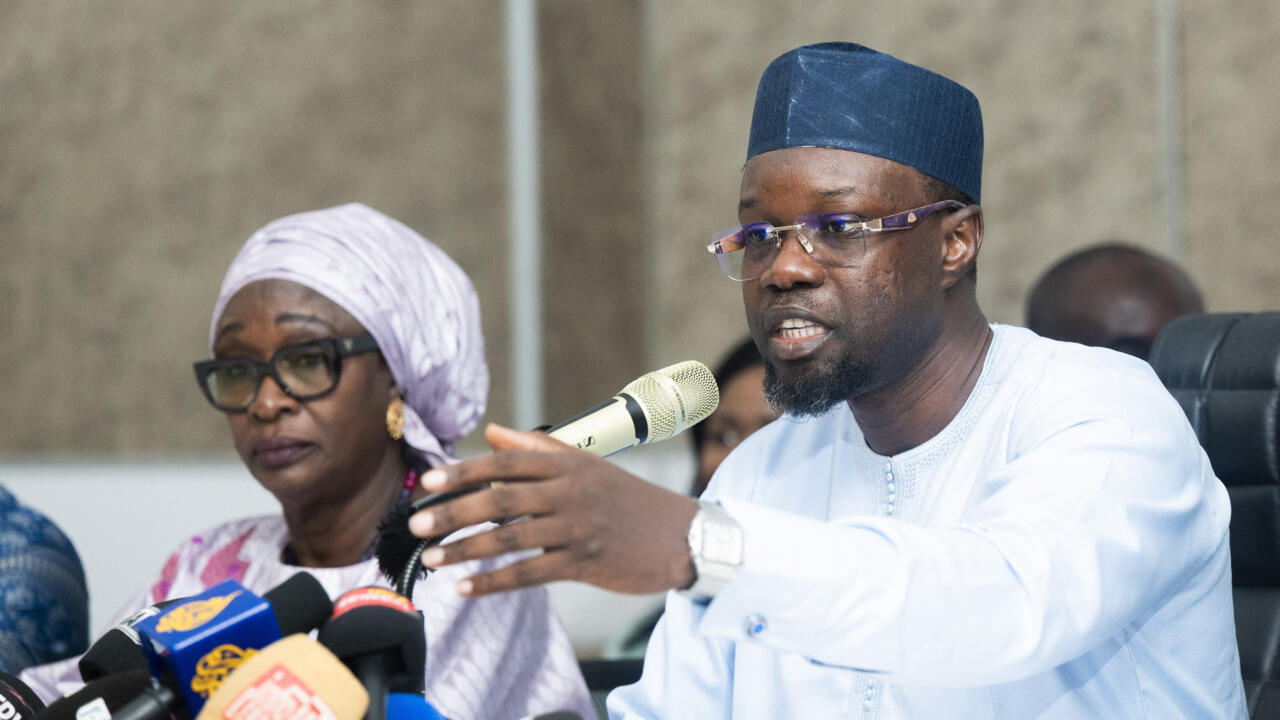
Less than a week after President Bassirou Diomaye Faye removed him from office, outgoing Prime Minister Ousmane Sonko launched a sharp counterattack. Addressing the press in Dakar, he criticized the newly formed cabinet headed by Prime Minister Al Amine Lô, calling its political legitimacy into question. “We have a government with no political foundation,” Sonko declared, dismissing the executive’s claims of a broad coalition as meaningless. For the Pastef leader, the label “technocratic government” is nothing more than a polite way of admitting isolation from the country’s elected majority.
Sonko emphasized that his party, Pastef, remains the nation’s leading political force—legitimately elected by the people—and warned that governing without it amounts to governing without the people’s mandate. He stressed that Pastef’s parliamentary majority gives it the power to challenge the government through a no-confidence motion, though he insisted this destabilization is not his goal. Instead, he framed the current situation as a form of political cohabitation, one he claims he had warned the president about for months, only to be ignored.
Testing the limits of presidential authority
The political landscape in Dakar has shifted dramatically. As Pastef’s 130 deputies—over 75% of the National Assembly—remain outside the government, analysts warn of mounting challenges ahead. Without direct representation in the executive, the president’s ability to push through reforms and legislation will hinge on his ability to secure cooperation from the parliamentary bloc he once led.
“The absence of Pastef in the government creates a fundamental political test for the Diomaye Faye administration,” observers note. “While the president retains full constitutional powers, the success of his agenda now depends on maintaining trust with the very lawmakers who once stood alongside him.” The stakes are high: the new government must navigate a fragile alliance while Pastef, led by Sonko, holds both the parliamentary majority and a mobilized base of supporters.
A fracture within the movement, not a traditional cohabitation
What is unfolding in Senegal is not a classic cohabitation—where the president faces an opposition-controlled parliament—but something far more complex. Analysts describe it as an internal rupture within the same political movement: a president who governs without the party that brought him to power, and a party that refuses to participate in the government it dominates. This unprecedented dynamic raises critical questions about governance, legitimacy, and the future of Senegal’s political stability.
“How can a technocratic government without its own parliamentary base govern when the majority party—whose leader is Sonko—holds absolute control in the Assembly and is simultaneously mobilizing a million-member force nationwide?” the situation’s gravity cannot be overstated. The answer, if it comes, will unfold in the streets, institutions, and corridors of power in the coming weeks and months.”