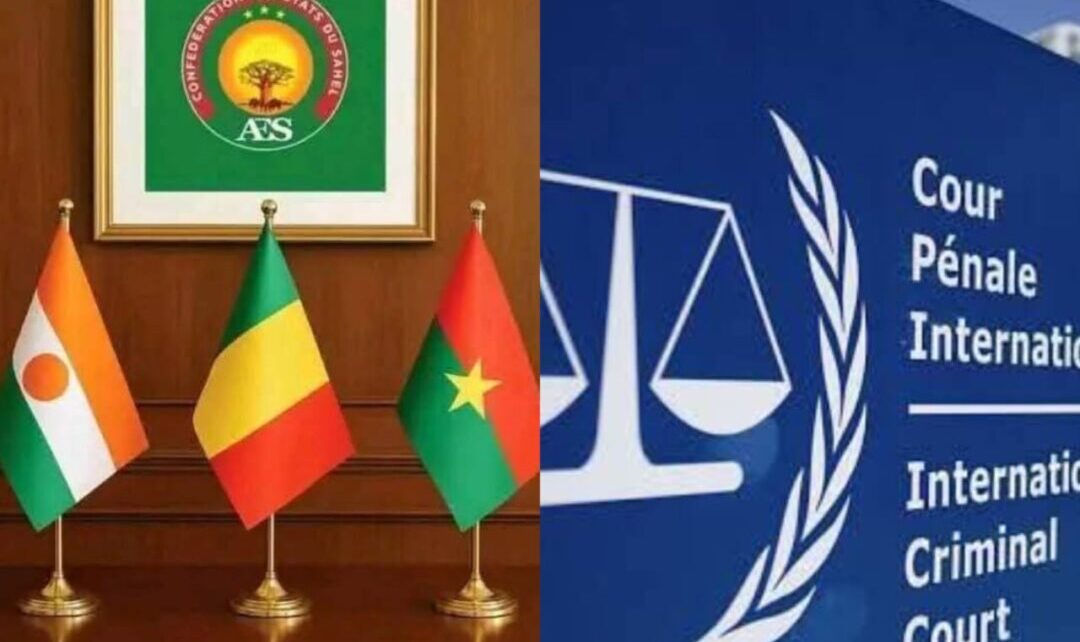
The decision by Burkina Faso, Mali, and Niger to withdraw from the International Criminal Court (ICC) is more than a political rupture—it is a seismic shift in the landscape of global justice. What began as a regional alliance now challenges the very foundations of an international system that has long struggled to reconcile universality with impartiality.
On September 22nd, the Alliance of Sahel States (AES) crossed a threshold that cannot be undone. By formally exiting the ICC, these three nations did not merely realign their foreign policies; they delivered the most decisive blow to international criminal justice since the Rome Statute’s inception in 1998. Critics argue this move paves the way for unchecked impunity among embattled military regimes. Yet, the decision resonates deeply across the Global South, where perceptions of the ICC as a tool of Western dominance have festered for decades. For the citizens of the Sahel, this withdrawal is not an act of defiance but a mirror held up to the ICC’s own failures—its contradictions, its selective enforcement, and its inability to transcend geopolitical divides.
From Bamako to Ouagadougou and Niamey, the exit from the ICC is framed as a necessary assertion of sovereignty. It follows a broader pattern of disengagement: the annulment of military accords with France and the United States, the severance of ties with ECOWAS, and the withdrawal from La Francophonie. Each step has reinforced a doctrine that Sahelian affairs must be resolved by Sahelians, free from external oversight. But beneath this rhetoric of independence lies a calculated strategy to shield military operations from judicial scrutiny.
Facing an asymmetric war of unparalleled brutality against terrorist factions, the governments of the AES have confronted persistent allegations of civilian casualties and human rights abuses. By distancing themselves from the ICC, they erect a legal barrier for their security forces while aligning with non-Western partners—most notably Russia—which have also rejected the court’s authority.
The resonance of this decision among local populations stems from a damning reality: the ICC’s promise of equal justice has been consistently undermined by glaring imbalances. Consider the 2003 invasion of Iraq, launched under false pretenses and outside the bounds of international law. Despite its catastrophic consequences, neither George W. Bush nor Tony Blair have ever faced investigation in The Hague. When the ICC dared to explore allegations of war crimes committed by U.S. forces in Afghanistan, Washington responded with direct financial sanctions against the court’s prosecutors.
This impunity for powerful actors is compounded by a perception of partisan justice. The case of former Ivorian President Laurent Gbagbo exemplifies this injustice. Held in detention for nearly a decade after a post-election crisis, Gbagbo was ultimately acquitted on all charges, with judges condemning the prosecution’s ‘exceptional weakness’ in presenting evidence. The ICC’s reputation as a ‘victor’s justice’ system was further cemented when it pursued one side of the conflict while overlooking abuses committed by allied forces.
The swift issuance of an arrest warrant for Vladimir Putin following the invasion of Ukraine—while Western powers responsible for conflicts like Iraq or Afghanistan have faced no consequences—only deepens the perception of a court that operates on double standards. To many in Africa and beyond, the ICC appears less as a neutral arbiter and more as an instrument of Western geopolitical influence.
Yet, the solution is not to abandon justice altogether. Africa already possesses robust frameworks to uphold fundamental rights, including the African Court on Human and Peoples’ Rights (ACHPR) at the continental level and the ECOWAS Court of Justice at the regional level. The challenge lies in consistency. It is hypocritical for Sahelian states to condemn the ICC for overreach while ignoring rulings from their own regional courts—particularly when those rulings challenge authoritarian excesses or protect civil liberties. Too often, governments celebrate membership in ECOWAS but refuse to implement its judicial decisions when they conflict with their own interests.
If the Sahel’s withdrawal from the ICC is to have meaning beyond political posturing, it must serve as a catalyst for strengthening regional justice systems. States must commit to funding, respecting, and enforcing the rulings of the ECOWAS Court of Justice and the ACHPR. Without this, the withdrawal risks replacing external domination with internal arbitrariness, leaving citizens without recourse. True sovereignty demands accountability—not just from foreign powers, but from domestic leaders as well.
The message from the Sahel is clear: the ICC’s monopoly on global justice is over. The challenge now falls to African nations and their institutions to prove that the alternative is not the law of the strongest, but a justice system that is strong, independent, equitable, and universally respected.