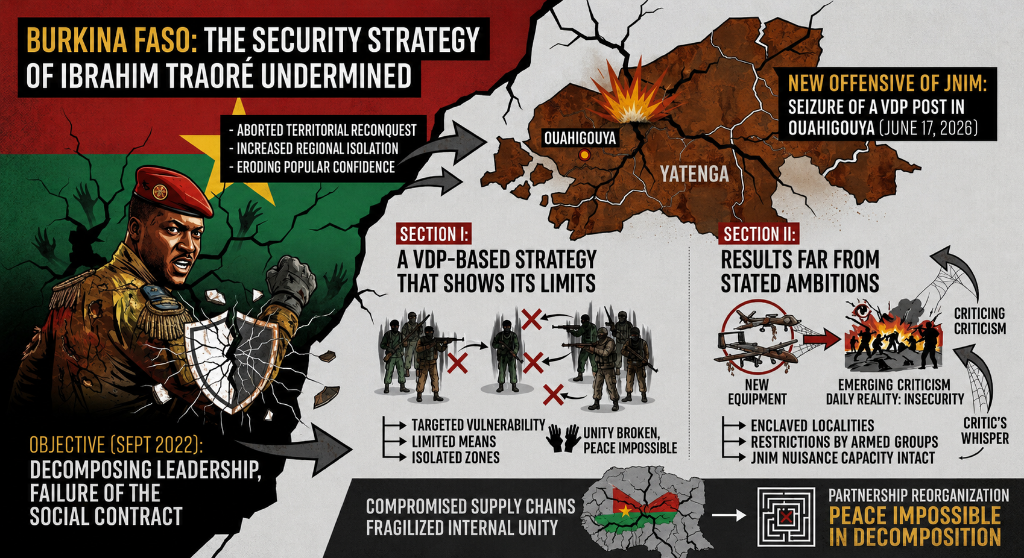
The security landscape in Burkina Faso continues to deteriorate as militant factions escalate their offensive operations. On June 17, 2026, the Group for the Support of Islam and Muslims (JNIM), affiliated with Al-Qaeda in the Sahel, launched a coordinated assault on a Volunteer Forces for the Defense of the Homeland (VDP) outpost in Ouahigouya, the administrative center of the Yatenga Province in northern Burkina Faso.
The JNIM offensive exposes vulnerabilities in the national security framework
The attack serves as a significant setback for the transitional government’s territorial restoration strategy, spearheaded by Captain Ibrahim Traoré since his rise to power in September 2022. Traoré’s administration had pledged to reclaim and secure the nation’s borders, but the latest assault has cast doubt on the viability of this approach.
Civil defense units bear the brunt of asymmetric warfare
The VDP, deployed extensively to address critical shortfalls in the regular army’s manpower, has become a primary target for armed groups. Often stationed in remote and under-equipped locations, these civilian-led units lack the training and resources necessary to withstand sustained militant attacks. The assault on Ouahigouya underscores the persistent challenges faced by Burkina Faso’s security apparatus.
Despite repeated military operations, several strategic positions remain precariously held, if at all. Observers note that the JNIM retains substantial operational flexibility and disruptive capacity in northern and eastern regions, complicating efforts to restore stability.
Public skepticism grows amid unmet security promises
While government officials emphasize advancements such as the acquisition of surveillance and combat drones, citizens in affected regions continue to endure daily threats. Numerous communities remain cut off from essential services, with some areas subjected to de facto control by militant factions imposing movement restrictions.
Public discontent is intensifying, with critics questioning the effectiveness of the current security policy. The inability to guarantee civilian safety, a key justification for the 2022 overthrow of the civilian government, has resurfaced as a central grievance in national discourse.
Regional alliances and future military strategies in question
As Burkina Faso strengthens its collaboration within the Alliance of Sahel States (AES) and prepares to escalate operations in 2026, the Ouahigouya attack highlights the inherent difficulties of countering asymmetric warfare through military means alone. The incident serves as a stark reminder of the complex, protracted nature of the conflict gripping the Sahel.