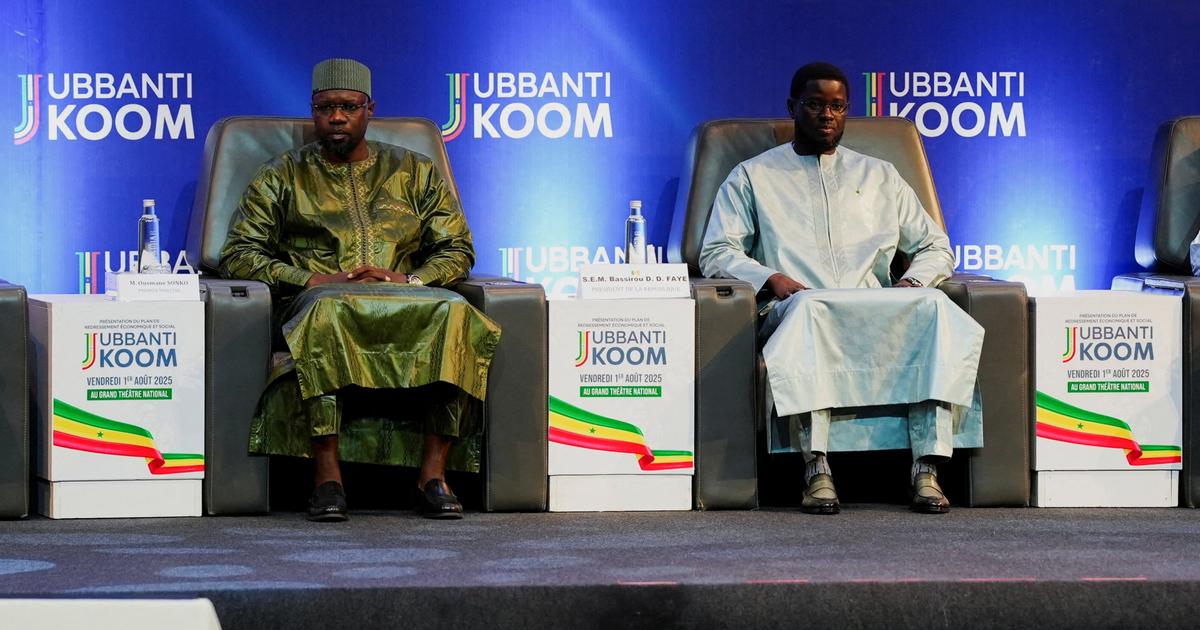
The dismissal of Ousmane Sonko by Bassirou Diomaye Faye on May 23, 2026, signals more than a clash of egos—it marks the irreconcilable divide between two opposing economic philosophies. Two years after the 2024 political transition that brought Faye to power and Sonko to the premiership, the partnership collapsed over three critical economic pillars: debt management, hydrocarbon contracts, and the source of political capital.
Debt management: the first battleground
Sonko’s public revelation in September 2024 of undisclosed debt under Macky Sall’s administration set off alarms. By March 2025, an IMF mission estimated hidden commitments at €7 billion, pushing the debt-to-GDP ratio beyond 100%. Annual debt servicing consumes 5,500 billion CFA francs (€8.4 billion), while refinancing needs reach 6,000 billion (€9.1 billion). The country’s credit rating plummeted three times in twelve months.
Under this pressure, diametrically opposed strategies emerged. Sonko refused any restructuring, framing debt denial as a moral crusade against the previous regime. His rhetoric resonated with the diaspora and militant base but isolated him from global lenders. Faye, however, pursued a pragmatic path—engaging with the IMF, hosting delegations in November 2025, and launching a national dialogue in May 2026. With a suspended €1.55 billion program, frozen international markets, and a looming 2028 sovereign default, Sonko’s stance became economically unsustainable despite its political utility.
Hydrocarbon contracts: rhetoric vs reality
The Sangomar oil field, operational since June 2024 under Australian firm Woodside (82% stake), and the Tortue-Ahmeyim gas project (operated by BP at the Senegal-Mauritania border, with 500 billion cubic meters of reserves) became ideological trenches. Sonko publicly labeled contracts with BP as “unfair and imbalanced,” issuing ultimatums while demanding €2.5 billion in projected savings and additional tax revenues from GTA between 2025–2040.
Faye, in contrast, framed negotiations as “highly satisfactory,” emphasizing incremental progress. The majors remained unmoved—Sonko’s confrontational approach yielded no concessions, while Faye’s measured diplomacy ensured continued investment. This divergence wasn’t tactical but doctrinal: Sonko championed absolute economic sovereignty, believing rhetorical rupture alone would force concessions, while Faye prioritized fiscal discipline and investor confidence to unlock hydrocarbon revenues—the state’s only tangible economic lever.
Political financing: mass mobilization vs institutional stability
Sonko’s political machine, the Pastef party, thrived on micro-donations from the diaspora and digital-native entrepreneurs. This grassroots funding secured 130 of 165 parliamentary seats, with many deputies loyal to Sonko personally rather than the presidency. Faye, however, pivoted toward technocratic elites and former officials, prioritizing institutional stability over militant rupture. His coalition, “Diomaye président,” reactivated in March 2026, reflected a shift toward economic realism.
The May 23 dismissal cemented this transition. With debt exceeding GDP and annual refinancing needs at €9 billion, market confidence hinged on coherent messaging. Senegalese euro- and dollar-denominated bonds collapsed at the first signs of discord, exposing the cost of fractured economic signaling.
Two visions, one dilemma
Sonko’s line exposed hidden debt, forcing transparency unmatched since independence. Without his revelations, the country would have continued borrowing against falsified figures. Faye’s approach, however, sought to restore credibility through IMF negotiations and fiscal discipline—accepting the social cost of recovery. Neither strategy was complete without the other, but the Senegalese political system, built on a monolithic presidency, lacked the institutional architecture to harmonize them.
Market forces prevail
The multinational corporations that weathered two years of Sonko’s rhetorical battles were vindicated. Their patience reflected a wager on institutional resilience over short-term disruption. May 23, 2026, was not their orchestration but a testament to the primacy of economic realities over political posturing. This is the real state—where market forces dictate outcomes, not proclamations.
Looking ahead to 2029, Sonko regains freedom as a mobile political operator, poised to mobilize the diaspora and transform the Pastef into a formidable opposition force. Faye, unshackled from internal dissent, can now finalize IMF agreements, refinance debt, and present a stability narrative. Senegalese voters will face a stark choice: affirmed sovereignty or managed sovereignty. Neither option is flawless, and both carry hidden costs.