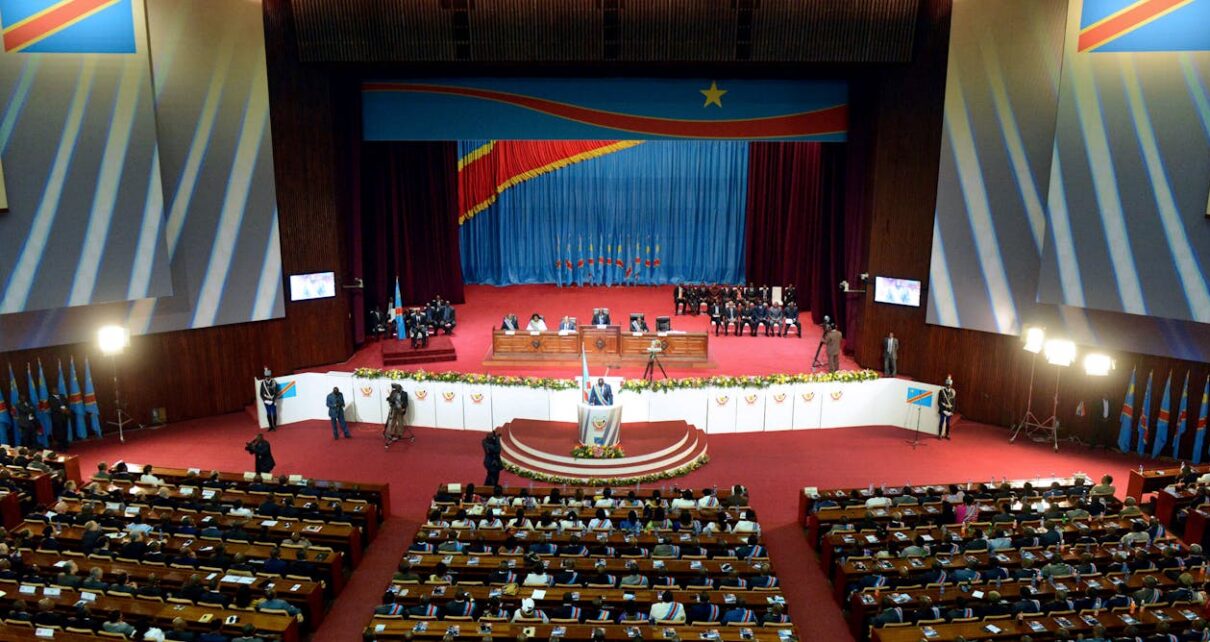
In a moment that has ignited widespread debate across the Democratic Republic of Congo, a disturbing incident unfolded on the floor of the National Assembly on May 15, 2026. The video, which quickly went viral, captured a troubling breach of professionalism during a legislative session. Micheline Mpundu, a sitting member of parliament, had just concluded her formal address when Christophe Mboso, the Second Vice President and presiding officer that day, publicly commented on her appearance from the speaker’s podium. His remarks, delivered in Lingala, included lines such as “She’s very beautiful… you see?” and “Look at her—God made her this way.” He went on to mimic her body shape with hand gestures, further intensifying the humiliation under the watchful eyes—and laughter—of fellow legislators. The session continued without interruption.
Days later, amid growing public outrage from civil society, human rights advocates, and internal parliamentary pressure, Mboso issued a belated apology. Crucially, he faced no formal disciplinary action. This incident is not an isolated incident but a symptom of a deeper, systemic issue: the National Assembly remains a hostile environment for women representatives despite constitutional guarantees of gender equality.
My doctoral research in political science examines how masculinity operates within legislative bodies in the DRC. This video is not just an aberration—it exposes a structural failure. It reveals a glaring gap between the DRC’s formal commitments to gender parity and the lived reality of women in politics. Legislative bodies are not merely places where laws are debated; they are microcosms of societal norms. When women elected to represent the people are reduced to objects of ridicule, the very foundation of democratic representation is undermined.
a continental pattern of parliamentary sexism
Verbal and symbolic violence against women in politics is not confined to the DRC. Across Africa, legislative chambers have become stages where sexist behavior is not only tolerated but often applauded. The video involving Mboso resonated deeply with many, not only because of its explicit nature but because it echoed similar episodes documented across the continent.
The early 1990s wave of democratization across Africa brought a surge in women’s political participation. Between 1990 and 2010, the number of women legislators tripled in many countries. Yet this progress has not translated into cultural transformation within parliaments. Instead, women elected officials often face resistance from male colleagues—whether from opposing parties or their own ranks—who view politics as a male domain. These attitudes persist despite constitutional reforms and international commitments to gender equality.
Global data from the Inter-Parliamentary Union (IPU), based on surveys of women parliamentarians from 39 countries across five continents, reveals a disturbing trend: over 65.5% reported repeated verbal abuse and insults during their terms. These figures are not just statistics—they reflect a persistent culture of intimidation. What is particularly telling is how women legislators are judged not by their legislative contributions, but by their appearance, marital status, or conformity to traditional gender roles. Their competence is often overshadowed by scrutiny of their bodies and personal lives.
A 2021 joint study by the IPU and the African Parliamentary Union confirmed that this problem persists across African legislatures, with minimal progress toward meaningful political participation for women. The applause heard in the DRC video is not incidental—it signals systemic acceptance of sexist behavior. As philosopher Kate Manne argues, such actions are part of a broader mechanism of patriarchal control that relegates women to subordinate positions, even in institutions that claim to be democratic. This is what Mona Lena Krook terms semiotic violence—a form of symbolic domination that reinforces women’s status as bodies rather than legislators.
The concept of coloniality of gender, as theorized by feminist scholar María Lugones, helps explain why this hierarchy feels natural despite legal equality. Women in the DRC are elected under the same constitution and by the same voters as their male counterparts. Yet, once inside the chamber, they are subjected to patriarchal control that strips them of their authority. They hold equal rights on paper but unequal dignity in practice.
glimpses of sexism across african legislatures
The DRC is not alone in witnessing such incidents. In Senegal, the late Deputy Amy Ndiaye, who was visibly pregnant, was physically assaulted in 2022 during a parliamentary session—kicked in the stomach while cameras rolled. In Nigeria, Senator Natasha Akpoti-Uduagha was suspended in 2025 not for misconduct, but for publicly naming sexual harassment she faced from the Senate President. These cases, spanning three countries, reveal a disturbing trend: African parliaments may allow women to speak, but they do not respect their dignity or autonomy.
sexism in the congolese parliament: documented patterns
This is not the first time sexist behavior has surfaced in the DRC’s legislative chambers. On April 30, 2020, former Senate President Alexis Thambwe Mwamba publicly shamed Senator Bijoux Ngoya during a plenary session, alleging—without evidence—that she had made inappropriate advances in exchange for support in her bid for a leadership position. The session ended in chaos, with many legislators expressing outrage. No consequences followed for the senator’s accuser.
On July 15, 2021, during a constitutional debate, Deputy Christelle Vuanga was interrupted by colleague Nsingi Pululu, who simply stated in Lingala: “You are a woman.” The message was clear: her gender disqualified her from participating meaningfully in the discussion.
The Mboso incident, while shocking, is not surprising. The DRC has ratified international conventions, adopted progressive laws, and made public commitments to gender equality. Yet within the halls of power, the culture remains unchanged. The disconnect between policy and practice has been documented for years. What is new is the refusal to acknowledge it.
the cost of silence and the path forward
Decades after Simone de Beauvoir wrote that women are defined as the Other, this marginalization persists. In the Congolese Parliament, women legislators—who make up only 13% of the 477-seat National Assembly in a country where they constitute 51% of the population—are still reduced to their bodies rather than recognized for their political contributions. The absence of sanctions sends a clear message: sexist behavior will go unchecked.
Other legislatures have begun to act. Campaigns such as #NotTheCost and #NotInMyParliament have proven that cultural change is possible through accountability and victim protection. The DRC has strong laws, including a 2025 Senate bill addressing violence against women. But laws without enforcement are hollow. Silence is no longer an option. Failing to sanction Mboso reinforces the message to aspiring female politicians: the system is not ready to protect them.
Parliaments are meant to reflect the societies they govern. When women are silenced, ridiculed, or reduced to objects, democracy itself is weakened from within. The time for accountability is now.