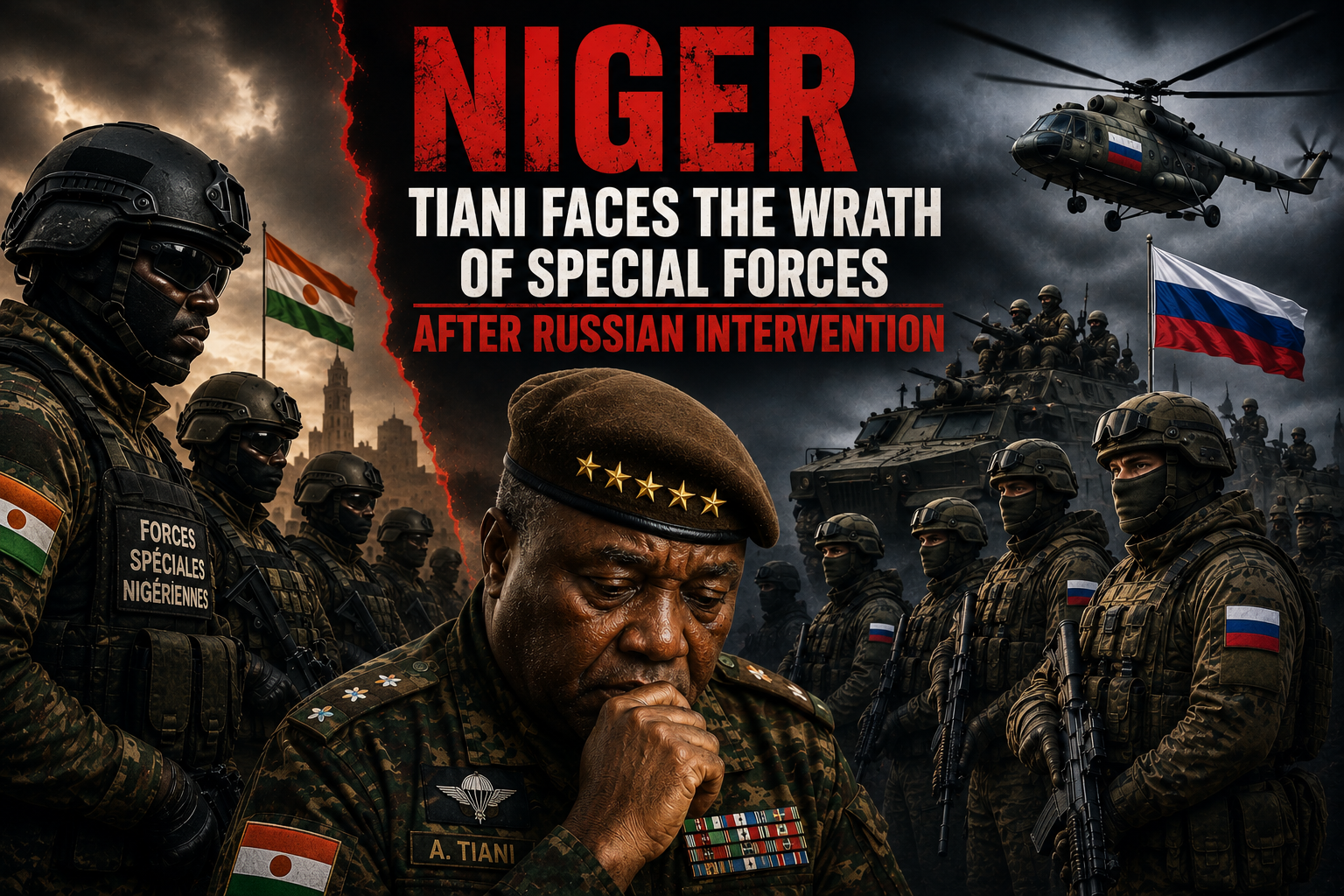
In Niamey, the apparent calm following the events of 29 August may be hiding the real story. Behind the official statements of control and the assurances from those in power, a question is becoming increasingly difficult to avoid: is Niger’s military chain of command as united as it would like to appear?
Appearances can be deceptive.
In Niamey, traffic has resumed, authorities are communicating, and the government gives the impression of having closed the chapter on 29 August. But in military regimes, the return to calm on the streets does not necessarily mean a return to normalcy in the barracks.
That is precisely where the main blind spot of the Nigerien crisis lies today.
According to information reported notably by Burkinabè activist Henry Segbo, relations between General Abdourahamane Tiani and General Moussa Barmou, a central figure in Niger’s special forces, have significantly deteriorated.
This information still needs to be cross-checked and independently documented. But it raises enough questions to warrant a thorough investigation.
Because if part of the special forces did indeed refuse to be engaged against dissenting soldiers, the matter would go far beyond a simple mutiny.
It would strike at the very heart of power: the loyalty of the military apparatus to the man who leads it.
The 29 August: what is known, and especially what is not
The first problem is transparency.
What exactly happened on 29 August?
Which units were mobilized? Which ones refused to intervene? What orders were transmitted? To whom? At what time? Through which chain of command?
And above all: who made the operational decisions during the most critical hours?
For now, the official narrative does not provide precise answers to all these questions.
Yet, in a military crisis, silences can sometimes be as instructive as declarations.
The absence of a detailed timeline leaves several hypotheses open: a crisis limited to a few units, a broader movement but quickly contained, a disagreement between military leaders, or a deeper confrontation over the conduct of power.
It is now up to the Nigerien authorities to clarify these grey areas.
Because the longer the government delays in documenting events, the more fertile ground there is for alternative narratives.
Barmou, a name that carries weight
In this equation, General Moussa Barmou holds a special position.
As head of the special forces, he belongs to that category of military leaders whose influence is not measured solely by their official title.
In an army facing a prolonged war against armed groups, elite units are a major strategic asset.
Therefore, a potential divergence between Barmou and Tiani could not be reduced to a personal quarrel.
The real question would be institutional:
Can the junta leader still count unreservedly on all the elite units under his authority?
And if some of them refuse to participate in operations against other soldiers, at what point does a disagreement become a rupture in the chain of command?
It is this boundary that now needs to be established.
Military discontent predates 29 August
Reducing the crisis to a confrontation between a few officers would be too simplistic.
For several years, Nigerien forces have been engaged on multiple fronts against armed groups. They bear the burden of an asymmetric war, with its losses, logistical constraints, supply difficulties, and the constant pressure on deployed units.
Behind the official rhetoric about the strengthening of defence forces, another reality deserves documentation: the daily life of soldiers.
What equipment is actually available on the ground?
Which units have the means announced by the government?
Are the promised bonuses and benefits actually paid?
Are rotations respected?
Do the families of soldiers killed or wounded actually receive the support announced?
These are less spectacular questions than a military communiqué. Yet they are essential for understanding the strength of an army.
An army can accept difficult conditions when it believes its sacrifices serve a common cause. It can become much less tolerant when it feels that risks are borne by soldiers while decisions are made elsewhere.
The Russian dossier: the detail that changes everything
But one element could make the 29 August crisis particularly sensitive: the possible use of Russian combatants.
Again, one must distinguish what is established from what remains to be verified.
The presence of Russian personnel in Niger is not in itself a mystery. The Niamey government has gradually strengthened its security cooperation with Moscow.
The real question lies elsewhere:
Under what circumstances are these personnel mobilized?
Are they intended exclusively to fight armed groups?
Are they tasked with protecting certain strategic installations?
Can they be used to secure the regime’s institutions?
And above all: were they called upon or engaged during the events of 29 August?
If this last hypothesis were confirmed by independent evidence, its political significance would be considerable.
Because the use of foreign forces in a crisis between Nigerien soldiers themselves would completely change the interpretation of the event.
It would mean that the government preferred, or was compelled, to rely on an external force rather than solely on its own military apparatus.
For a junta that came to power in the name of national sovereignty, the symbolism would be particularly embarrassing.
Tiani’s paradox
This is where the regime could find itself facing its own contradiction.
Tiani came to power after a military coup. His political legitimacy therefore rests largely on a conception of power in which the army presents itself as the ultimate arbiter of the nation.
But this logic has a fundamental weakness.
If the army is the source of the regime’s legitimacy, it is also its main vulnerability.
A civilian president can survive dissent within the army thanks to constitutional institutions, political forces, and the administration.
A military junta has far fewer institutional protections.
When soldiers begin to challenge the soldier who leads the state, the question is no longer merely political.
It becomes existential.
After the crisis: actions will speak louder than words
To understand what really happened on 29 August, one must watch what the government does in the coming days and weeks.
The appointments.
The transfers.
The changes in command.
Possible arrests.
The sidelining.
The promotions.
Unusual movements of military leaders.
The reinforcement of certain units around institutions.
The possible change in the head of state’s close protection.
It is these signals, more than official statements, that will reveal the depth of the crisis.
In an army, a transfer can be a simple administrative decision.
It can also be a punishment.
A promotion can reward competence.
It can also serve to move a man who has become too influential.
That is why mapping the movements of military leaders after 29 August should be a priority for any serious investigation.
Who controls what in Niamey?
Another question deserves to be asked openly: how many security decision-making centres actually exist around Tiani?
Does the junta leader have a perfectly unified chain of command?
Or are there now several networks of influence within the military apparatus?
Special forces.
Presidential guard.
Gendarmerie.
Army.
Intelligence.
Units benefiting from foreign cooperation.
The answer to this question could help explain why 29 August escalated so significantly and why the government’s reaction generated so much speculation.
Because a regime can officially control all institutions while, in practice, having to contend with multiple internal power dynamics.
A battle for the narrative
In addition to this military crisis, there is another battle: the battle for information.
Since the events, social media has become the theatre of a war of narratives.
Some present 29 August as a simple incident quickly neutralized.
Others see it as the beginning of a deeper challenge.
Between these two narratives, one thing is still missing: public evidence to precisely reconstruct the events.
Geolocated images.
Timeline of troop movements.
Corroborating testimonies.
Authenticated internal documents.
Official communications.
Command decisions.
Elements to identify the units actually engaged.
It is on this ground that the real investigative work must take place.
Not in rumours.
Not in slogans.
Not in anonymous videos.
But in the methodical cross-referencing of information.
The risk of a closed-door crisis
The danger for Tiani may therefore no longer be only that of popular protest.
It is the risk of a gradual erosion of trust within the very system that keeps him in power.
A divided army does not necessarily fracture in a single day.
Cracks often begin with refusals to obey.
Disagreements between officers.
Contested appointments.
Units that view each other with suspicion.
Leaders who no longer speak directly to each other.
Parallel chains of command.
Then comes the moment when everyone starts wondering which side the others are on.
It is precisely this stage that must be monitored in Niger.
Because if reports of tensions between Tiani and certain figures in his security apparatus are confirmed, 29 August could retrospectively appear not as the end of a crisis, but as the first visible symptom of a recomposition of military power.
The question Niamey cannot avoid forever
The regime can continue to assert that the situation is under control.
But controlling a capital is not necessarily controlling an army.
And controlling an army does not necessarily mean gaining the loyalty of all its leaders.
The real question is no longer just whether Tiani survived the 29 August crisis.
It is much deeper:
Does Tiani still have undisputed authority over all the forces that could guarantee his political survival?
If the answer is yes, the authorities should be able to demonstrate it through actions.
If the answer is no, then Niger may have entered a new phase: one where the battle for power is no longer played out only between the junta and its opponents, but within the very apparatus that brought it to power.
In Niamey, the calm may be real.
But it does not necessarily mean the crisis is over.
It may simply mean that the next battle will not take place in the streets. It will be decided in the barracks, in the intelligence offices, and around the tables where military decisions are made.