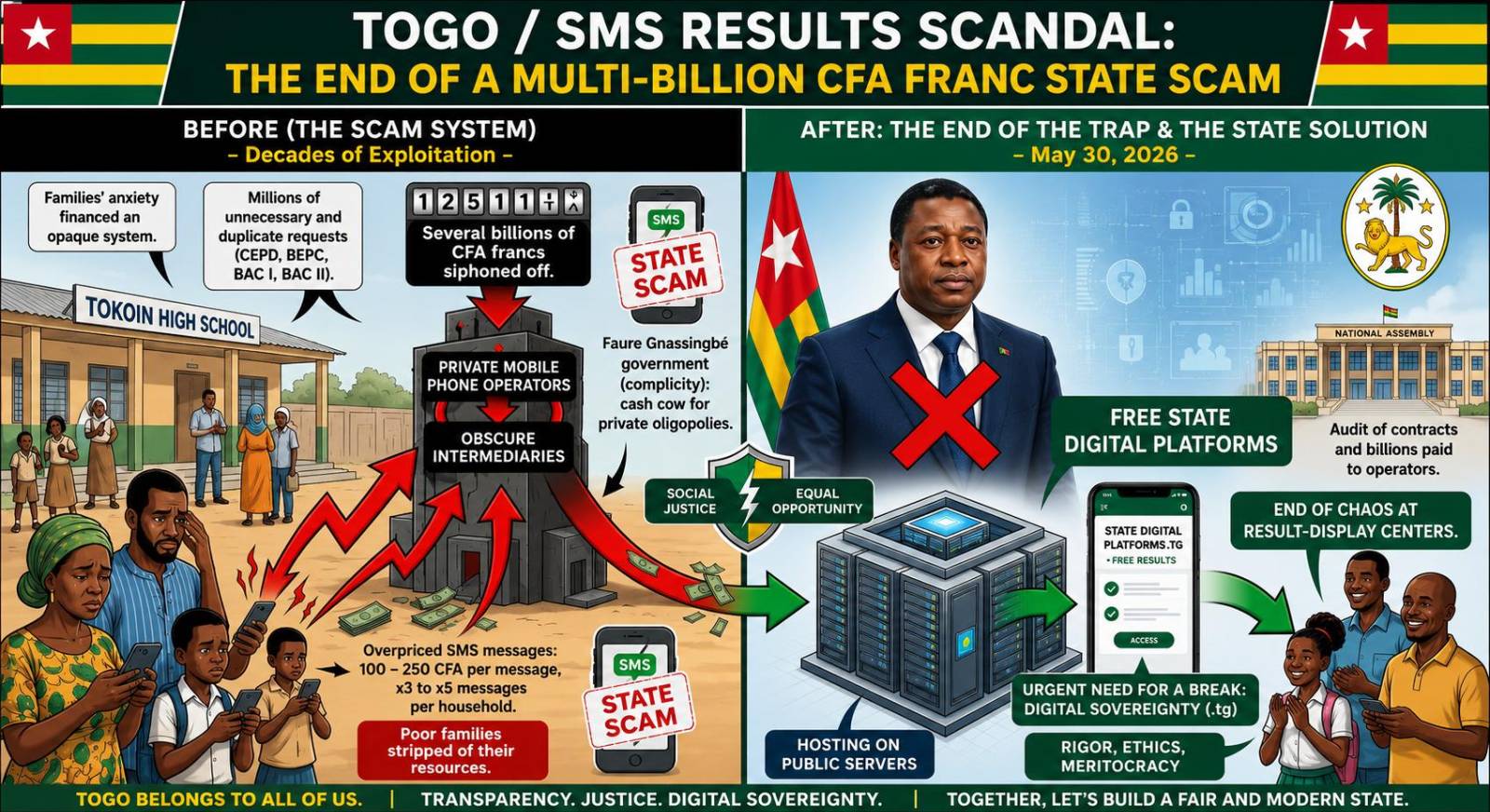
Putting an end to a decades-long financial drain on families
For many years, Togo’s education system operated what amounted to a financial extraction machine, siphoning funds directly from the wallets of low-income households. The abrupt announcement by the new Minister of National Education, Mama Omorou, to discontinue the practice of delivering exam results via SMS has exposed a staggering financial scandal perpetuated under the administration of Faure Gnassingbé.
The mechanics of a deliberate financial trap
On May 30, 2026, during an unannounced inspection of the BAC I correction centers in Tokoin and Agoè-centre high schools, Minister Omorou delivered a scathing assessment. The SMS-based result delivery system, he declared, was nothing short of an exploitative scheme and a monumental waste of public resources.
The process was deceptively simple yet ruthlessly effective. Each time national exams such as the CEPD, BEPC, BAC I, or BAC II were administered, families would fall prey to anxiety-driven redundancy. Parents, guardians, relatives, and even the candidates themselves would send multiple overpriced text messages—each costing between 100 and 250 francs CFA—to retrieve identical results. Millions of redundant queries were generated annually, inflating expenses without adding any real value to the process.
Quantifying the financial hemorrhage
While the minister has not yet released detailed financial audits, a conservative estimate based on demographic trends and usage patterns reveals a staggering scale of financial loss.
By aggregating the number of candidates across all national exams in Togo—amounting to hundreds of thousands each year—and factoring in the multiplication of SMS messages per household (often three to five per family), the total volume of messages per session reached tens of millions. Over the past 15 to 20 years, this practice has resulted in billions of francs CFA being diverted from families to private entities.
The question remains: where did this money go? It certainly did not benefit public education. Instead, the bulk of these funds enriched private mobile operators and shadowy intermediaries who operated under state concessions that were never scrutinized. This amounted to a scandalous transfer of wealth from impoverished families to private oligopolies, with the tacit or active complicity of outgoing authorities.
Building a transparent and equitable digital alternative
Minister Omorou’s decision to abolish the SMS system is a critical step forward, but it must be accompanied by robust digital infrastructure to prevent a return to the chaos of standing in long queues outside exam centers, with all the associated risks of overcrowding and distress.
Togo, which has long championed its digital integration strategy—particularly through the Ministry of Digital Economy—must now prioritize the development of secure, state-run digital platforms for result dissemination.
The following principles must guide this transition:
- Digital sovereignty: Results must be hosted on government-controlled servers under the .tg domain, ensuring national data security and integrity.
- Full transparency: Access to results must be free of charge, financed through the national education budget to ensure equitable access for all candidates, regardless of socioeconomic background.
- Modernization: Leveraging email waves or lightweight web portals optimized for mobile devices is not only feasible but also cost-effective in today’s technological landscape.
Reaffirming ethical standards in education
Beyond the financial scandal, the minister used the inspection tour to reinvigorate the morale of examiners, emphasizing the need to restore rigor, ethics, and meritocracy as the cornerstones of Togo’s education system.
This announcement signals a significant ideological shift. By shielding families from institutionalized fraud, the ministry is laying the groundwork for a school system rooted in social justice. The question now is whether the government will demonstrate the political will to follow through by auditing past contracts with mobile operators and uncovering the full extent of the financial drain that has deprived Togo’s youth of critical resources.