Niger’s temporary shift in trade policy exposes deeper regional fractures
In a region already strained by geopolitical tensions, Niger’s transitional government has taken a bold, if controversial, step to redirect its trade flows—a move that has left economists and regional partners scrambling to interpret its long-term implications.
A fleeting lifeline for Algerian exports
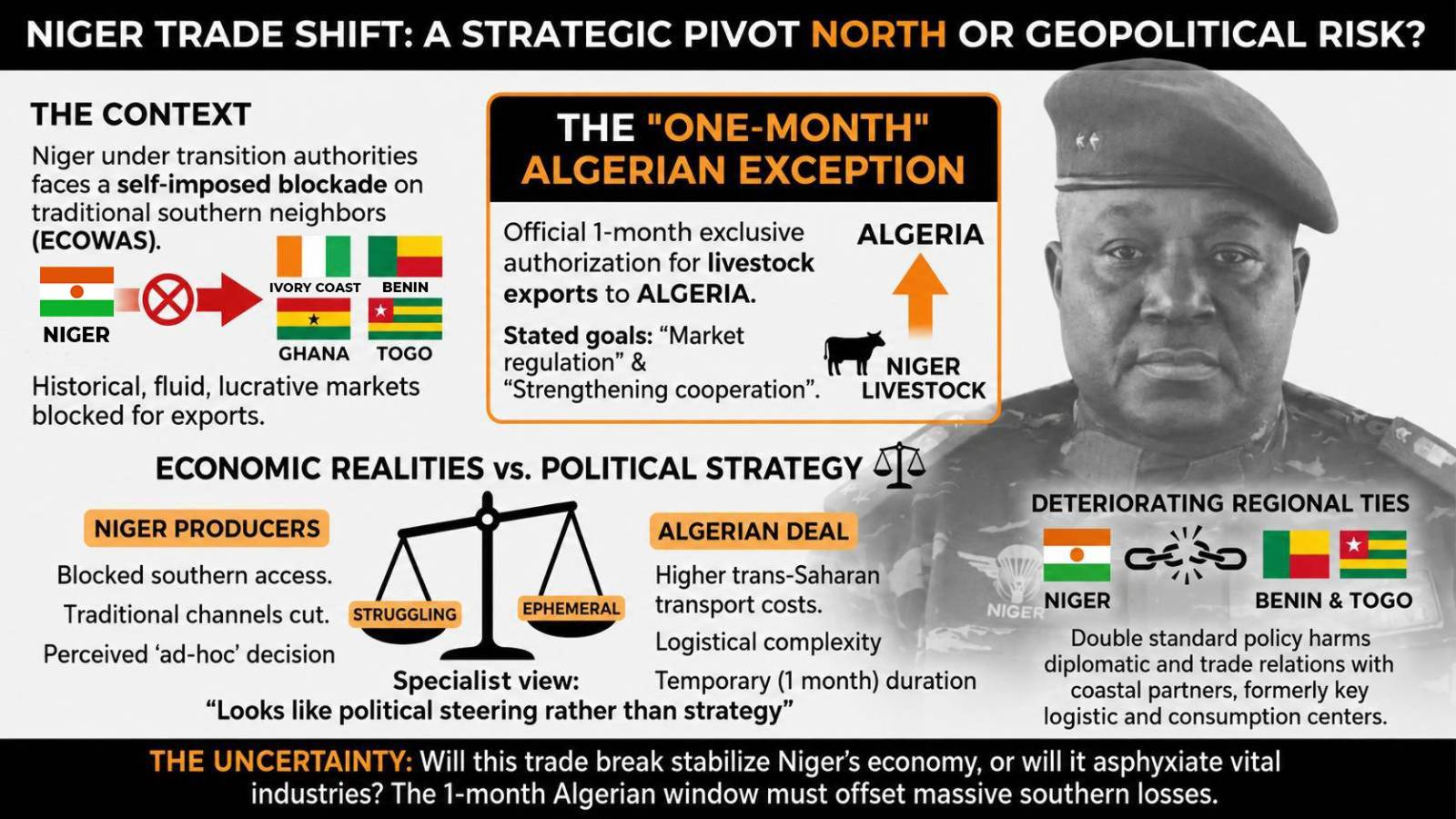
The Nigerien authorities have approved a one-month exception allowing the export of livestock to Algeria, a decision shrouded in official rhetoric about “internal market regulation” and “deepening economic cooperation.” While framed as a strategic pivot toward new partners, the policy’s immediate consequences reveal a far less straightforward reality for local producers.
Algeria, long a secondary market for Nigerien cattle, now stands as the sole beneficiary of this unexpected window of opportunity. Yet, for a nation whose pastoral economy has historically thrived on seamless trade with its southern neighbors, this abrupt redirection feels less like economic strategy and more like a desperate gamble.
Regional partners left in the cold
The decision has sparked widespread unease among traders and analysts, particularly as Niger’s traditional outlets in the Gulf of Guinea—Côte d’Ivoire, Bénin, Ghana, and Togo—remain either fully or partially closed. These countries have long served as the backbone of Niger’s livestock trade, offering not only lucrative markets but also efficient transit routes. By sidelining them in favor of a distant Saharan partner, the government risks undermining the very sectors it claims to protect.
“This isn’t economic policy—it’s political signaling,” remarks a regional trade analyst familiar with Sahelian supply chains. “Prioritizing Algeria over neighbors with whom you share decades of economic interdependence suggests a fundamental shift in priorities, one that could have lasting consequences.”
Diplomatic fallout and economic uncertainty
The policy’s ripple effects extend beyond economics, further straining relations with West African partners. Bénin and Togo, once critical to Niger’s trade networks, now find themselves sidelined in favor of a more logistically complex Saharan route. The decision has done little to reassure regional allies, who view it as a departure from the principles of collective economic integration that have long defined the West African bloc.
For Nigerien herders, already grappling with the fallout of successive crises, the one-month window to Algeria offers scant comfort. Transport costs across the Sahara threaten to erode any potential gains, leaving many to question whether this measure will do more harm than good. With southern markets still off-limits, the gamble feels increasingly precarious.
The true test will come when the month-long exception expires. Will this tactical move stabilize Niger’s economy, or will it further isolate a sector already teetering on the edge of collapse? The answer may well hinge on whether this decision was the product of calculated foresight—or a hasty response to immediate pressures.