West African Economic Integration Faces Uneven Progress Toward Eco
As the Economic Community of West African States (ECOWAS) pursues its goal of launching the Eco by 2027, the region’s economic realities reveal stark disparities in preparedness among member states. In this evolving landscape, Benin has emerged as a standout candidate for early participation in the monetary integration process.
Historical Foundations and Current Challenges
The concept of a single West African currency has long been central to ECOWAS’s economic integration agenda. However, the gap between political ambition and economic reality remains significant. Persistent challenges include inflationary pressures, public debt burdens, foreign reserve inadequacies, exchange rate instability, and divergent national economic policies.
Given these obstacles, a gradual approach to monetary union may prove more feasible than a synchronized transition. This would allow countries meeting convergence criteria to adopt the Eco earlier, while others continue working toward alignment.
Benin’s Macroeconomic Performance Outshines Regional Peers
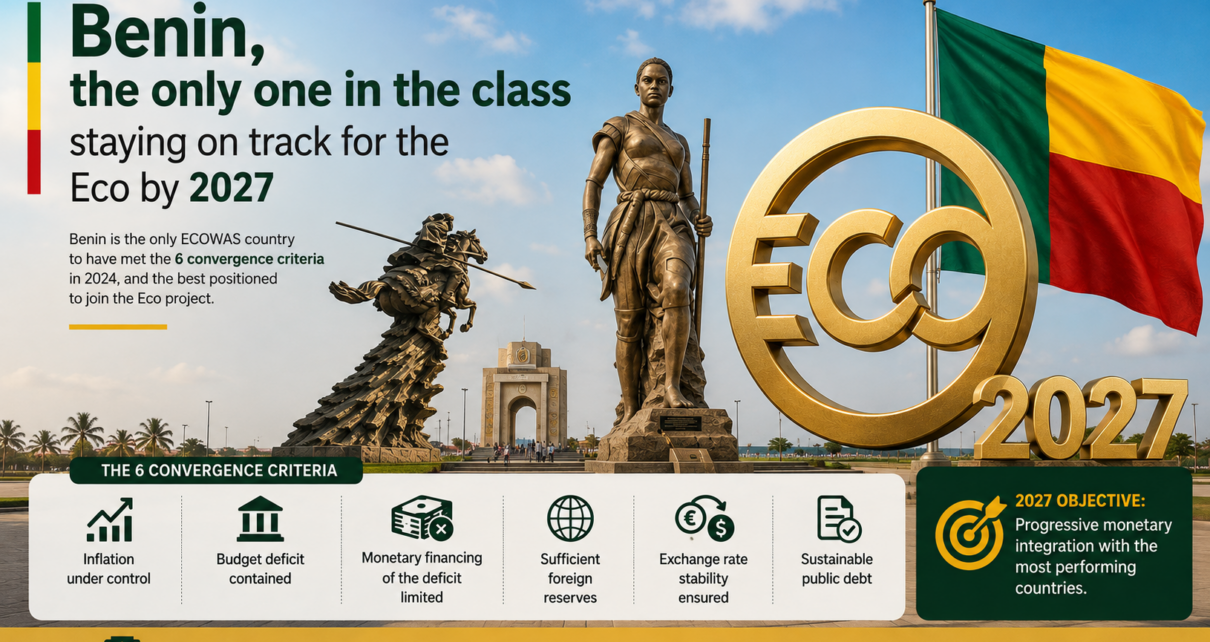
In 2024, Benin distinguished itself as the sole ECOWAS member state to satisfy all six primary convergence criteria outlined for the Eco project. This achievement extends beyond mere statistical compliance—it reflects a sustained commitment to disciplined economic governance.
The convergence criteria serve as technical benchmarks designed to ensure that no single country’s economic imbalances undermine the stability of a shared currency. These indicators encompass:
Inflation control: Maintaining price stability to protect purchasing power and monetary credibility;
Fiscal discipline: Limiting budget deficits to agreed thresholds;
Monetary financing restrictions: Preventing excessive money supply growth to fund public spending;
Foreign reserve adequacy: Ensuring sufficient reserves to cover multiple months of imports;
Exchange rate stability: Preserving nominal exchange rate predictability;
Public debt sustainability: Keeping debt levels within manageable bounds.
A Deliberate Strategy Built on Reform
Benin’s compliance with these criteria is not accidental it results from years of targeted economic restructuring. The country has prioritized revenue mobilization, improved public financial management, and maintained robust infrastructure and public service investments. Yet these advances have required careful balancing, particularly in reconciling fiscal austerity with development financing.
The next critical phase for Cotonou will be sustaining this performance over time. Meeting convergence standards for a single year is a positive signal; doing so consistently over multiple years would significantly bolster Benin’s credibility in the Eco framework.
Progressive Integration as a Strategic Path Forward
The diversity of West African economies complicates uniform progress toward monetary union. Member states vary widely in debt levels, fiscal flexibility, inflation rates, and exposure to external shocks such as security crises, geopolitical tensions, and trade disruptions.
A phased transition whereby ready countries adopt the Eco first could mitigate risks associated with uneven economic conditions. This approach would shift the focus from simultaneous adoption to a tiered system based on preparedness.
Benin’s Strategic Advantage in Regional Monetary Integration
If this gradual model is adopted, Benin stands to benefit significantly. Early compliance with convergence criteria positions Cotonou as a potential frontrunner in the first wave of Eco adopters, enhancing its influence in regional economic discussions.
A shared currency transcends mere currency replacement it demands closer coordination in fiscal, monetary, and trade policies. For Benin, early readiness could translate into strengthened economic attractiveness, improved financial credibility, and deeper regional integration.
Uncertainties Cloud the 2027 Timeline
Despite Benin’s progress, the 2027 launch date remains uncertain. Success depends not only on individual economic performance but also on collective political decisions, institutional governance frameworks, and mechanisms for solidarity among member states.
Recent shifts in regional dynamics including departures by certain Sahelian countries from ECOWAS further complicate the integration landscape. The original vision of monetary union must now adapt to a more fragmented institutional environment.
From First Place to Long-Term Leadership
Benin’s current lead in convergence criteria is a significant but transient advantage. To maintain its position, the country must continue prioritizing macroeconomic stability, debt management, inflation control, and structural reforms all while sustaining investment in essential public infrastructure.
The true test will come as the Eco transitions from a political aspiration to an economic reality. For Benin, the challenge is not merely to excel in the short term but to remain at the forefront of a new monetary era in West Africa.