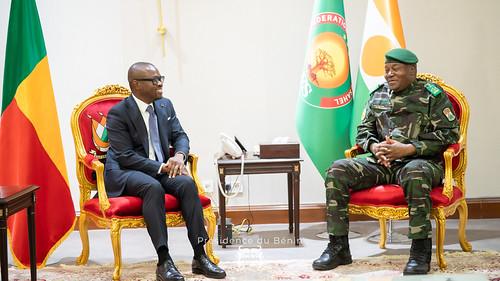
A concrete sign of dialogue resumption
This Friday, June 19, 2026, the runway at Cotonou’s international airport hosted a diplomatic move long awaited by West African diplomatic missions. The arrival of the official Nigerien delegation, greeted with full ceremony by Beninese authorities, marks the concrete start of the second phase of bilateral negotiations. For international analysts, this moment transcends staged handshakes or protocol formalities. It is the clear proof that the dialogue thread, once considered severed, is firmly reconnected between the two neighbouring states.
This revival of official talks did not emerge from nowhere. It follows directly from the path begun in Niamey during the historic one-on-one meeting between Beninese President Romuald Wadagni and Nigerien transition leader General Abdourahamane Tiani. Both leaders then agreed on the urgent need to break the deadlock. Ahead of today’s crucial meeting, technical experts, career diplomats, and senior military officers from both nations worked behind closed doors for two straight weeks. Their task was to smooth over the sharpest edges, list mutual grievances, and prepare the ground for political decision-makers. The ultimate goal of this coordinated effort is now clearly stated: seal a comprehensive and lasting agreement to reopen the common border, closed after the major political upheavals in Niamey.
Beyond symbolism, a genuine determination from both executives to accelerate and reach concrete solutions is palpable. The era of hostile rhetoric and distrustful postures appears to be giving way to a phase of rigorous pragmatism. In Cotonou, the atmosphere of the talks is described by those close to the dossier as both heavy, due to the gravity of the stakes, and deeply constructive, given the weight of expectations from populations and economic operators pressing on the negotiators’ shoulders.
A bilateral economic asphyxiation
For outside analysts trying to gauge the importance of this summit, the urgency of the discussions is first and foremost visible in macroeconomic indicators, which have become dire for both nations over months of closure. The historical interweaving of the Beninese and Nigerien economies means the prolonged blockade has acted like a double noose, choking both sides of the border simultaneously.
Niger bears the full brunt of its geographical situation. As a landlocked country with no direct sea access, it has historically depended vitally on the infrastructure of the Autonomous Port of Cotonou for most of its imports and exports. The prolonged rupture of this traditional logistics axis has plunged Nigerien truckers and Niamey traders into a critical situation. To bypass the Beninese lock, supply chains had to be entirely rerouted to other regional ports, imposing endless journeys over often impassable or highly dangerous tracks. The immediate result of this forced route overhaul was an explosion of transport costs, directly reflected in consumer markets in Niamey through runaway inflation, squeezing purchasing power already weakened by international sanctions.
On the Beninese side, the economic backlash firmly refutes the idea that the country could emerge unscathed from this crisis. The corridor linking Cotonou to Niamey is the true economic and financial lung of Benin, driving a substantial portion of its port platform activity. The sharp slowdown in goods transit has led to a significant drop in state customs revenues, drying up a crucial funding source for national development projects. More seriously, the forced halt of trucks has brought to its knees an entire socio-economic ecosystem that depended directly on cross-border flow. From large logistics companies stripped of contracts to informal sector players like street vendors, roadside food sellers, or bus station loaders, a whole subsistence economy suddenly found itself deprived of income. Far from the coldness of macroeconomic statistics or the serenity of ministerial lounges, reopening this road axis has become, over the months, a matter of daily survival for thousands of families on both sides of the border.
Security and sovereignty at the heart of blockages
While financial imperatives and economic distress push both delegations toward compromise, the true Gordian knot of this bilateral discord remains deeply rooted in issues of national security and state sovereignty. Since the advent of the National Council for the Safeguard of the Homeland in Niamey, Niger’s new military authorities maintain an inflexible doctrine: no economic imperative, however pressing, will come at the expense of territorial security and the stability of transition institutions.
In this context of high alert, the discussions currently under way in the Beninese economic capital focus on technical dossiers of extreme geopolitical sensitivity. Negotiators must necessarily agree on rigorous control of the Niger River, a natural border that has sometimes been the scene of complex infiltrations. Another major sticking point involves setting up joint surveillance protocols along the land border to prevent movements of armed terrorist groups that regularly bring mourning to the Sahel region. Niamey has repeatedly expressed fears that this permeable border could be exploited by hostile elements to destabilise its territory. To reassure the Nigerien side, the Beninese delegation must offer solid guarantees, including a mechanism for real-time sharing of military and security intelligence.
The great challenge for the experts gathered in Cotonou is therefore to invent a new model of border management. The aim is to design a demarcation line that is totally watertight against asymmetric threats and illicit trafficking, while guaranteeing the necessary fluidity for legitimate trade flows. Finding this perfect balance between jealous state sovereignty and the economic pragmatism essential for population survival constitutes the true keystone of these negotiations.
Analysis: Towards a new regional paradigm?
This prolonged face-to-face in Cotonou demonstrates strikingly that realpolitik and geography always end up prevailing over ideological postures and sometimes disconnected regional solidarity impulses. The crisis was born from the stringent sanctions adopted after the regime change in Niamey, but the persistence of the blockade ultimately proved the fundamental interdependence linking these two West African nations.
However, seasoned observers of West African politics agree that a simple return to the previous situation is highly unlikely. Mutual trust having been deeply shaken, the signing of an agreement will not mean a resumption of relations on the same basis as before. If both delegations manage to wrest a solid and lasting compromise, this text will lay the foundations for a profoundly redefined bilateral relationship. This new partnership will undoubtedly be marked by heightened mutual vigilance, stricter controls, and residual mistrust, but it will also be guided by the acute awareness that neither nation can sustainably prosper by turning its back on its neighbour.
Beyond the strict bilateral framework between Benin and Niger, the outcome of these negotiations is closely watched by international partners, financial institutions, and neighbouring countries. The Cotonou-Niamey axis is a central link in regional economic integration. The resolution of this crisis will serve as a barometer to assess the ability of regional states, whether they belong to the Economic Community of West African States or the new Alliance of Sahel States, to overcome their political differences to preserve what is essential: economic stability and social peace in the sub-region. On the ground, populations weary from months of uncertainty now await concrete actions and the effective lifting of barriers to quickly confirm the official smiles captured by photographers.