The Slogan That Echoed Nationwide
In official statements from Captain Ibrahim Traoré and the military-led authorities in Ouagadougou, the phrase “Y’a pas crédit dedans” has become a rallying cry for economic independence. Repeated endlessly across social media and by regime supporters, the slogan aims to project an image of Burkina Faso financing its own development—road repairs, infrastructure projects, equipment upgrades, and state modernization—without relying on foreign debt.
The message is clear: Burkina Faso is moving forward under its own steam, free from the constraints of international creditors. But beneath the polished rhetoric lies a far more nuanced reality.
From Rhetoric to Reality: The Debt Paradox
Economic sovereignty is a legitimate goal for any nation. Few would dispute the merits of reducing external dependence, boosting domestic revenue collection, or strengthening national capacity. Yet when every public investment is framed as self-funded, questions arise—especially when financial documents, funding agreements, and official announcements reveal otherwise.
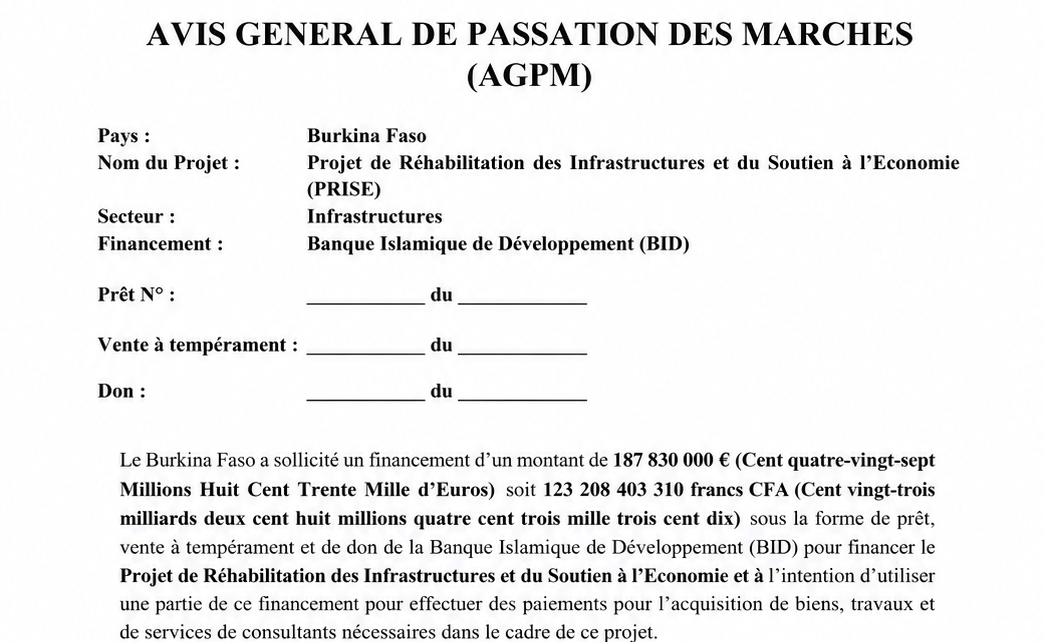
Recent financing deals with the Islamic Development Bank for major road projects underscore a persistent contradiction. These agreements involve concessional loans and multilateral financing—resources that must be repaid under agreed terms, even if interest rates are favorable. Far from being free money, these funds represent future liabilities recorded in the national budget.
The Discrepancy That Fuels Skepticism
Why insist that “there is no credit involved” when multiple projects depend on external financing? Borrowing is not an anomaly—it is a standard tool governments use when public resources fall short. What raises eyebrows is the gap between:
- A narrative portraying near-total financial autonomy;
- Ongoing reliance on international financial partners.
This inconsistency fuels doubts about the transparency of government communication.
The Economic Landscape: No Room for Self-Funding Illusions
Burkina Faso’s economic challenges make the idea of mass self-financing even less plausible. The country faces multiple pressures:
- A deepening security crisis with soaring military expenditures;
- Strained public finances under the weight of urgent needs;
- Critical infrastructure gaps requiring billions in investment;
- Massive internal displacement disrupting economic activity;
- Weakened tax revenues in conflict-affected regions.
In such a climate, financing hundreds of billions of CFA francs in development projects without external support appears unrealistic to many economists.
The Real Issue Isn’t Debt—It’s Transparency
Public borrowing is not inherently problematic. When used wisely, debt can:
- Fund productive infrastructure;
- Improve transportation networks;
- Stimulate economic growth;
- Enhance public services.
The critical concern lies in accountability. Citizens deserve clarity on:
- The exact sources of funding;
- The size of loans contracted;
- The interest rates applied;
- The repayment schedules;
- The guarantees provided;
- The true cost of each project.
A responsible financial governance model prioritizes clear information over slogans.
The Political Function of a Popular Slogan
The phrase “Y’a pas crédit dedans” serves a clear political purpose. It reinforces the image of a government breaking from past practices and presenting every achievement as proof of regained autonomy. It also taps into national pride at a time when sovereignty debates dominate political discourse.
Yet when communication overshadows fiscal education, the risk is fostering unrealistic expectations about the state’s ability to fund development independently. The consequences of such messaging will be borne not only by today’s taxpayers but by future generations.
The Burden of Today’s Decisions
Every loan contracted today will be repaid tomorrow from future tax revenues. While today’s infrastructure may benefit future generations, so too will the debt incurred to build it. This makes transparency in borrowing not just a fiscal issue, but a democratic one.
Citizens must be able to assess whether loans finance productive investments capable of generating sufficient returns to cover repayment. True economic sovereignty is not measured by the absence of debt, but by:
- Sustainable public finance management;
- Efficient investment strategies;
- Transparent reporting;
- Public accountability;
- Responsible borrowing practices;
- A gradual reduction in dependence through a more competitive economy.
A strong nation is not one that denies its financial obligations, but one that acknowledges them openly and uses them to build a sustainable future.
Beyond Slogans: The Need for Fiscal Clarity
The slogan “Y’a pas crédit dedans” has resonated widely. But public finance cannot be managed on catchphrases alone.
The reality is that Burkina Faso, like many developing nations, continues to rely on external financing for key infrastructure projects. The debate should not pit borrowing against sovereignty, but focus instead on:
- The quality of financial governance;
- The transparency of loan agreements;
- The efficiency of public investments.
Ultimately, it is today’s and tomorrow’s taxpayers who will feel the long-term impact of today’s budgetary choices.