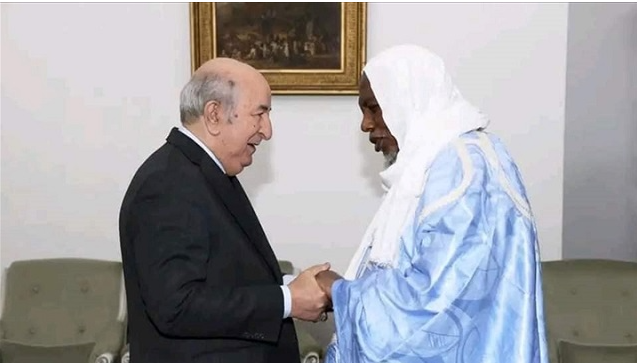
The growing influence of Imam Mahmoud Dicko and Algeria in the Sahel
Mali is grappling with a deepening security crisis, marked by a surge in deadly attacks that have claimed the lives of civilians and military personnel alike. According to reliable security sources, the situation remains perilous, with no signs of immediate resolution.
Northern Mali has emerged as a pivotal battleground, not just for Mali itself but for the broader Sahel region, encompassing Niger, Burkina Faso, Chad, and Mauritania. Western analysts warn that control over this area could redefine the political landscape across these nations.
The influence of Imam Mahmoud Dicko, a prominent religious figure based in Algeria, has expanded far beyond his traditional role as a moral leader. His supporters now portray him as a visionary spiritual guide, wielding authority reminiscent of a centralized religious leadership—often likened to the Iranian model. This perception positions him as more than just a spiritual figure; he is increasingly seen as a quasi-caliphal leader, merging moral and religious influence into a single, powerful force.
Cities like Kidal, Gao, and Timbuktu—key symbols of Malian sovereignty—have become focal points of Dicko’s strategic efforts. These areas, now under his sway, are not merely urban centers; they are gateways to controlling trade routes, forging alliances, and shaping regional power dynamics.
Algeria’s covert military maneuvers in Mali
Recent reports from Tamanrasset suggest that Algeria’s military involvement in Mali is intensifying. Intelligence sources indicate that a battalion from Algeria’s 4th Military Region has been redeployed to the 6th Military Region, with troops divided into smaller units to evade satellite surveillance. These covert operations underscore Algeria’s strategic commitment to bolstering Imam Mahmoud Dicko’s militias and armed jihadist factions in northern Mali.
The Algerian government, led by President Abdelmadjid Tebboune and General Saïd Chengriha, is reportedly leveraging these alliances to extend its influence. By supporting jihadist groups and Dicko’s militias, Algeria aims to secure a foothold in northern Mali before expanding its reach to target the leadership of neighboring Sahel nations. This strategy aligns with broader geopolitical maneuvers, including the U.S. administration’s operations against Iran and Israel’s actions targeting Iranian proxies.
While Imam Mahmoud Dicko remains officially exiled in Algeria—drawing parallels to Iran’s former leader Khomeini in France—unofficial reports paint a different picture. He is increasingly perceived as a pivotal decision-maker, wielding influence where Algeria’s state apparatus, under Tebboune and Chengriha, struggles to assert itself. This alliance serves existential interests for Algeria, reinforcing its role in the region.
France issues urgent travel advisory for Mali
Following a wave of coordinated attacks on April 25 across multiple locations, including Bamako, the security environment in Mali has deteriorated sharply. The French Foreign Ministry has issued a stern warning, urging its nationals in Mali to depart the country immediately via available commercial flights.
In a stark contrast to France’s concerns, Mali’s transitional leader, General Assimi Goïta, has publicly declared the security situation “under control.” His remarks came during a national address on state television, just three days after jihadist forces from the Jama’at Nusrat al-Islam wal-Muslimin (JNIM)—aligned with Tuareg separatists from the Azawad Liberation Front (FLA)—launched unprecedented assaults.
The conflicting narratives highlight the complexity of Mali’s crisis, where geopolitical ambitions, religious influence, and military operations intersect, threatening to destabilize the entire Sahel region.