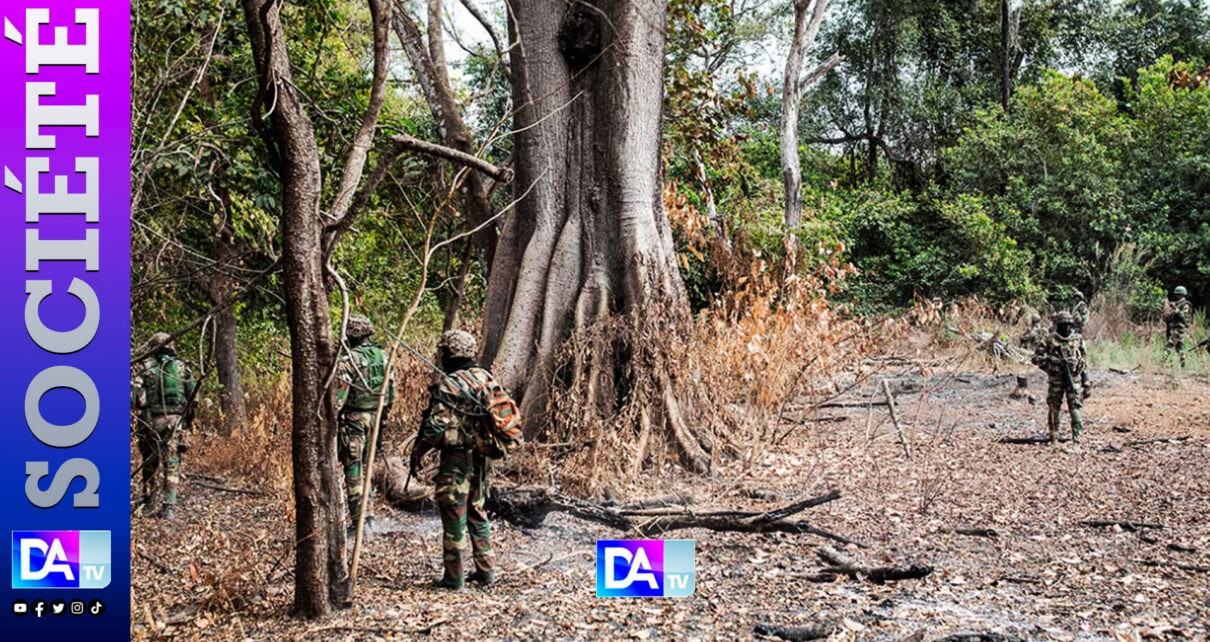
In early May, Senegalese security forces—backed by trained sniffer dogs—conducted a major operation to dismantle cannabis plantations in Casamance. This crackdown marks the latest chapter in a decades-old conflict that has simmered for over four decades in southern Senegal, despite the rebel group’s diminished strength.
The military action unfolded near the Gambian border, where remnants of the Movement of Democratic Forces of Casamance (MFDC)—a separatist faction fighting for Casamance’s independence since December 1982—have maintained hideouts. According to regional military commander Colonel Cheikh Guèye, the operation progressed smoothly, resulting in 14 arrests, the seizure of firearms, and more than six tons of cannabis.
Once a formidable threat, the MFDC now faces severe decline. Analysts note its dwindling combat effectiveness, with aging fighters, no new recruits, and deep internal divisions among political and military factions. Arms and ammunition supplies have dwindled as neighboring Gambia and Guinea-Bissau—historical support bases—cooperate with Dakar to curb rebel activities.
Local civil society leaders highlight another critical factor: the erosion of the MFDC’s local support. Communities that once backed the rebellion now prioritize peace, disillusioned by decades of violence and instability. The rise of political leaders from Casamance, such as Prime Minister Ousmane Sonko, has further reduced the group’s influence by fostering a sense of regional representation in national governance.
Sonko, addressing residents in Ziguinchor—Casamance’s largest city—in March, emphasized the rebels’ inability to control even a single village after 40 years of fighting. His remarks followed a tragic accident during anti-cannabis operations that claimed the lives of three soldiers and injured three others on March 17. Just days earlier, another attack had killed one soldier and wounded six.
Beyond the human cost, the cannabis trade remains the MFDC’s primary funding source. Colonel Guèye stressed that the May raid targeted the heart of the rebels’ illegal economy, stripping them of resources critical to sustaining their operations. The dense forests of northern Sindian—bordering Gambia—provide ideal conditions for illicit cultivation, compounded by poor infrastructure that traps local populations in poverty and pushes some toward the drug trade.
Some residents have even sought religious justifications for cannabis cultivation, querying local imams about its permissibility under Islamic law. Meanwhile, ongoing peace efforts are gradually bearing fruit. A faction of the MFDC signed a peace accord with the government in early May, celebrating its third anniversary near Ziguinchor. Another agreement, finalized in Bissau in February 2025, reflects cautious progress, though not all factions have committed to disarmament.
For many displaced families in Casamance, these developments offer a glimmer of hope. Refugees and internally displaced persons are slowly returning to villages as hostilities subside and weapons are partially surrendered. Yet, challenges persist. Not all armed groups have laid down arms, and the path to lasting peace remains uncertain.
Casamance rebels: from armed struggle to economic crime
The MFDC’s shift from a separatist movement to a criminal enterprise driven by cannabis has reshaped the conflict. Prime Minister Sonko has made it clear: Senegal will not tolerate any erosion of its territorial integrity. « We will deploy all necessary means to dismantle these networks, » he stated, underscoring the government’s unwavering stance.
The human cost and lingering divisions
The decades of conflict have left deep scars. In November 2025, a soldier held captive for seven months by armed factions was finally freed, a rare moment of relief amid the violence. Yet, the North Sindian region remains a hotspot, where poverty, isolation, and illicit economies fuel instability. While some factions engage in dialogue, others cling to arms, prolonging a cycle of tension that has outlasted generations.
The question now is whether recent military successes and fledgling peace accords can break this pattern—or if the cannabis trade will continue to undermine stability in southern Senegal.