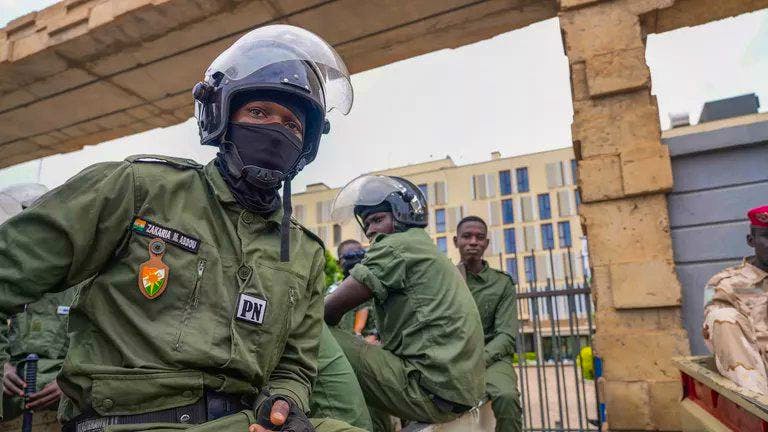
At least eleven soldiers and two civilians lost their lives Thursday morning during a fresh jihadist assault on the international airport in Niamey, the capital of Niger. The attack comes six months after a similar offensive claimed by the Islamic State group.
According to the Ministry of Defence, the assailants—some wearing explosive belts—attempted to breach the airport terminal. However, a swift response from security forces prevented them from reaching the building. A statement read on national television confirmed the provisional toll: 13 martyrs on the friendly side, including 11 defence and security personnel and two civilians, plus four wounded. On the enemy side, 22 attackers were neutralised and about twenty suspects were arrested.
Security situation now under control
The ministry said a large-scale operation by defence and security forces is underway, adding that “the situation is under control” and that the airport remains open to air traffic. However, flight tracking site Flightradar indicated several flights bound for Niamey had been diverted or delayed.
Residents reported that gunfire erupted around 6 a.m. (05:00 GMT) and lasted at least two hours. The shooting occurred at a checkpoint on the only road leading to the airport, just a few hundred metres from the terminal entrance. Witnesses told local media that the attackers arrived in taxis and were met with fierce resistance from security forces. By 10 a.m. calm had returned, and the assailants scattered into nearby neighbourhoods, where security forces conducted extensive sweep operations.
Sensitive site targeted again
This incident follows the January 29 attack that shook Niger, marking the first time jihadists struck the capital’s airport. That earlier assault caused four injuries and significant material damage. The site is particularly sensitive because between December and January it held a large shipment of uranium concentrate awaiting export, though no movement of that cargo has been reported since.
General Abdourahamane Tiani, head of the military regime that took power in a July 2023 coup, previously acknowledged a “gap in the security apparatus” that allowed the January attack, whose goal he said was to destroy all of the army’s air capabilities. In response, authorities have recently ramped up security: demolishing neighbourhoods around the airport, extending the perimeter wall, and installing over 350 cameras both inside and outside the facility.