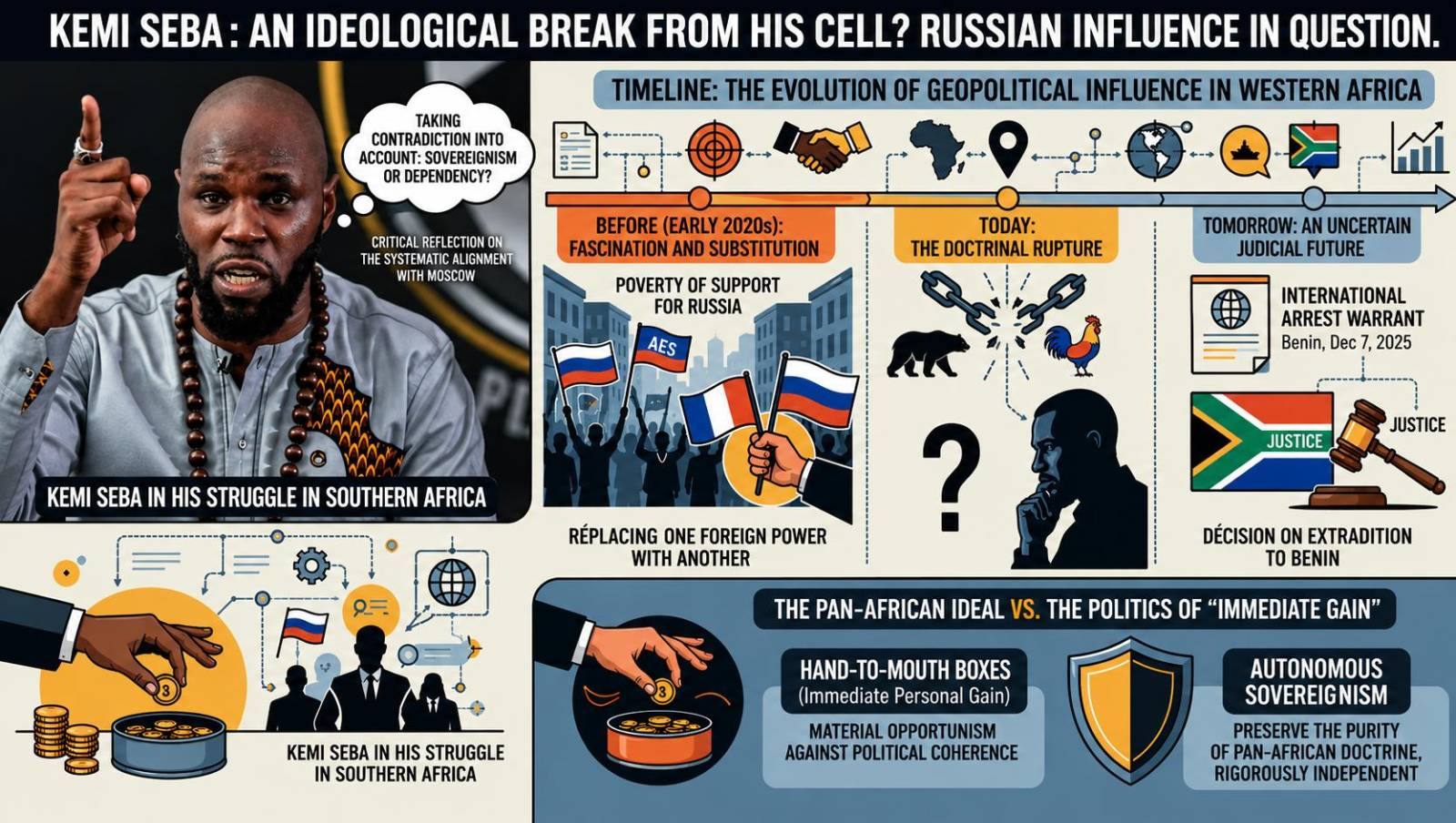
In recent years, the political landscape across parts of Africa—particularly within the Sahel States Alliance (AES)—has been dominated by highly symbolic displays. During numerous sovereignty-driven protests, the public space has been flooded with Russian flags and chants unequivocally supportive of Moscow. For a vocal segment of activists, Russia is now framed as the indispensable savior, offering an alternative to traditional Western powers.
Yet this growing fascination raises fundamental questions, especially when it emerges from movements advocating total independence. Today, one of the leading voices of contemporary Pan-Africanism, Kemi Seba, appears to be undergoing a major doctrinal shift from his prison cell in South Africa, challenging this prevailing trend.
Substitution trap: sovereignty versus new dependency
While seeking fresh international partnerships is a legitimate diplomatic pursuit for any nation or political movement, the temptation to replace one foreign influence with another is widely seen as a profound ideological inconsistency. Swapping France’s historical dominance for that of Russia does not, in itself, signify liberation—merely a transfer of dependency.
Evidence suggests Kemi Seba is now confronting this contradiction head-on. The Pan-African thinker is critically reassessing what he views as the limitations of an uncritical alignment with Moscow, refusing to endorse any new protectorate—even one positioned as anti-Western.
Pan-African ideals versus the politics of immediate gain
This distancing highlights a fissure within sovereignty-driven movements. While some of the fervent support for Russia stems from a genuine desire for geopolitical change, other dynamics appear driven more by material interests than by ideology.
Kemi Seba strongly opposes such opportunism, encapsulated in his vivid metaphor of maintaining « stew pots »—a critique of prioritizing short-term personal enrichment over long-term political coherence. By rejecting this mercenary approach to ideology, the activist seeks to uphold the doctrinal integrity of a Pan-Africanism rooted in strict autonomy.
Political and judicial fate hinges on Pretoria
This doctrinal introspection unfolds amid a profoundly critical personal moment for the activist. Targeted by an international arrest warrant issued by the Beninese government following the December 7, 2025 coup attempt, Kemi Seba remains incarcerated in South Africa.
His future no longer hinges solely on ideological debates but on legal outcomes. The South African judiciary is poised to rule on Cotonou’s extradition request. Will his time behind bars mark a definitive rupture—or merely a recalibration—of Pan-African discourse? The coming weeks will be pivotal not just for Seba’s political trajectory, but for the movements he inspires.