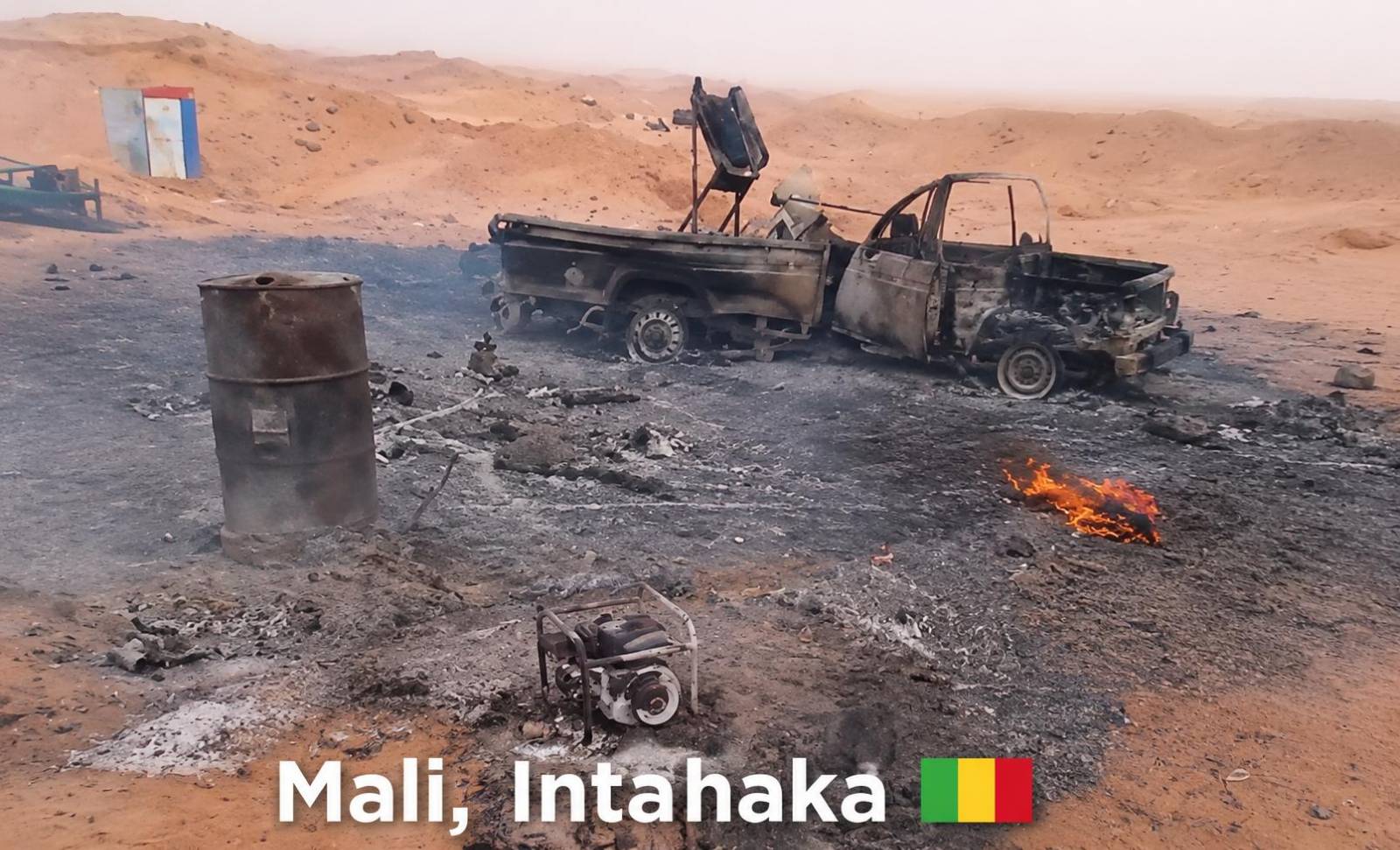
The morning of May 18th brought devastating news to the people of Intahaka, near Gao. A Malian military drone, intended to strike suspected terrorists, instead decimated a vehicle belonging to the GATIA armed group—a coalition long allied with Bamako’s central government. The tragic error left multiple fatalities and severe injuries, underscoring the widening cracks in the junta’s military approach.
Intahaka: a strike that backfired on its architects
Local reports confirm the incident occurred at dawn, as the drone unleashed its payload on a pick-up truck in the heart of the region’s most critical mining zone. Official statements initially labeled the attack a “terrorist neutralization,” but eyewitness accounts and military insiders quickly dismantled the narrative. This wasn’t an isolated miscalculation—it was a damning symptom of systemic failure.
The GATIA, despite its controversial past, had positioned itself as a stabilizing force in the Gao area, working alongside government troops to curb insurgent advances. Yet, the drone strike has shattered that fragile alliance, leaving both civilians and allied fighters trapped in the crossfire of Bamako’s flailing security apparatus. Military observers point to a lethal combination of poor coordination, outdated targeting protocols, and an overreliance on drone surveillance that has repeatedly failed to distinguish friend from foe.
Technology’s false promise in a war without rules
Since seizing power, the Malian junta under Colonel Assimi Goïta has championed drone technology as the cornerstone of its counterinsurgency strategy. But the reality in Gao tells a different story. Far from restoring order, these high-tech tools have become instruments of indiscriminate destruction, striking markets, convoys, and now even allied militias. The recent massacre in San, where civilians bore the brunt of a misdirected strike, was only the latest in a series of avoidable tragedies.
Meanwhile, the insurgency gains ground. The Permanent Strategic Framework, now rebranded as the Liberation Front of Azawad (FLA), has merged with the Group for the Support of Islam and Muslims (JNIM) to form a formidable coalition. These groups, once fragmented, now wield advanced drone-jamming technology and suicide drones of their own, rendering Bamako’s air superiority obsolete. Government forces, bogged down by poor training and vague directives, are being outmaneuvered on every front.
Intahaka’s gold veins run with blood and betrayal
Intahaka isn’t just another battlefield—it’s the economic heartbeat of northern Mali. Home to the region’s largest artisanal gold mine, the area sustains thousands of families who depend on daily earnings from ore extraction. But the drone strike has plunged the local economy into freefall. Mining operations, already hobbled by Islamist blockades and rebel checkpoints, now face an additional existential threat: the government’s own aerial campaign.
“We don’t know where to go anymore,” laments a resident of Gao, speaking on condition of anonymity. “The roads are controlled by terrorists, food prices have tripled, and now the army’s drones are bombing us from above. There’s nowhere left to hide.” The once-heralded presence of the Malian armed forces has morphed into a source of terror rather than security.
The juncture that reveals all
This latest disaster in Intahaka is more than a tragic error—it’s a revelation. The Malian junta’s insistence on a purely military solution, devoid of political compromise or community engagement, has isolated even its most loyal partners. The GATIA’s betrayal by Bamako signals a turning point: the government’s narrative of “restoring national sovereignty” rings hollow when its own allies are targeted and innocent lives are erased.
As the north and central regions slip further from state control, the junta’s gamble on high-tech warfare looks increasingly like a suicide mission. Without a shift toward inclusive governance and realistic security strategies, the drones will keep falling—and so will Mali.