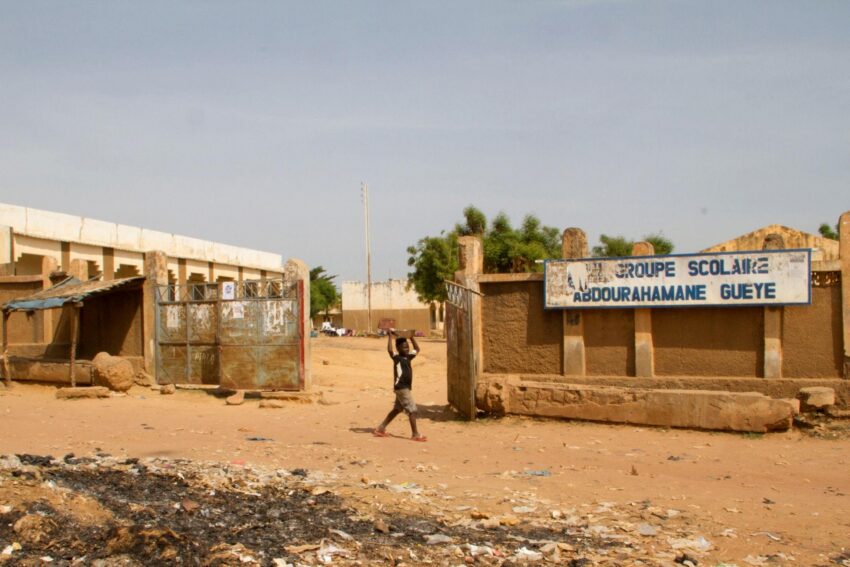
BAMAKO — Mali’s 2026-2027 school year officially began on Thursday, October 1. The transition president, General Assimi Goïta, had declared it the “Year of Education and Culture.” But the official slogan collides with a harsh reality: more than 2,400 schools will not reopen nationwide, leaving over 730,000 children without instruction. This record underscores the strategic deadlock of the military junta in Bamako.
Schools as targets and symbols of terrorist control
Nationwide, more than one in five schools is now out of service. This collapse is not accidental; it stems directly from the territorial expansion of armed terrorist groups. Islamist katibas that reject so-called Western education loot or burn school buildings, and sometimes convert them into makeshift shelters for thousands of internally displaced people. The map of closures reveals a geography of state abandonment. In the far northern Kidal region, nearly 84% of schools remain shut. In neighboring Ménaka, where the Islamic State in the Greater Sahara (ISGS) operates, 52% of schools in the academy are deemed “non-functional.” The situation is no better in Gao or central districts like Mopti and Bandiagara, as well as parts of Ségou and Koulikoro, now directly exposed to the Group for the Support of Islam and Muslims (JNIM, Al-Qaeda affiliate).
Setbacks for a cornered junta
For the transitional authorities, who built much of their legitimacy on promises to restore national sovereignty and security, these figures are a stinging rebuke. Since the coups of 2020 and 2021, the junta has made a radical geopolitical shift, breaking with traditional partners: expelling French Barkhane forces, ending the UN MINUSMA mission, and scrapping the Algiers peace accord. To fill the void, Bamako turned to Russian military partnership and Africa Corps mercenaries (formerly Wagner). Yet the promised swift military reconquest has turned into a series of dramatic reversals. Despite the highly publicized recapture of Kidal in late 2023, Mali’s armed forces (FAMa) and their Russian auxiliaries have bogged down in bloody wars of attrition. The resounding defeat at Tinzaouatène in summer 2024 against rebel fighters and JNIM combatants marked a turning point, exposing structural vulnerabilities in the junta’s military setup. Far from containing the threat, this exclusively security-focused strategy triggered devastating reprisals from terrorist groups. They intensified operations beyond their traditional northern and central strongholds, striking at the heart of institutions, as seen in the spectacular attacks on the Faladié gendarmerie school and Bamako’s military airport in September 2024.
The encirclement map: territorial reality
Today, analysis of control over Malian territory shows a sovereignty largely fragmented. In the far north, covering Kidal, Ménaka, and Taoudénit, the state retains only an essentially insular presence, confined to heavily fortified administrative centers. ISGS controls vast desert stretches of Ménaka, imposing its law and collecting zakat from populations, while JNIM and various regional armed groups vie for border routes with Mauritania and Algeria. In the center, including Mopti, Ségou, and San—considered the beating heart of the JNIM insurgency through Katiba Macina—rural areas almost entirely escape administrative control. Insurgents enforce regular blockades on entire towns like Niono and Djenné and mandate the closure of republican schools under threat of targeted executions of teachers. Finally, in the south and west, notably Koulikoro, Sikasso, and Kayes, once spared, rapid infiltration is now underway. JNIM sleeper cells orchestrate economic blockades there, targeting fuel and major roads, gradually choking supplies to the capital.
A sacrificed generation
Amid this general deterioration, the contrast between official rhetoric and daily life for Malians has never been starker. While transition speeches celebrate the country’s “refoundation,” access to knowledge—a fundamental right—continues to recede dramatically. Each closed school is another ideological victory for obscurantist groups, which find in this idle youth fertile ground for recruitment. The “Year of Education” proclaimed in Bamako may well become, for hundreds of thousands of young Malians, another blank year amid the din of weapons.