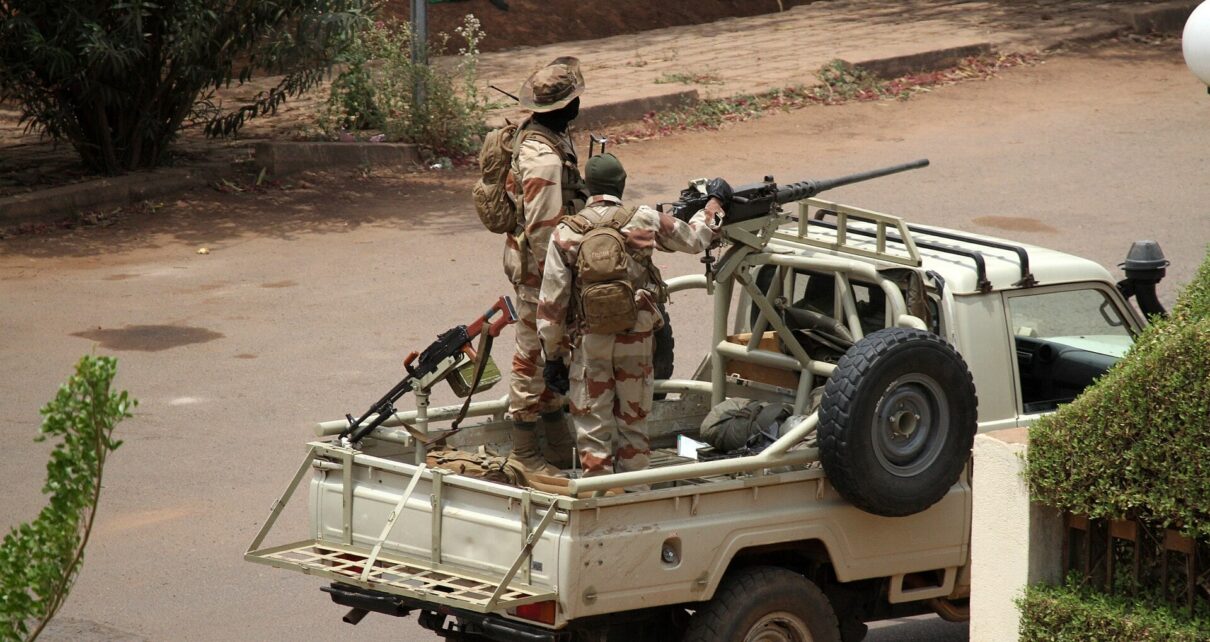
The April 25 coordinated assault across Mali was more than just another chapter in the country’s ongoing turmoil—it marked a critical turning point. Islamist armed factions and Tuareg separatists launched synchronized strikes on military outposts and vital civilian hubs, forcing Russian-backed Malian troops out of Kidal, a northern stronghold with deep historical significance for Tuareg resistance. The attack’s scale now looms over Bamako, raising urgent questions for the Sahel region and Algeria, both of which face a mounting security dilemma.
Mali’s junta stumbles on its security strategy
To grasp Mali’s current predicament, it’s essential to examine the decisions made after the 2021 military takeover. The junta, led by Colonel Assimi Goita, severed ties with French forces, terminated the MINUSMA UN peacekeeping mission, and turned to the Wagner Group (now under direct Russian state control) for security support. Critics in the West cautioned that this shift would create a dangerous power vacuum. The junta dismissed these concerns as interference. The April offensive proved their warnings entirely justified.
The Wagner Group’s forces, once touted as a decisive counter-insurgency asset, have now been expelled from Kidal, a city of immense strategic and symbolic value. Far from demonstrating superiority, the militants outmaneuvered Russian firepower, adapting their tactics and expanding their influence. The junta’s gamble—exchanging French operational expertise and regional institutional partnerships for Wagner’s support—has left Mali more vulnerable than ever.
The emergence of a unified Islamist-Tuareg coalition is equally telling. Historically, these groups have clashed over control of Mali’s ungoverned north. Their current alliance signals a shared assessment: the junta’s grip is weakening, and an opportunity to apply simultaneous pressure has arrived. Their confidence may not be misplaced.
Algeria faces a growing security nightmare
Algeria, Mali’s neighbor with a long and porous southern border, has every reason to be deeply concerned. For decades, this frontier has served as a conduit for arms trafficking, drug smuggling, human migration, and militant recruitment. Algerian leaders know all too well that unchecked instability in Mali does not stay isolated—it spreads, infiltrates, and destabilizes. The crisis unfolding in Mali is no longer a distant issue; it is knocking at Algeria’s door.
The irony in Algeria’s position is striking. For years, Algiers positioned itself as the region’s key mediator, playing a central role in brokering the 2015 Algiers Peace Agreement between Mali’s government and Tuareg representatives. That agreement unraveled in early 2024 when Goita formally withdrew, a move Algiers viewed as a deliberate snub. Tensions escalated further in March 2025 when Algerian forces intercepted a Malian drone near their shared border, sparking a diplomatic rupture involving Mali, Burkina Faso, and Niger—all members of the Russia-aligned Alliance of Sahel States.
Algeria now finds itself increasingly sidelined from the very conflict it is most exposed to. It lacks the leverage to impose a solution on Bamako, cannot reliably coordinate with a hostile junta, and cannot afford to ignore the fallout. The stakes are existential: if armed groups establish permanent footholds along Algeria’s southern frontier, the country’s internal security could face severe threats.
In a public statement, Algerian Foreign Minister Ahmed Attaf reaffirmed Algeria’s commitment to Mali’s territorial integrity and condemned terrorism without reservation. Yet declarations alone cannot restore a dialogue that no longer exists.
America’s absence worsens the Sahel’s instability
The Sahel’s downward spiral is also a story of American disengagement. The United States significantly reduced its counter-terrorism footprint in West Africa in response to pressure from governments aligned with Moscow, and has yet to offer a coherent alternative. The result is a dangerous power vacuum. Russia fills part of it through military contractors, while Islamist networks exploit it fully—establishing their own systems of governance, taxation, and recruitment in areas abandoned by the state.
The situation in Mali is a real-time case study Washington should heed. Military cooperation, intelligence sharing, and sustained counter-terrorism efforts are not optional elements of regional stability—they are its foundation. When they disappear, the vacuum is not left empty. It gets filled—often by forces hostile to U.S. interests and values.
Three possible futures for Mali—and the Sahel
Three potential outcomes now lie ahead for Mali. First, the junta could strike a political deal with Tuareg factions, halting further territorial losses but at the cost of major concessions. Second, it could escalate its military campaign, doubling down on Russian air and ground support to reclaim the north, though success is far from guaranteed. Third, it may continue its current pattern of strategic retreat, insisting on its legitimacy even as Bamako itself comes under threat.
Algeria is watching all three scenarios with growing alarm. The Sahel’s collapse is no longer a distant concern—it is arriving at the border, and time is running out.