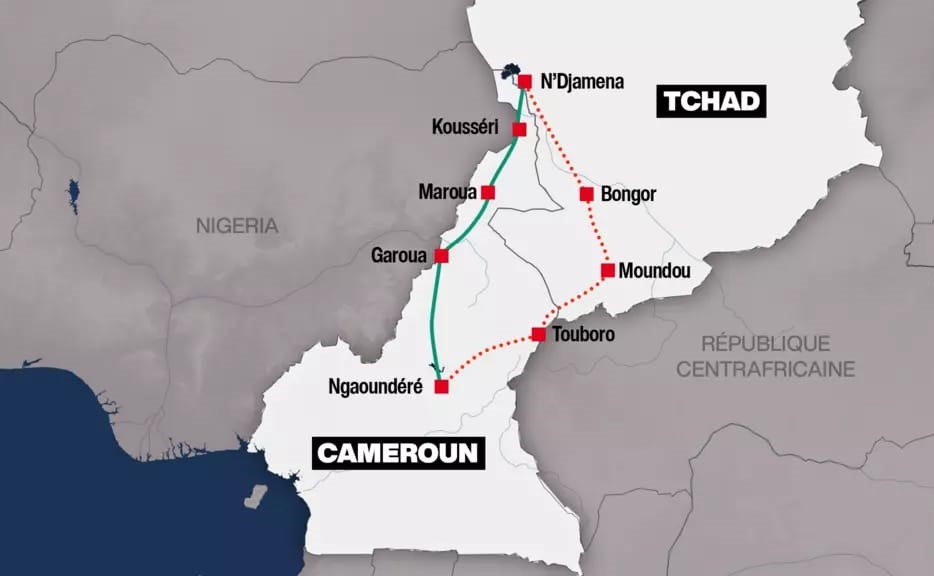
Presented as one of the key infrastructure projects for economic integration in Central Africa, the planned railway linking Cameroon to Chad is already facing its first political hurdles. On 4 June, the steering committee for major projects, chaired by Cameroon’s head of state, met at the Unity Palace and approved the rail corridor connecting Ngaoundéré to N’Djamena via Garoua, Figuil, Maroua, and Kousséri before crossing the Chadian border to reach the neighbouring capital.
Cameroonian authorities described the route as the most viable from economic, technical, and territorial perspectives. It is intended to serve as a natural extension of Cameroon’s rail network into the Sahel and reinforce the country’s role as the maritime gateway for landlocked Central Africa. However, the announcement prompted an immediate reaction from Chadian officials.
In a statement issued days later, Chad’s Ministry of Transport stressed that no final route had yet been jointly approved by both states. N’Djamena voiced its disapproval of what it saw as a premature decision, asserting that several options remained under discussion as part of ongoing bilateral studies and consultations. This disagreement, far from trivial, highlights the weaknesses in governance of major cross-border projects in the subregion.
A MAJOR PROJECT FOR REGIONAL INTEGRATION
The project’s ambition is immense. Spanning over 900 kilometres according to various preliminary studies, the future rail line is designed to directly connect Cameroon’s network to Chad, a landlocked country where more than 80% of foreign trade passes through the Douala-N’Djamena corridor. The infrastructure aligns with the regional strategy for developing multimodal corridors promoted by the Economic Community of Central African States (ECCAS) and supported by several international technical and financial partners. Its cost is estimated at several billion dollars, making it one of the largest infrastructure investments ever considered between the two countries. Ultimately, the railway should facilitate the transport of hydrocarbons, cotton, livestock, cereals, construction materials, and containerised goods from the ports of Douala and Kribi. Project proponents also hope to reduce logistics costs, improve business competitiveness, and smooth trade flows across the entire Cameroon-Chad basin.
A STRATEGIC PROJECT FOR TWO COMPLEMENTARY ECONOMIES
For both Cameroon and Chad, the stakes go far beyond rail transport alone. As a landlocked country, Chad is heavily dependent on the Cameroonian corridor for its external trade. A significant portion of its imports already transits through the port of Douala before being trucked to N’Djamena. This logistical dependency has been a major source of economic vulnerability for decades.
THE ARRIVAL OF THE RAILWAY COULD DEEPLY CHANGE THE SITUATION
According to several studies conducted in recent years, a modern rail link would significantly reduce logistics costs, accelerate goods movement, and improve the competitiveness of businesses in both countries. It would also offer a more sustainable alternative to road transport, whose maintenance costs remain high and performance is often affected by weather conditions. For Cameroon, the project also represents an opportunity to further leverage the port infrastructure of Douala and Kribi by strengthening their role as natural gateways to the Sahelian hinterland. The stakes are therefore considerable: creating a genuine economic corridor capable of boosting trade, attracting industrial investment, and promoting local processing of raw materials.
BEHIND THE ROUTE, A BATTLE FOR ECONOMIC BENEFITS
While the debate appears to centre on a simple route choice, the real issues lie elsewhere. The route approved by Yaoundé prioritises a path through Cameroon’s Far North before reaching N’Djamena. This option serves several national objectives. It would first help further open up Cameroon’s northern regions, which often suffer from an infrastructure deficit. It would also promote the development of logistics, commercial, and industrial hubs in cities like Garoua, Maroua, and Kousséri. For the Cameroonian government, this is as much a land-use planning tool as a transport project.
BUT FROM THE CHADIAN SIDE, THE PERSPECTIVE IS DIFFERENT.
N’Djamena believes the currently favoured route does not sufficiently meet the needs of its national economy. Several Chadian officials advocate for a variant that would better serve certain agricultural and productive areas of the country, ensuring that the benefits of the future corridor are not limited to the capital. This divergence illustrates a reality often seen in regional projects: each state naturally seeks to maximise the economic returns on its own territory. The railway is not just an infrastructure; it determines the future location of investments, logistics platforms, industrial zones, and service activities. Choosing a route therefore means distributing development opportunities for decades to come.
REGIONAL INTEGRATION TESTED BY NATIONAL SOVEREIGNTIES
The episode also highlights the persistent difficulties of economic integration in Central Africa. Despite rhetoric favouring regional cooperation, major infrastructure projects are still often designed along essentially national lines. However, the economic viability of a cross-border corridor depends precisely on its ability to serve the interests of all stakeholders. International experience shows that successful regional infrastructure projects are generally built on shared governance mechanisms from the design phase. Decisions on financing, routes, technical standards, and operation are made jointly to ensure political buy-in from all partners.
WITHOUT THAT, THE RISKS OF DEADLOCK INCREASE SIGNIFICANTLY
The case of the Cameroon-Chad railway comes at a time when several African countries are seeking to strengthen