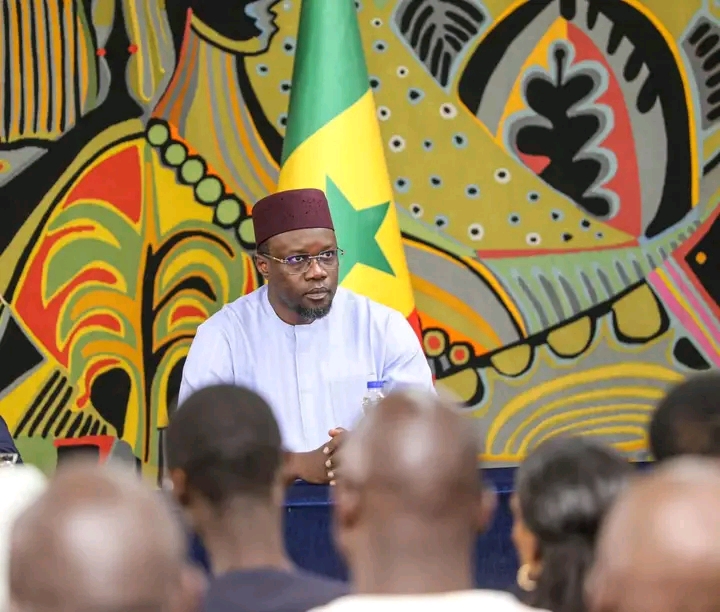
In a rare public display of internal disagreement, Senegal’s Prime Minister Ousmane Sonko openly contradicted President Bassirou Diomaye Faye over the management of political funds. The confrontation comes as part of an ongoing national discussion about financial transparency and accountability in governance.
The Prime Minister made it clear that while he respects the President’s authority, he fundamentally disagrees with the current approach to handling these sensitive financial resources. «I do not share the President’s position on this matter. I believe he has made a mistake, and I hope he will reconsider,» Sonko stated during a parliamentary session.
Addressing the root of the controversy, he emphasized that the coalition government’s original mandate was never to eliminate these funds entirely, but to eradicate their misuse. «Our goal is to ensure that no secret ‘slush fund’ exists in Senegal—where public money is entrusted to individuals without oversight or accountability,» he explained.
The Prime Minister revealed that the Prime Minister’s Office alone manages 1.77 billion CFA francs in political funds, highlighting the urgent need for reform. He stressed that these resources should never serve as «election tools or personal enrichment schemes for political operatives.»
To enforce greater transparency, Sonko proposed adopting a French-style parliamentary oversight model. While acknowledging that certain classified budgets—like those related to national security—cannot be disclosed publicly, he advocated for a restricted commission of lawmakers to verify that allocated funds are used as intended. «The amounts voted by Parliament must be allocated correctly,» he insisted, adding that the debate was not about abolishing the funds but ensuring they are managed with integrity.
Demonstrating his commitment to change, Sonko announced a shift away from cash transactions in favor of digital transfers and checks for all government financial operations. «This is a matter of principle,» he declared. «The funds will remain, and I have no objection to increasing them—provided they are subject to strict controls.» His remarks were met with applause from lawmakers, signaling strong support for his reformist stance.